
AI Trending Topic Detection: How It Actually Works
How AI trending topic detection works in 2026. The signals, tools, models, and workflow to spot rising topics before competitors. Updated May 2026.
AI Trending Topic Detection: How It Actually Works
AI trending topic detection finds emerging subjects 2 to 8 weeks before they peak in mainstream search. The systems scan millions of unstructured data points across social platforms, news feeds, forums, and academic databases. They cluster the data with natural language models. Then they score each cluster on growth velocity.
Most marketers still spot trends the slow way. They scroll Twitter. They check Google Trends after a topic is already hot. By then the search volume curve is already flattening and the cost-per-click has doubled. Publishing at the peak is the same as publishing late.
The cost of late detection is brutal. A topic that drives 50,000 monthly searches at week 2 is worth maybe 5,000 by week 12. The first 5 publishers capture 60% of the long-term link equity. Everyone after that fights for scraps.
We publish 3,500+ blog posts across 70+ industries. Trend detection is a core part of how we plan editorial calendars. The tools changed. The signals changed. The window for capturing a trend collapsed from months to days.
This guide walks through how AI trending topic detection actually works, which signals matter, which tools are worth paying for, and how to build a workflow that turns early signals into published content within 72 hours.
Here is what you will learn:
- The 4 data signals AI systems use to detect emerging topics
- How NLP topic modeling clusters raw data into trends
- The difference between trend detection and trend prediction
- A 7-stage workflow to capture trends before they peak
- Which tools to use for which signal type
- How to validate a trend before you commit content resources
- The 6 mistakes that waste budget on dead trends
What AI Trending Topic Detection Actually Is
AI trending topic detection is the use of machine learning to find emerging subjects within large, unstructured datasets. The system reads text, images, audio, or video from multiple sources. It identifies clusters of related content. It measures the growth rate of each cluster. It flags the clusters growing fastest.
The output is not a list of keywords. It is a list of topic clusters with a momentum score, a growth velocity, and a predicted peak window.
Three terms appear interchangeably in the industry. They are not the same:
| Term | What It Does | Time Horizon |
|---|---|---|
| Topic detection | Identifies topics that exist in the data right now | Real-time |
| Trend detection | Identifies topics gaining momentum compared to baseline | 0 to 4 weeks |
| Trend prediction | Forecasts which topics will trend before they show momentum | 4 to 24 weeks |
Detection tells you what is happening. Trend detection tells you what is heating up. Prediction tells you what is about to heat up.
For most content teams, trend detection is the high-value zone. Prediction systems exist but carry false-positive rates above 40%. Detection without momentum gives you noise, not signal.
The systems that work in 2026 combine all three layers. They detect every topic in the data. They measure momentum on each topic. They forecast which ones will continue growing.
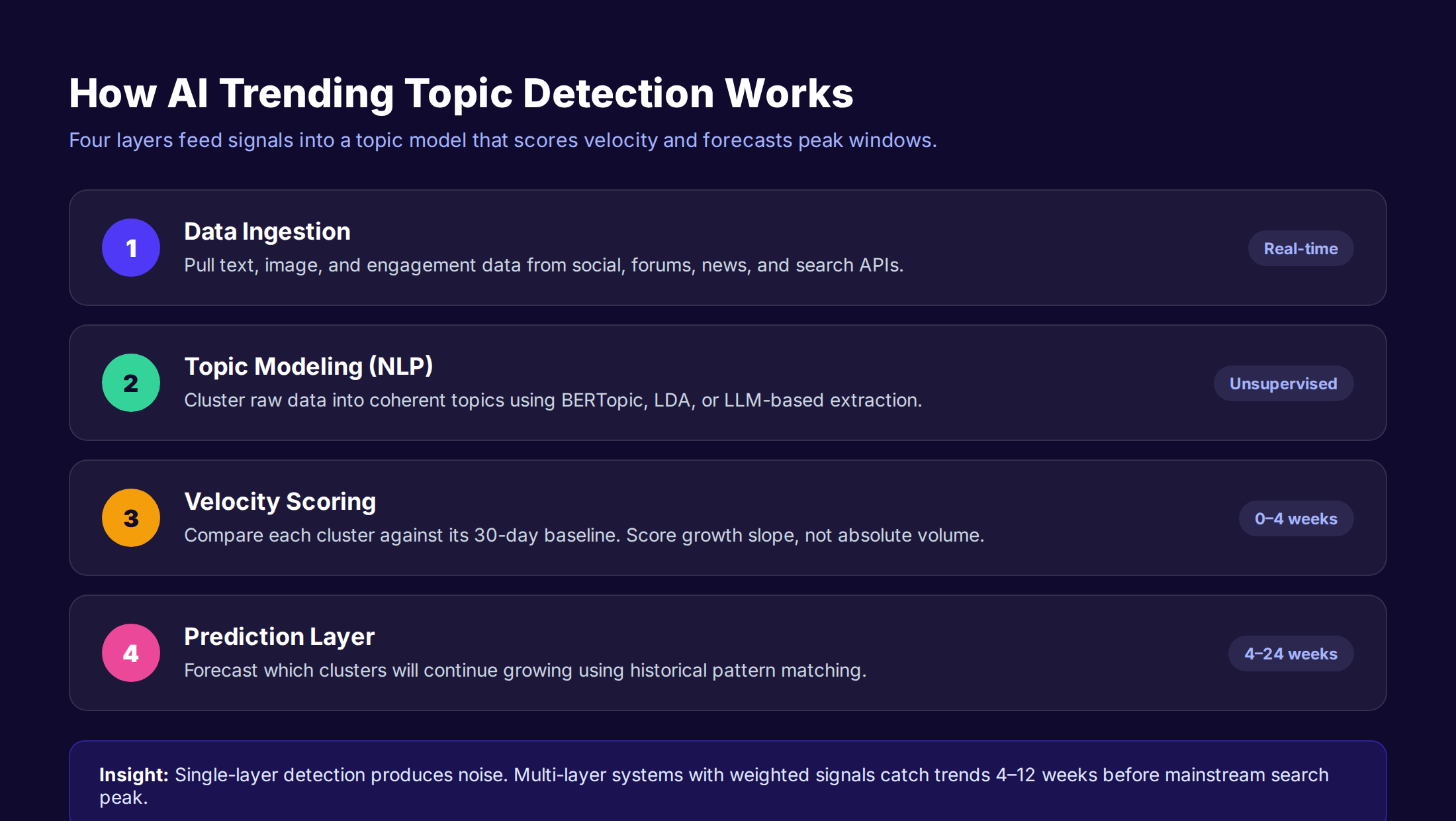
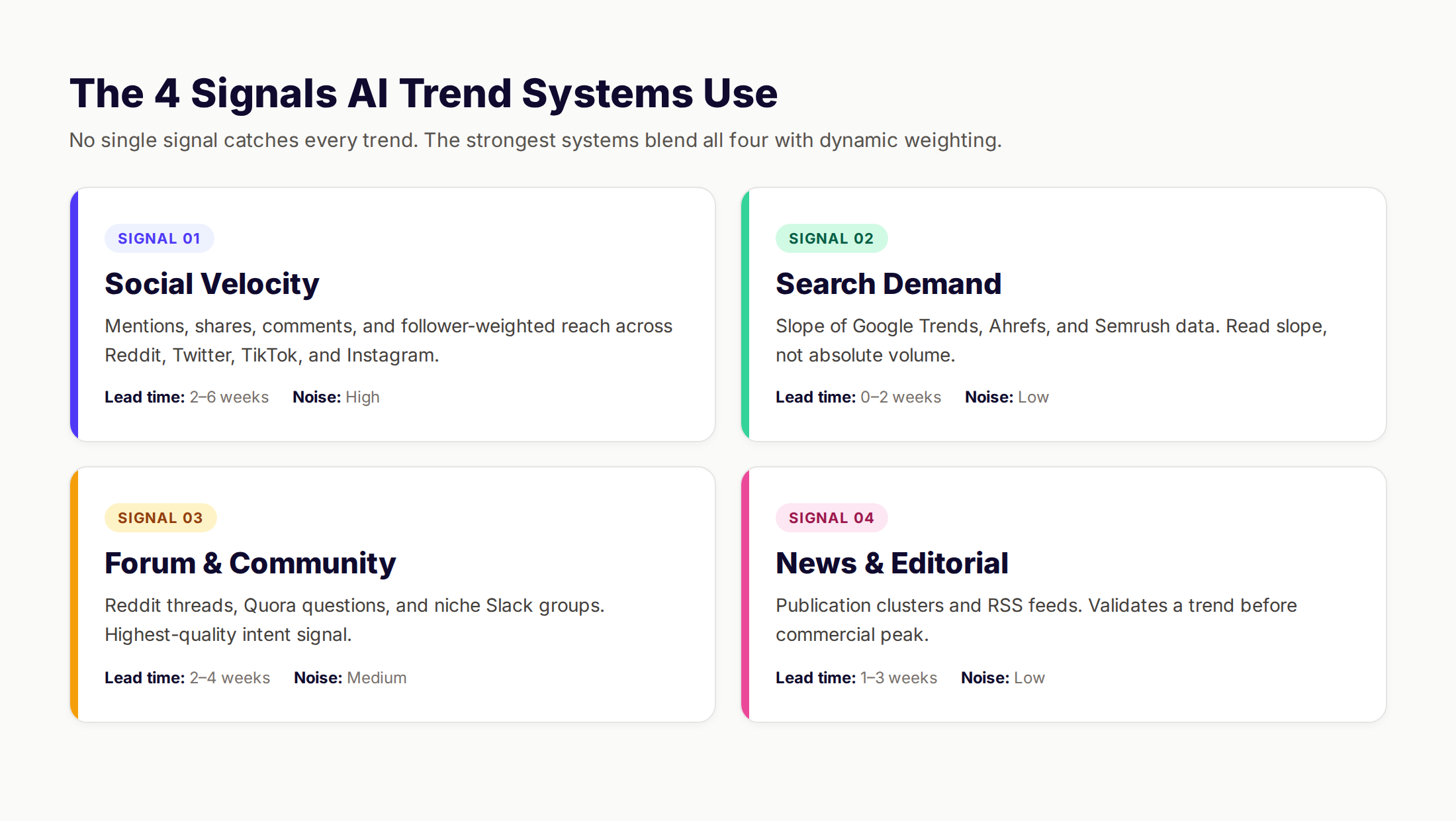
The 4 Signals AI Systems Use
A trend detection system is only as good as the signals it ingests. Single-source detection misses most trends. The best systems blend 4 signal types and weight them dynamically.
Signal 1: Social Velocity
Social platforms produce the earliest signal. A topic spikes on Reddit, Twitter, or TikTok 2 to 6 weeks before it appears in Google search data. The systems track mentions, shares, comments, and follower-weighted reach.
The challenge is noise. A spike in mentions does not equal a trend. Bot activity, coordinated posting, and meme cycles produce false positives. Good systems filter by author diversity, sentiment variance, and platform overlap.
A real trend appears on 3+ platforms within 7 days. A fake trend stays on one.
Signal 2: Search Demand
Google Trends shows you what people search for. The signal lags social by 2 to 4 weeks but carries the highest commercial intent. AI systems pull search demand through the Google Trends API, Ahrefs Keywords Explorer, and similar sources.
The trick is reading slope, not volume. A keyword going from 100 searches to 400 in 2 weeks matters more than one going from 10,000 to 11,000. Slope reveals new interest. Volume reveals established interest.
Our keyword research workflow treats slope as the primary signal during trend phases.
Signal 3: Forum and Community Discussion
Reddit, Quora, niche Slack groups, and specialized forums produce the highest-quality trend signal. The discussions are deeper. The intent is clearer. The community filters out noise.
AI systems crawl subreddits, parse threads, and detect topic shifts using clustering. A new question appearing in 5 separate subreddits within a week is a strong signal. So is a comment thread switching vocabulary, like product names entering the discussion.
This signal source produces the highest-quality content briefs. The questions become the H2s. The vocabulary becomes the keyword set.
Signal 4: News and Editorial Coverage
News coverage validates a trend. When 10 major publications write about a topic in 5 days, the topic is moving past early adopters. AI systems track news APIs, RSS feeds, and publication clusters.
This signal lags social by 1 to 3 weeks. It rarely catches the earliest stage. But it is the strongest validation signal before commercial peak.
The 4 signals layered together produce a trend score. Each tool weighs them differently. The combination matters more than any single source.
How NLP Topic Modeling Works
Behind every trend detection system sits a topic model. The model groups raw text into coherent clusters without being told what the topics are. The unsupervised nature is what makes detection scalable.
Three model architectures dominate the field in 2026:
LDA (Latent Dirichlet Allocation). The classical approach. Treats each document as a mixture of topics and each topic as a mixture of words. Works well on stable corpora. Struggles with short texts like tweets.
BERTopic. Uses transformer embeddings plus density-based clustering. Better at short text. Better at semantic meaning. The current industry default for social and forum data.
LLM-based topic extraction. Uses models like GPT-4 or Claude to summarize clusters into human-readable topic names. Slower and more expensive but produces output you can publish directly.
The model architecture matters less than the corpus quality. A garbage-in topic model produces garbage topics no matter which algorithm you use.
The output of any topic model is a set of clusters. Each cluster has a topic label, a set of keywords, a confidence score, and a list of source documents. The clusters update as new data arrives.
For content teams, the practical question is not which model. It is whether your tool exposes the clusters or hides them behind a dashboard. Exposed clusters let you read the source documents and validate the signal. Hidden clusters force you to trust a black box.
Trend Detection vs Trend Prediction
The two terms get confused constantly. They solve different problems.
Trend detection answers: “What is gaining momentum right now?” The system looks at observed data, measures growth, and ranks topics by velocity. The signal is high-confidence because the trend is already happening.
Trend prediction answers: “What will gain momentum in the next 4 to 12 weeks?” The system uses pattern matching against historical trends. The signal is lower-confidence because no trend has materialized yet.
Both have a place. Most teams should focus on detection first.
Prediction systems work best when you have:
- A specific niche with clear historical patterns
- Time to publish content months before peak
- Budget to absorb false positives (30 to 50% are common)
- A way to measure prediction accuracy and refine the model
If you cannot meet all 4 conditions, prediction is an expensive distraction. Detection with a fast publishing workflow beats prediction with a slow one.
The strongest content teams blend both. They use detection for high-confidence opportunities and prediction for moonshots in well-defined niches.
Stop guessing which topics matter. Start publishing on the ones already moving. Stacc publishes 30 SEO articles per month on the topics our trend detection flags as high-momentum. Topic research, writing, optimization, publishing — all included for $99. Start for $1 →
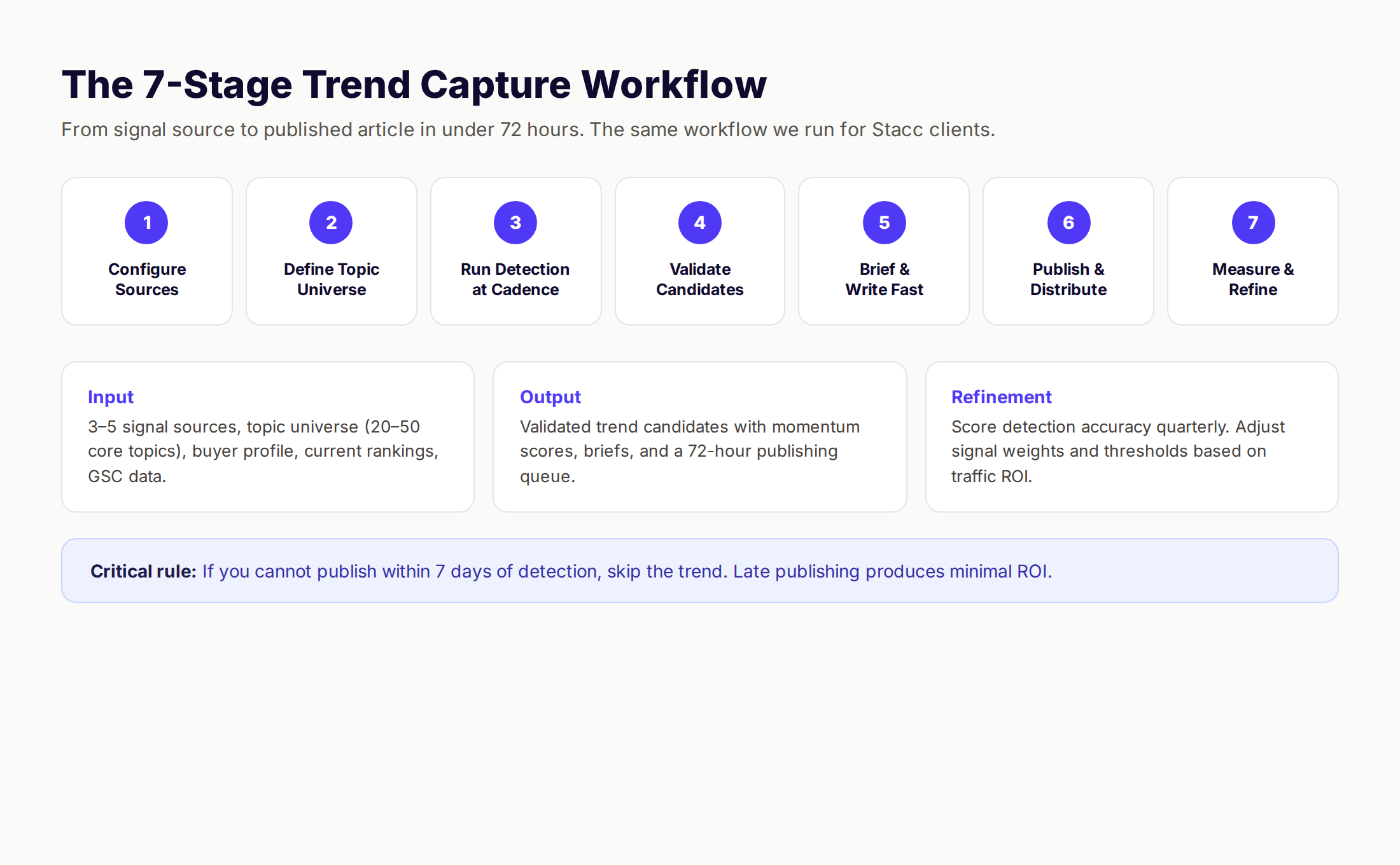
The 7-Stage Workflow That Captures Trends
Detection without a publishing workflow is just data hoarding. The teams that win at trend content compress the gap between signal and publish to under 72 hours. Here is the workflow we use.
Stage 1: Configure Your Signal Sources
Pick 3 to 5 signal sources. Do not try to monitor everything. Quality of signal beats volume of signal.
A balanced starting setup:
| Source | Why |
|---|---|
| Reddit (niche subreddits) | Highest-quality intent signal |
| Google Trends | Commercial intent validation |
| Ahrefs Trending | Search demand slope |
| X (Twitter) | Real-time velocity |
| Exploding Topics | Curated early-stage trends |
Add or remove sources based on your niche. B2B SaaS teams should weight LinkedIn and Hacker News. Consumer brands should weight TikTok and Instagram. Local businesses should weight Nextdoor and Google Business Profile insights.
Stage 2: Define Your Topic Universe
Detection without scope is noise. You need a topic universe — the boundary of subjects relevant to your business.
Write it down. List 20 to 50 core topics that your content covers or could cover. Use the topics as filters for the detection system. Trends outside your universe should not surface.
This is the same exercise as a topical map. Detection just runs on top of the map.
Stage 3: Run Detection at the Right Cadence
Daily detection produces too much noise. Weekly detection misses fast-moving trends. The sweet spot for most B2B niches is every 48 hours. Consumer or news-driven niches need daily or even hourly cadence.
Set a momentum threshold. A topic should not appear in your queue unless its growth rate exceeds 30% week-over-week and it appears in at least 2 of your signal sources.
The threshold filters 90% of the noise. The remaining 10% is where real opportunities live.
Stage 4: Validate Before You Publish
A trend score is not a green light. It is a candidate. Before committing content resources, validate each candidate against 4 questions:
- Does this topic have search intent? Check Google for at least 100 monthly searches on related queries.
- Does this topic match our search intent? Informational, commercial, or transactional?
- Can we add a unique angle? If 10 sites already cover the basics, do not write the 11th basic article.
- Will this trend last? Some trends peak in a week. Others compound for a year.
Validation kills 50 to 70% of trend candidates. That is healthy. The remaining 30 to 50% become your publishing queue.
Stage 5: Brief and Write Fast
Trend content has a short shelf life. A trend article published in week 2 gets 5 to 10 times the traffic of the same article published in week 8.
Use AI to compress brief and draft time. A modern AI writing workflow can produce a 2,500-word draft in under 30 minutes. The draft is not publish-ready, but it gets you 70% of the way.
Editing matters more than ever. Trend articles compete on speed, but Google still rewards quality and depth. Skipping editing creates content that ranks for a week and disappears.
Stage 6: Publish and Distribute
A trend article that nobody reads in week 1 will lose to a competitor’s article that nobody reads in week 1 if the competitor gets 10 backlinks and you get 0.
Pair publishing with distribution. Post on the platforms where the trend originated. Email subscribers. Submit to relevant communities where appropriate.
The content distribution strategy determines whether trend content reaches escape velocity or dies on page 4.
Stage 7: Measure and Refine the Model
Track every trend you publish on. Note the publish date, the trend score at publication, the peak traffic week, and the total 90-day traffic.
After 90 days, score the detection system itself. What percentage of flagged trends produced positive ROI? What percentage were false positives? Adjust signal weights and momentum thresholds based on the data.
The system improves only if you measure it. Most teams skip this step and wonder why their detection results stagnate.
Which Tools to Use for Each Signal
Tool choice depends on the signal you prioritize. There is no single best tool. There are best tools per signal type.
For Early Social Signals
Exploding Topics. Tracks emerging topics across Reddit, YouTube, and news. Updated daily. Strong at consumer trends. Weaker at B2B. Starts at $39/month.
TrendlyAI. Monitors 42 languages with predictive scoring. Claims to identify trends 2-3 weeks before competitors. Strong for global brands.
BuzzSumo. Content discovery across social platforms. Best for finding what is being shared right now, not necessarily what will trend.
For Search Demand Validation
Google Trends. Free. The baseline tool. Use to confirm whether social signals are translating to search demand.
Ahrefs. Trending Keywords feature shows queries with rising volume. Premium pricing but the most accurate search data.
Glimpse. Built on top of Google Trends with better visualization and trend scoring. Affordable for solo creators.
For Forum and Community Signals
GummySearch. Reddit-specific trend detection. Surfaces emerging discussions and questions across subreddits.
Answer the Public. Aggregates search questions and surfaces emerging query patterns. Good for content brief input.
For News and Editorial Signals
Feedly with AI. RSS aggregation with machine-learning topic clustering. Customizable for any niche.
TrendHunter AI. Combines AI with human researchers. Strong for consumer and lifestyle trends. Less useful for B2B SaaS.
For All-In-One Detection
YouScan. Social listening with AI trend detection. Enterprise pricing.
Brand24. More affordable social listening with trend alerts. Good entry point for small teams.
No single tool covers all 4 signals well. Most teams end up combining 2 to 3. The integration cost is real. The signal lift from multiple sources is real too.
| Tool | Best For | Starting Price | Free Plan |
|---|---|---|---|
| Exploding Topics | Consumer trends | $39/mo | Limited free |
| TrendlyAI | Global early signals | Custom | Trial |
| Google Trends | Search validation | Free | Full free |
| Ahrefs | Search demand slope | $129/mo | No |
| GummySearch | Reddit discussions | $19/mo | Trial |
| BuzzSumo | Social shares | $99/mo | Trial |
| Feedly AI | News aggregation | $12/mo | Limited free |
| Brand24 | Social listening | $99/mo | Trial |
The 6 Mistakes That Burn Trend Budget
Trend detection looks easy. The execution failure modes are predictable. We see these mistakes in nearly every content team we audit.
Mistake 1: Mistaking volume for momentum. A topic with 10,000 monthly searches is not trending if it had 10,000 last year. Always check slope, not absolute volume.
Mistake 2: Acting on single-source signals. A spike on one platform is not a trend. It is an event. Wait for confirmation on at least 2 signal types before committing resources.
Mistake 3: Chasing every flagged topic. Detection systems flag 50+ topics per week for active niches. You cannot publish on 50 trends per week. Pick 3 to 5 that match your topic universe and audience.
Mistake 4: Skipping search intent validation. A topic can be trending socially with zero commercial search intent. If nobody searches Google for the topic, it will not drive organic traffic regardless of social buzz.
Mistake 5: Publishing too late. A trend article published 8 weeks after detection is competing against 50+ articles that captured early link velocity. If you cannot publish within 7 days of detection, skip the trend.
Mistake 6: Treating trend content like evergreen. Trend articles need different optimization. Faster publishing. Looser SEO targets. More aggressive social distribution. Different success metrics. Treating trends like evergreen articles wastes both.
The teams that capture trends consistently are not the ones with the best detection tools. They are the ones with the fastest publishing workflow.
Your competitors are publishing on this week’s trends right now. Stacc detects, briefs, writes, and publishes 30 trend-aligned SEO articles every month. No writers to manage. No deadlines to chase. Just published content. See pricing →
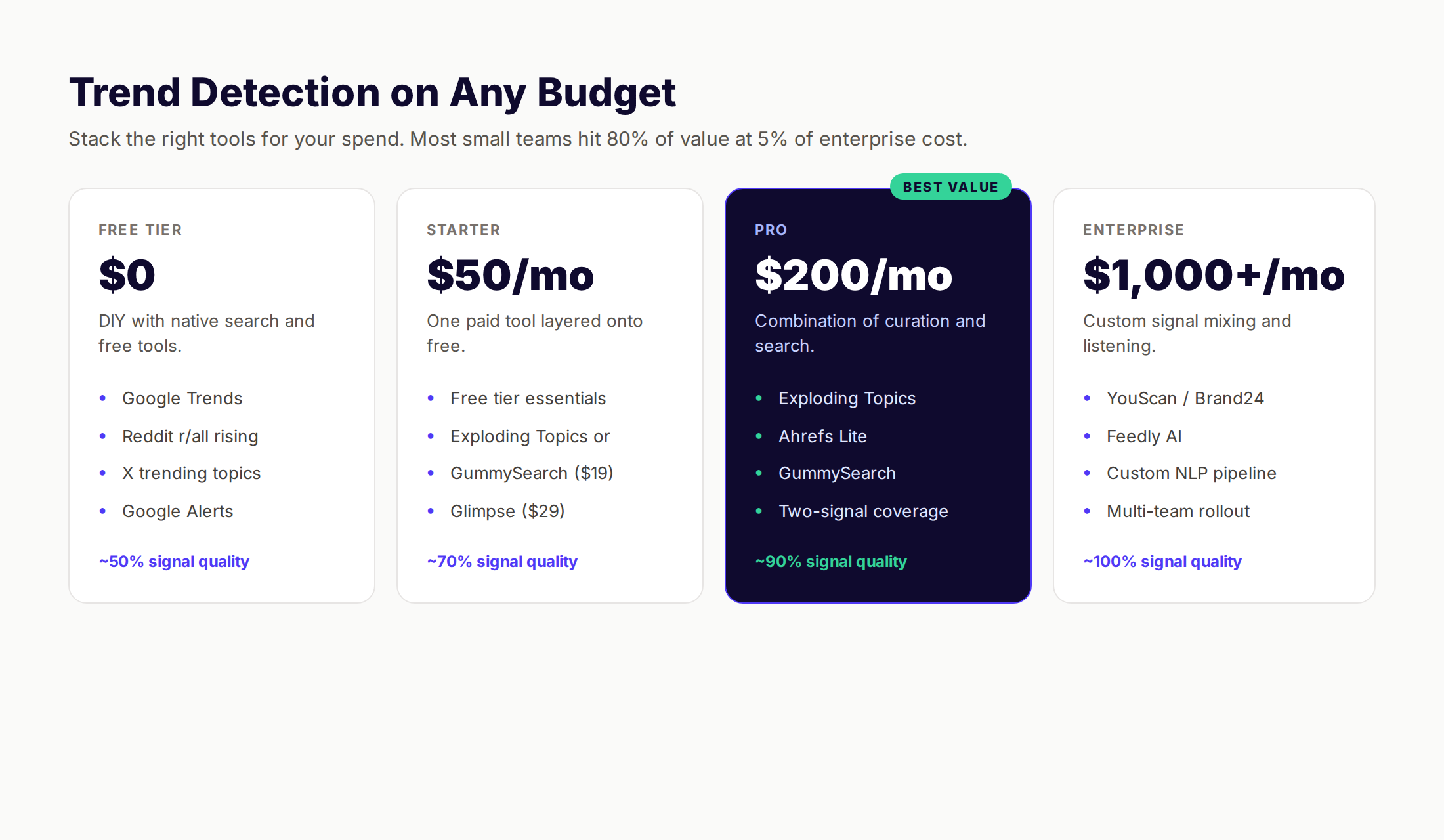
How to Build a Detection System on a Budget
Not every team can afford a $500+/month tool stack. Here is what a budget detection system looks like.
Free Tier ($0/month)
- Google Trends for search demand
- Reddit native search and the r/all rising filter
- X trending topics with niche filtering
- Google Alerts for keyword monitoring
- Manual review every 48 hours
Time cost: 4 to 6 hours per week. Signal quality: 50% of what paid tools produce.
Starter Tier ($50/month)
Add one of:
- Exploding Topics ($39/mo) for curated early-stage trends
- GummySearch ($19/mo) for Reddit-specific signal
- Glimpse ($29/mo) for Google Trends amplification
Time cost: 2 to 3 hours per week. Signal quality: 70% of enterprise tools.
Pro Tier ($200/month)
Combine:
- Exploding Topics for curation
- Ahrefs Lite or Semrush Pro for search validation
- GummySearch or BuzzSumo for one more signal layer
Time cost: 1 to 2 hours per week. Signal quality: 90% of enterprise tools.
Enterprise Tier ($1,000+/month)
Add custom solutions:
- YouScan or Brand24 for social listening
- Feedly AI for editorial coverage
- Custom NLP pipeline for proprietary signal mixing
This tier only makes sense for teams publishing 50+ trend articles per month or operating in news-driven niches.
The honest answer for most small businesses: the starter tier hits 80% of the value at 5% of the cost.
When Trend Detection Fails
Trend detection has limits. Knowing the limits matters more than knowing the strengths.
Detection fails in noisy niches. Crypto, AI, and consumer tech generate so many false signals that detection produces more noise than insight. Manual curation beats automation in these niches.
Detection fails on short-cycle trends. A meme that peaks in 48 hours and dies in 96 will not produce ROI even if you publish within 24 hours. Skip these unless you are a news outlet.
Detection fails without distribution. Publishing trend content into a site with no audience or backlink profile produces nothing. Trend content needs distribution muscle. New sites should focus on building topical authority before chasing trends.
Detection fails when intent is missing. Some trends drive social engagement but zero search demand. These trends are valuable for social content. They are useless for SEO.
Detection fails on enterprise B2B. Buying cycles run 6 to 18 months. A trend that peaks in 4 weeks does not match enterprise purchase timing. Stick with evergreen content here.
The point is not to give up on detection. It is to apply it where it works and avoid it where it does not.
How AI Trend Detection Differs from Traditional Methods
Before AI, trend detection meant reading industry reports, scanning social manually, and trusting analyst intuition. The methods worked but did not scale.
| Method | Time Cost | Coverage | Speed |
|---|---|---|---|
| Manual social scanning | 10-20 hrs/week | 1 platform | Slow |
| Industry reports | 2-4 hrs/week | Lagging | Very slow |
| Google Trends only | 1-2 hrs/week | Search only | Medium |
| AI multi-source detection | 1-2 hrs/week | All platforms | Fast |
| AI with publishing automation | 0 hrs/week | All platforms | Very fast |
The shift is not just speed. AI detection sees patterns humans cannot. A topic spiking simultaneously on 3 obscure subreddits and 2 trade publications is invisible to manual scanning. A model trained on cross-platform clustering surfaces it within hours.
The reverse is also true. AI cannot judge whether a trend matches your brand voice or audience values. Human curation still matters at the validation stage.
The right blend in 2026 is AI detection plus human validation. Pure AI produces too many false positives. Pure human is too slow.
Real Examples of Trends That Detection Caught Early
Trend detection sounds abstract. Here are concrete cases where detection systems caught a trend 4 to 12 weeks before peak.
Generative AI tools (2022 to 2023). ChatGPT launched in November 2022. Trend detection systems flagged the topic by mid-December. Publishers who wrote AI tool guides in January 2023 captured massive traffic through Q2. Late entrants in May 2023 fought for scraps.
Vibe coding (2024). A niche term for prompt-driven software development. Surfaced on niche Twitter and Hacker News in spring 2024. Search demand followed by July. Publishers who captured the term early dominated SERP.
AI agents (2024 to 2025). The shift from chatbots to autonomous agents was flagged by detection systems in Q4 2024. Mainstream coverage hit in Q2 2025. Our own AI agents and buyer decisions post was written during the early signal phase.
Reddit SEO (2024). As Google’s algorithm started prioritizing Reddit threads in SERPs, detection systems flagged a spike in “Reddit SEO” discussions across SEO communities. Publishers who captured the trend wrote category-defining guides.
The pattern in every case is identical. Social signal first. Forum discussion second. Search demand third. News coverage fourth. Detection systems that monitor all 4 layers see the trend 4 to 12 weeks before the average publisher.
Frequently Asked Questions
How does AI find trending topics? AI systems scan multiple data sources including social media, forums, news, and search engines. They cluster the data into topic groups using natural language processing. They measure growth velocity on each cluster. Topics with growth rates above a defined threshold get flagged as trending.
What is the difference between trend detection and trend prediction? Trend detection identifies topics gaining momentum right now based on observed data. Trend prediction forecasts which topics will gain momentum in the future based on pattern matching against historical trends. Detection has higher confidence. Prediction has longer lead time.
Which AI trend detection tools are free? Google Trends is free and remains the baseline for search demand. Reddit native search and X trending topics provide free social signals. Google Alerts surfaces keyword spikes. The combination produces 50% of the signal quality of paid tools at zero cost.
How early can AI detect a trending topic? The earliest detection happens 4 to 12 weeks before mainstream search peak. Social signals appear first, usually 2 to 6 weeks before search demand. The detection window depends on the niche. Consumer trends move faster than B2B trends.
Can AI predict viral content? AI can identify content with viral potential but cannot guarantee it. Prediction systems use historical patterns to estimate which topics will spread. False positive rates run 30 to 50%. AI detection of already-spreading content is more reliable than prediction of future viral content.
What signals do AI trending topic detection systems use? The 4 primary signals are social velocity, search demand, forum and community discussion, and news coverage. The strongest systems blend all 4 with dynamic weighting. Single-source detection produces too many false positives.
How do I validate a detected trend before publishing? Check 4 criteria. Confirm at least 100 monthly searches on related queries. Match the topic to your audience and search intent. Identify a unique angle that competitors lack. Estimate the trend lifespan to confirm long-term value.
How fast should I publish after detecting a trend? Within 7 days for short-cycle trends. Within 30 days for longer trends. Publishing 8+ weeks after detection produces minimal ROI because early link velocity has already been captured by faster competitors.
The Bottom Line
AI trending topic detection works when you treat it as a system, not a tool. The signals come from social, search, forums, and news. The models cluster the data. The workflow turns clusters into published content within 72 hours.
Most teams fail at trend content not because detection is hard but because publishing is slow. By the time a brief gets written and a draft gets approved, the trend is gone.
The fix is to compress the gap between signal and publish. That is what we built Stacc to do. We detect trends, write articles, optimize for SEO, and publish — every month, automatically, for $99.
If you want to stop watching trends pass by, start your $1 trial and see what trend-aligned content looks like when the workflow runs itself.
Related Reading
- How to Scale Blog Content With AI
- Content Gap Analysis Framework
- AI Content Strategy Guide
- How to Track AI Search Visibility
- Search Intent Guide
Sources referenced in this article include Exploding Topics methodology, Search Engine Journal AI tracking research, and the arXiv survey on AI detection methods. Pricing verified May 2026.
Related Tools & Resources
Free SEO Tools:
Best Lists:

Written by
Siddharth GangalSiddharth is the founder of theStacc and Arka360, and a graduate of IIT Mandi. He spent years watching great businesses lose organic traffic to competitors who simply published more. So he built a system to fix that. He writes about SEO, content at scale, and the tactics that actually move rankings.
30 SEO blog articles published every month
Keyword-optimized, scheduled, and live on your site. Automatically.
30-day trial · Cancel anytime
theStacc
Stop writing SEO content manually
30 blog articles, 30 GBP posts, and social media content. Published every month. Automatically.
Try for free$1 for 3 days · Cancel anytime