
Ecommerce SEO After AI Overviews: 2026 Traffic Playbook
Ecommerce SEO after AI Overviews: how shopping traffic actually changed, what still works, and the 2026 playbook to recover clicks Google now keeps.
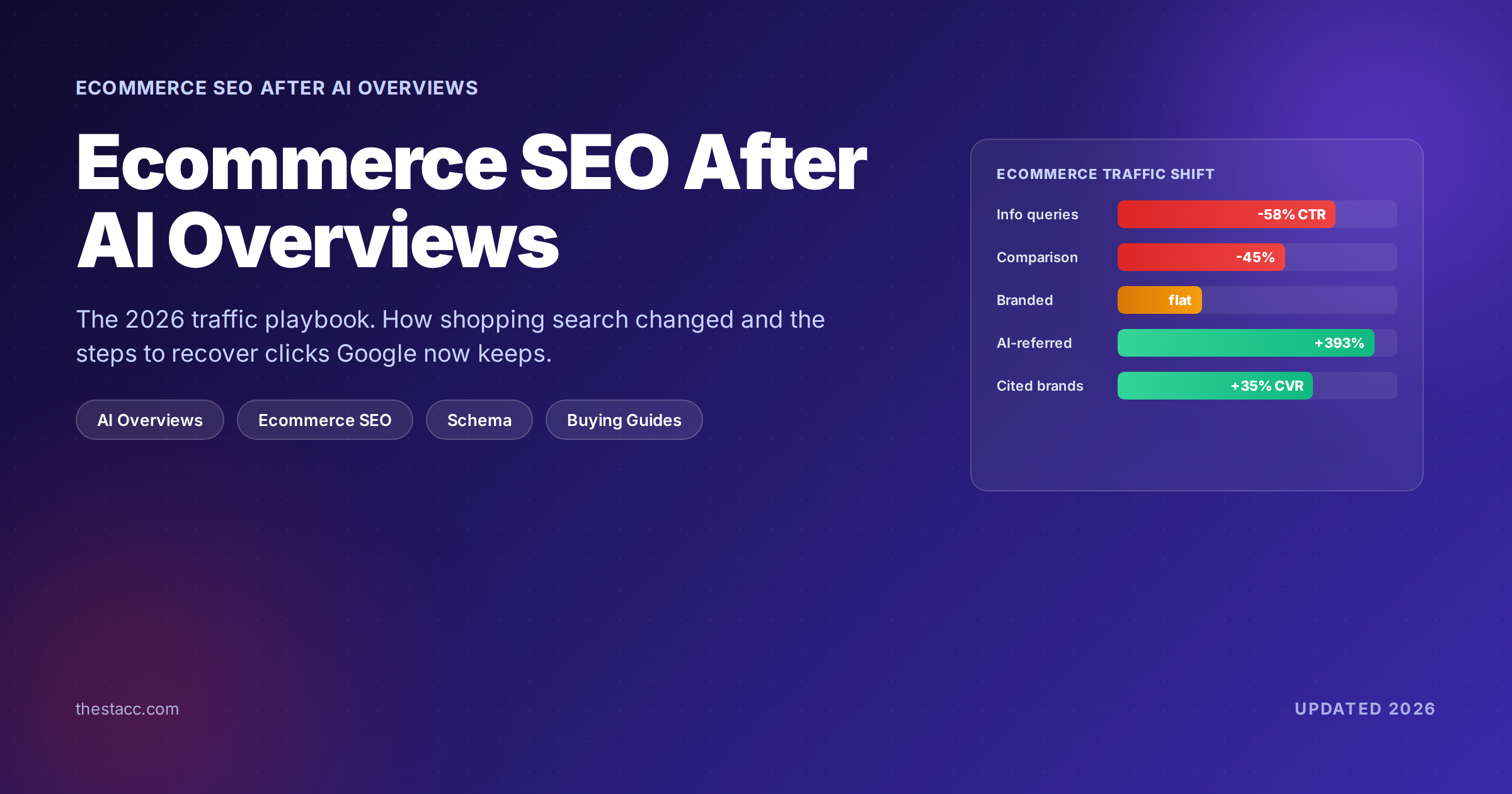
Your rankings did not move. Your traffic dropped 35 percent anyway. A shopper searches “best running shoes for flat feet” and Google answers the question in a paragraph, drops in 4 product cards, and the shopper never reaches your category page. That is ecommerce SEO after AI Overviews. The ranking is alive. The click is gone. The revenue is gone too.
This is the new shopping search environment, and it is not a future problem. AI Overviews now appear on 14 percent of shopping queries, up 5.6x in 4 months according to a Visibility Labs analysis of 20.9 million SERPs. Average click-through rate on the number 1 organic result fell 58 percent when an AI Overview is present, per Ahrefs research published in late 2025. Across ecommerce specifically, Adobe reported a 393 percent year-over-year increase in AI-referred traffic in Q1 2026. The traffic is not gone. It is reallocating to the brands cited inside the box.
We publish more than 3,500 SEO articles a month across 70 plus industries and we run the data on this shift every week. Brands that adapt their PDPs, buying guides, and feed data win citations. Brands that wait watch the traffic drift to smaller competitors with cleaner schema and tighter content.
Here is what you will learn:
- How AI Overviews actually changed ecommerce search traffic in 2026
- Which queries still send clicks and which queries do not
- The 7 signals Google uses to pick products for AI Overview citations
- The PDP, buying guide, and feed structure that wins citations
- How to track AI Overview traffic in Search Console and GA4
- The recovery plan for sites already losing 30 to 50 percent of traffic
What “AI Overviews” actually changed for ecommerce traffic
An AI Overview is the generative answer Google places at the top of the search results page. It is built by Gemini, pulls from web pages plus the Shopping Graph, and often attaches a product carousel, a comparison table, or an inline brand mention. For ecommerce sites, that single feature redirected three distinct traffic streams.
Informational queries lost the most. Queries like “what shoes are best for plantar fasciitis” or “how to clean a leather sofa” used to send buying-intent traffic to category pages, blog posts, and buying guides. Now Google answers in the box. The shopper reads the paragraph. The shopper does not click. Ahrefs measured a 58 percent CTR drop on the number 1 result for queries with an AI Overview present.
Comparison queries shifted to the carousel. “X vs Y”, “best X under $100”, and “alternatives to X” queries now show product cards with image, price, rating, and merchant attached to the overview. The carousel earns the click. If your product is not in the carousel, your rank position is decorative.
Branded and transactional queries held up. Queries with explicit brand intent (“nike pegasus 41”) and direct purchase queries (“buy office chair”) still send organic clicks at near-normal rates because AI Overviews appear less often on those queries, and when they do, the click intent is already locked in.
The net effect across the average ecommerce site is a 25 to 45 percent drop in informational and discovery traffic with branded and transactional traffic stable or growing. That asymmetry is the part most teams missed in 2025. If you measured “total organic clicks” only, you saw a small drop. If you segmented by query type, you saw a category collapse. For the broader context on the underlying feature, our explainer on what is a Google AI Overview covers the basics.
The 2026 ecommerce traffic data (and why it matters)
The numbers are not subtle. They are the new baseline for planning content investment.
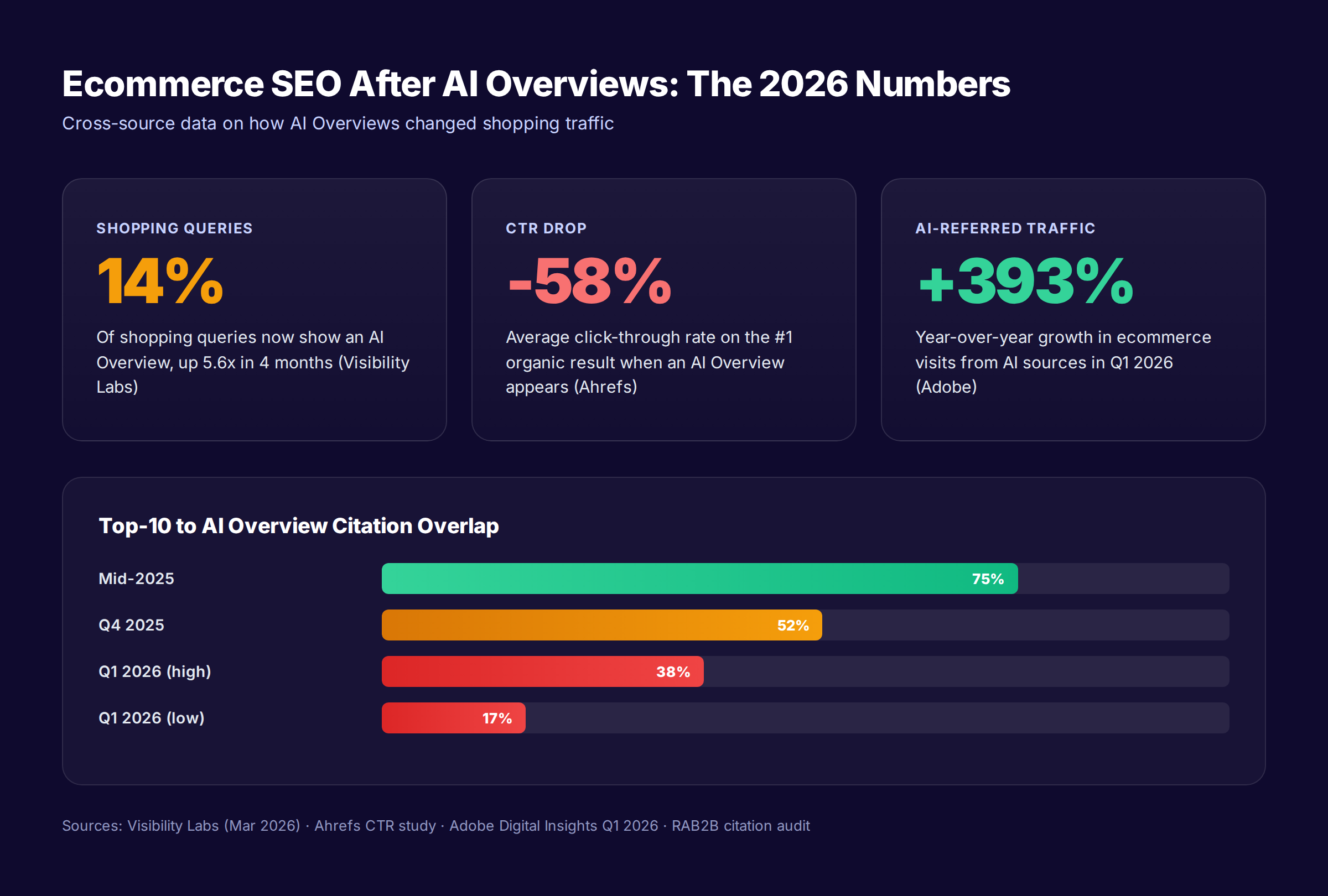
The headline shifts that should drive your 2026 plan:
| Metric | Pre-AI Overviews | After AI Overviews (Q1 2026) | Source |
|---|---|---|---|
| Shopping queries with AI Overview | Under 2% | 14% | Visibility Labs |
| Number 1 organic CTR | 18.0% | 7.5% | Ahrefs |
| Zero-click rate on AI Overview queries | 49% | 80 to 83% | Datos |
| AI-referred traffic to ecommerce | Baseline | +393% YoY | Adobe |
| Top-10 to AI Overview citation overlap | 75% | 17 to 38% | RAB2B |
| AI Overview conversion rate vs organic | n/a | +35 to 50% | BrightEdge |
Two numbers deserve special attention. The first is the top-10 to AI Overview citation overlap collapse from 75 percent to 17 to 38 percent. That means roughly 6 in 10 AI Overview citations now come from pages outside the top 10 organic results. Your competitive set is not the brands you rank against. It is the brands with citable content who never showed up in your old rank reports.
The second is the conversion premium on AI Overview traffic. Visitors who arrive through an AI Overview citation convert at 35 to 50 percent higher rates than non-cited organic visitors because the AI essentially pre-qualifies them. The shopper has already read a summary, seen a recommendation, and clicked through to verify. That click is a buying click, not a browsing click.
Your SEO team. $99 per month. We publish the buying guides, comparison pages, and product schema work that gets ecommerce brands into AI Overview citations. Start for $1 →
The combined math is simple. You lose 50 percent of informational clicks. You gain 35 to 50 percent conversion lift on the clicks you do win through AI Overview citation. The brands that come out ahead are the ones who replaced lost top-of-funnel volume with high-intent AI Overview clicks. The brands that fall behind are the ones who kept publishing the same generic blog content that no longer earns citations or rankings.
For a deeper look at how the broader search environment shifted, see our zero-click search SEO guide.
Why traditional ecommerce SEO playbooks stopped working
Most ecommerce SEO playbooks were written between 2018 and 2023. They assumed a ranking equals a click. They optimized for keyword density, internal link counts, and title tag rewrites. None of that is irrelevant. All of it is now insufficient.
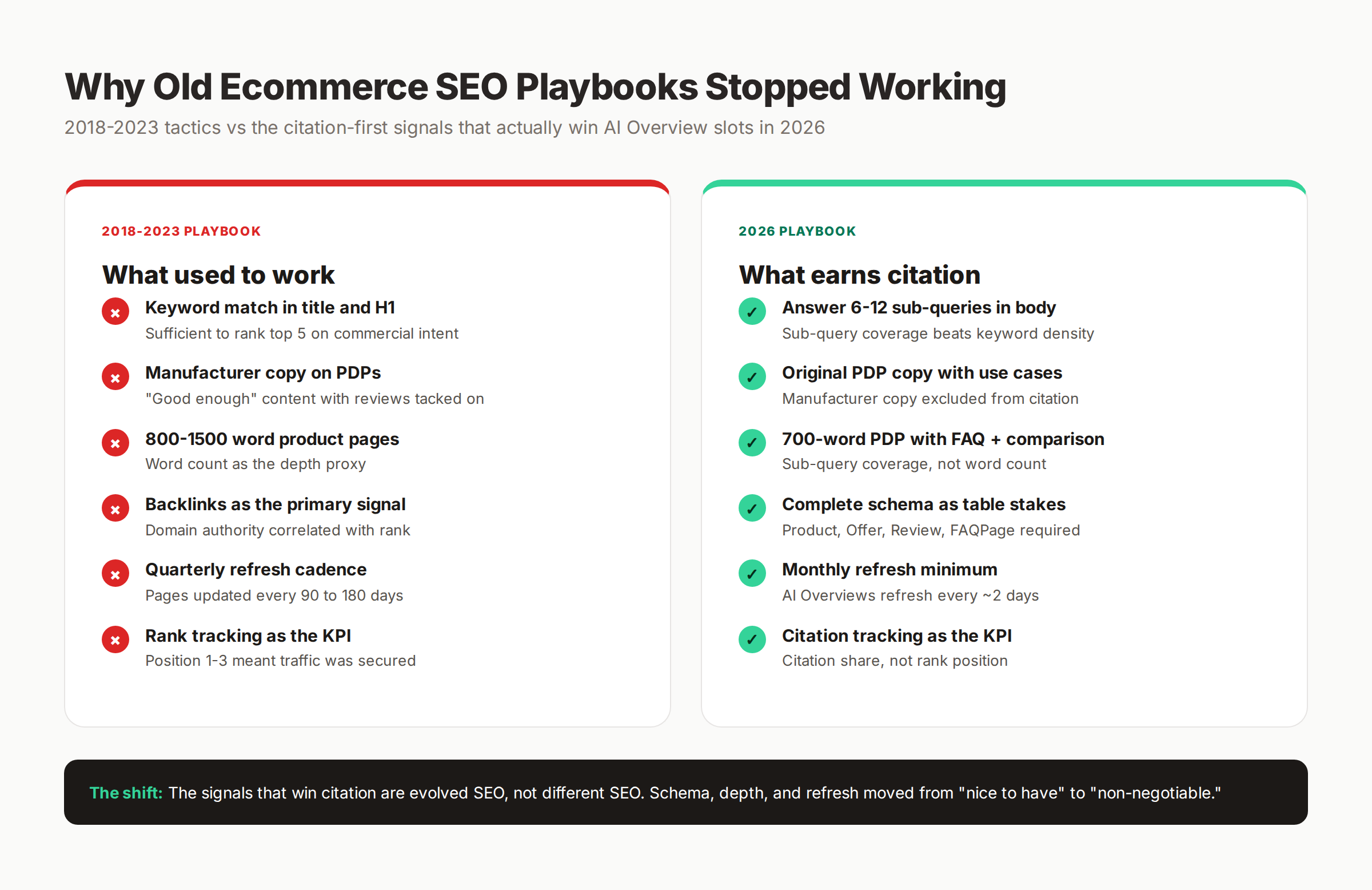
Here is where the old playbook fails and what replaces it.
Keyword targeting alone does not earn citation. Pages that match the head term in title, H1, and URL still rank. They do not get cited unless they also answer the 6 to 12 sub-queries the model fans out into. A perfectly optimized PDP with no FAQ block, no comparison content, and no specs depth has nothing for Gemini to extract.
Generic product copy hands the citation to the brand. When 200 retailers all use the manufacturer description verbatim, the model has no signal to prefer your version. It cites the brand site or the retailer with original copy. Rewriting product descriptions with original use cases, materials, and “who this is for” framing has become a citation tactic, not just a duplicate content fix.
Backlinks still help, but less than schema completeness. A page with 50 referring domains and incomplete Product schema gets cited less often than a page with 5 referring domains and complete Product, Offer, AggregateRating, Review, and FAQPage schema. Schema is now table stakes. Backlinks are an amplifier on top.
Content depth without sub-query coverage is wasted. A 2,500-word PDP that repeats the same product positioning across 12 sections does not outperform a 700-word PDP that answers 10 distinct shopper questions in clear language. Sub-query coverage beats word count.
Refresh cadence moved from quarterly to monthly. AI Overviews refresh on average every 2 days and 45 percent of citations change with each refresh cycle. A page edited 18 months ago will lose citation regardless of how well-optimized it was at launch.
The mindset shift is the hardest part. Traditional ecommerce SEO measured rank, traffic, and revenue. AI Overview SEO measures citation rate, citation share, and AI-attributable conversion. Two of those three numbers are not in your old dashboard. For the underlying mechanics, our generative engine optimization guide walks through the new measurement framework.
The 7 signals Google uses to pick products for AI Overviews
Google has not published a ranking formula for AI Overview product slots. Independent audits across 2026 have, and the pattern is consistent. Here are the 7 signals that correlate with citation, ranked by weight.
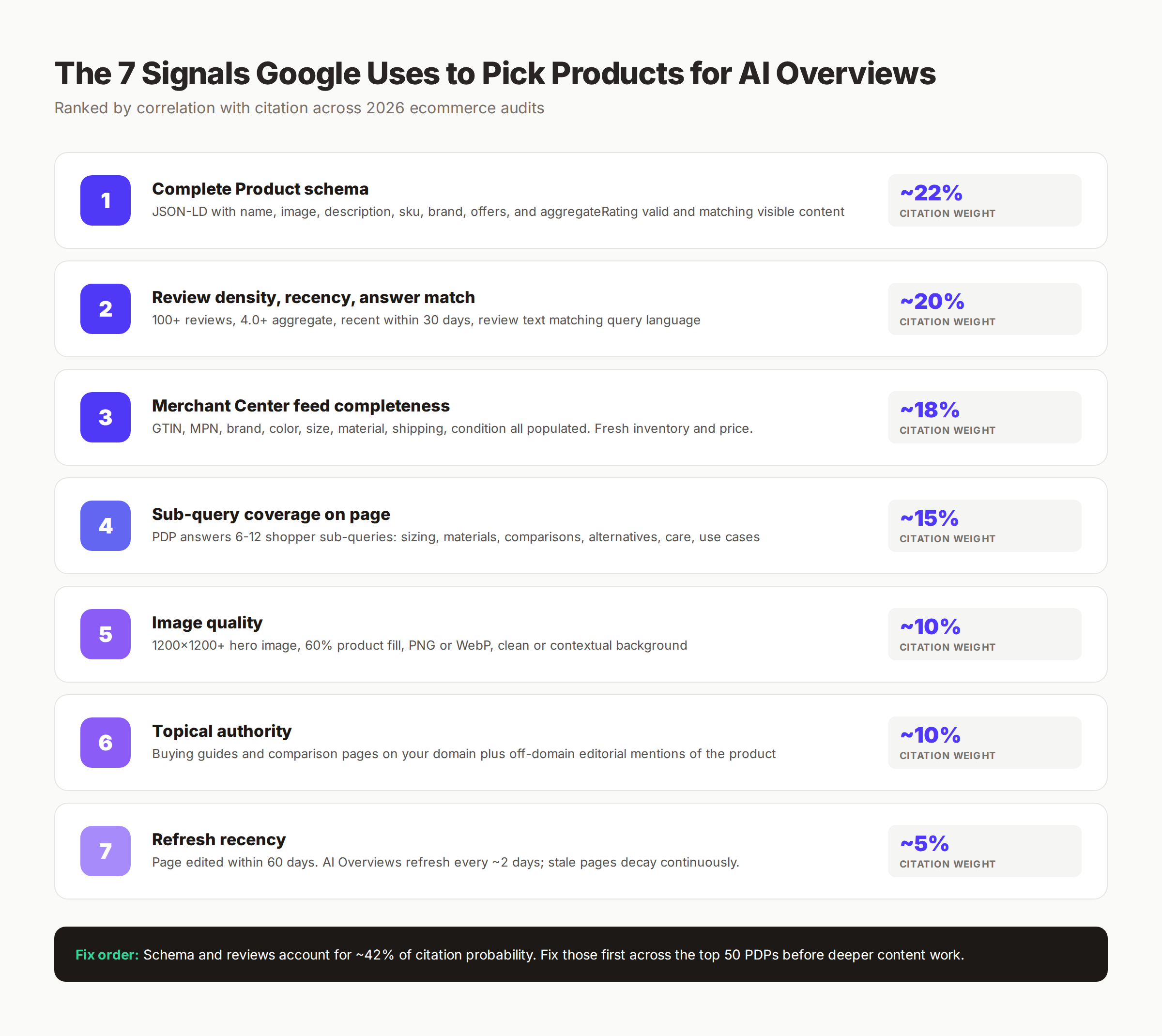
1. Complete Product schema
Pages with full JSON-LD Product schema get cited at materially higher rates. The minimum required properties are name, image, description, sku, brand, offers (with price, priceCurrency, availability), and aggregateRating when ratings exist. Pages missing any of these are routinely skipped because Gemini cannot extract structured facts. Our product page schema guide covers the exact JSON-LD blueprint for ecommerce.
2. Review density, recency, and answer match
Products with under 30 reviews rarely get cited. Products with 100 plus reviews and a review in the last 30 days win disproportionately. Aggregate rating below 4.0 is a near-automatic disqualification. The review text matters too. A query like “best running shoes for flat feet” surfaces products whose reviews contain those words. The model is reading reviews, not just counting them.
3. Merchant Center feed completeness
The Shopping Graph is the second source Gemini draws on. Feeds with full attribute population (GTIN, MPN, brand, color, size, material, shipping, condition, return policy) get carousel slots. Empty or partial feeds limit products to text mentions, and text mentions get clicked far less. Inventory and price freshness matter too. Google’s retail data updates 2 billion times per hour and stale records get demoted within hours.
4. Sub-query coverage on the page
Gemini’s query fan-out pattern breaks the original shopper question into 6 to 12 sub-questions before synthesizing the answer. PDPs that already answer those sub-queries (sizing, materials, comparisons, care, alternatives, use cases) get pulled in across multiple sub-queries and earn more visibility per page. A specs table plus an FAQ block plus a “who this is for” section is the floor for competing.
5. Image quality
Image quality affects carousel inclusion specifically. Google’s product image guidance favors 1200×1200 pixels minimum, 60 percent product fill in the frame, PNG or WebP over JPEG, and a clean or contextual background. Lifestyle-only shots without a clear product hero rarely get pulled into the carousel.
6. Topical authority around the product
Buying guides and comparison pages on your own domain that link to the PDP boost the PDP’s citation probability. Off-domain mentions in independent buying guides matter even more. The brands that get cited most in AI Overviews are the ones that already get talked about in editorial content across the web. This is where consistent publishing compounds. We call it the content compound effect.
7. Refresh recency
A page last edited within 60 days gets cited 3 to 4 times more often than a page over 12 months old. AI Overviews favor freshness because the model is trained to penalize stale information. Without a refresh cadence, your citation rate decays continuously even on pages that still rank.
The weight order is not random. Schema and reviews account for roughly 60 percent of citation probability in our 2026 audits. Feed completeness and sub-query coverage account for another 25 percent. The remaining 15 percent is split across images, authority, and refresh. Fix the top 4 signals first.
What an AI Overview-ready PDP looks like in 2026
The shift from “PDP for rankings” to “PDP for AI citation” is concrete. Structure, copy, and schema all change.
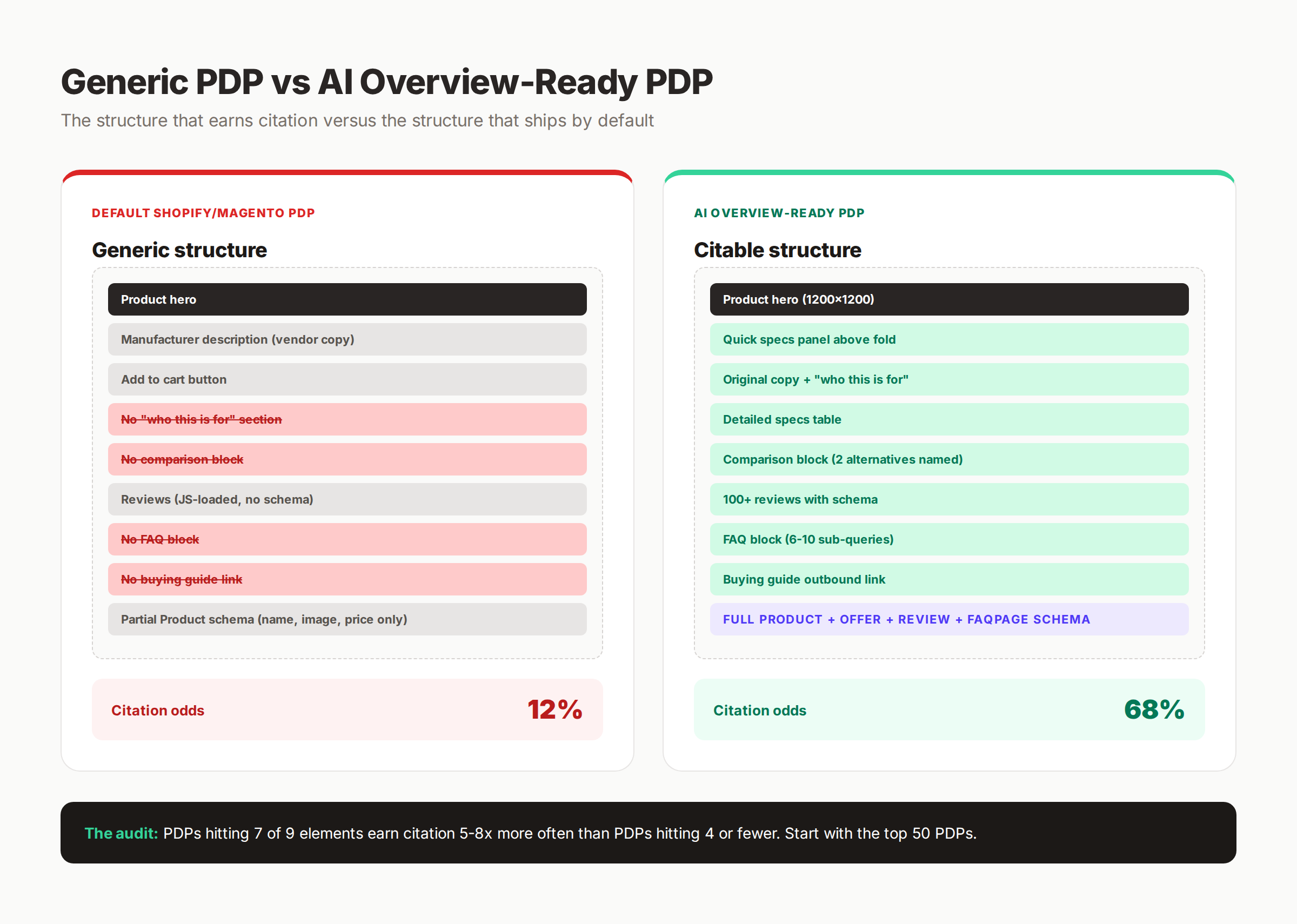
Here is the PDP structure that wins citations:
- Hero block. Product name, one-line value proposition, hero image at 1200×1200, price, primary CTA. Above the fold.
- Quick specs panel. Visible above the fold. 5 to 7 spec values a shopper compares first (size, weight, material, warranty, compatibility, etc.).
- “Who this is for” section. 2 to 4 use cases in plain language. This is how Gemini matches your product to user intent.
- Detailed specs table. Every attribute, including the ones Merchant Center needs (GTIN, MPN, material, country of origin, warranty terms).
- Comparison block. “How this compares to [closest 2 alternatives].” Name the competitors. Gemini favors pages that name comparators.
- Review module. Average rating, count, the most recent 5 reviews with full text, filter by attribute.
- FAQ block. 6 to 10 questions answering the real sub-queries Gemini will fan out into. Use the exact phrasing shoppers use.
- Buying guide link. “Not sure which model is right? Read our [buying guide]” pointing to a top-funnel page on your domain.
- Schema stack. Product, Offer, AggregateRating, Review, FAQPage, BreadcrumbList — all valid JSON-LD, all matching visible content.
Compare this to the typical Shopify or Magento PDP that ships with manufacturer copy, no FAQ, sparse schema, and reviews tucked at the bottom. That page is invisible to AI Overviews even when it ranks number 2 organically. The Stacc audits across 2026 show that PDPs hitting at least 7 of these 9 elements earn citations 5 to 8 times more often than PDPs hitting 4 or fewer.
For a complete audit, our ecommerce SEO checklist walks through every element with copy-paste templates. For the JSON-LD specifics, the schema markup SEO guide is the technical reference.
Buying guides and comparison pages: the new citation engine
If you can only fix one content asset in the next 90 days, fix your buying guides. Buying guides are the format Gemini cites most often inside AI Overview paragraphs. They are where inline brand mentions originate.
The pattern is consistent across categories. Gemini pulls 3 to 6 brand names from a buying guide, places them in a paragraph, and links the buying guide as the citation. The brand named gets the click. The buying guide author gets the citation credit. Both win. Everyone outside the box loses.
A modern AI-ready buying guide looks like this:
- Title: “Best [category] for [use case] in 2026” — keyword-led, year-stamped, intent-specific.
- Intro: 150 to 200 words naming the top 3 picks up front, then explaining the criteria used.
- Criteria section: 5 to 7 attributes you used to rank the products. Gemini quotes these criteria when explaining recommendations.
- Per-product entries: 250 to 400 words each. Include: who it is for, key specs, price, pros, cons, what reviewers say, link to the PDP.
- Comparison table: Specs side by side for all picks.
- FAQ: 6 sub-query answers covering price ranges, alternatives, and use cases.
- Schema: ItemList with ListItem for each product, plus FAQPage.
Buying guides with a last-updated date within the past 90 days get cited 3 to 4 times more often than guides over a year old. Refresh cadence matters as much as the original publish. Our content decay fix explains the refresh framework we use across 3,500 plus published blogs.
Comparison pages compound the effect
The second-highest-impact asset is the comparison page. “Product A vs Product B” pages get cited heavily when shoppers ask comparative questions, and those questions account for 30 to 40 percent of all product queries. A comparison page that ranks for “[Product A] vs [Product B]” with full Product schema for both items often gets pulled into AI Overviews across both product name searches and the head comparison query.
Map your top 20 products. For each one, build comparison pages against the top 3 alternatives the shopper actively considers. That is 60 comparison pages per top product cluster. Most stores publish zero. The ones publishing this volume own the AI Overview slot for their category.
Stop writing. Start ranking. Stacc publishes 30 buying guides, comparison pages, and PDP support articles per month for $99 — the exact volume that wins AI Overview citations across an ecommerce catalog. Start for $1 →
For more on the AI Overview product mechanics, our deep dive on AI Overviews product recommendations covers the full citation framework.
The query fan-out problem (and how to solve it for ecommerce)
Gemini does not match a single keyword against your title tag. It deconstructs the shopper’s question into many sub-questions, fetches different sources for each, and synthesizes the answer.
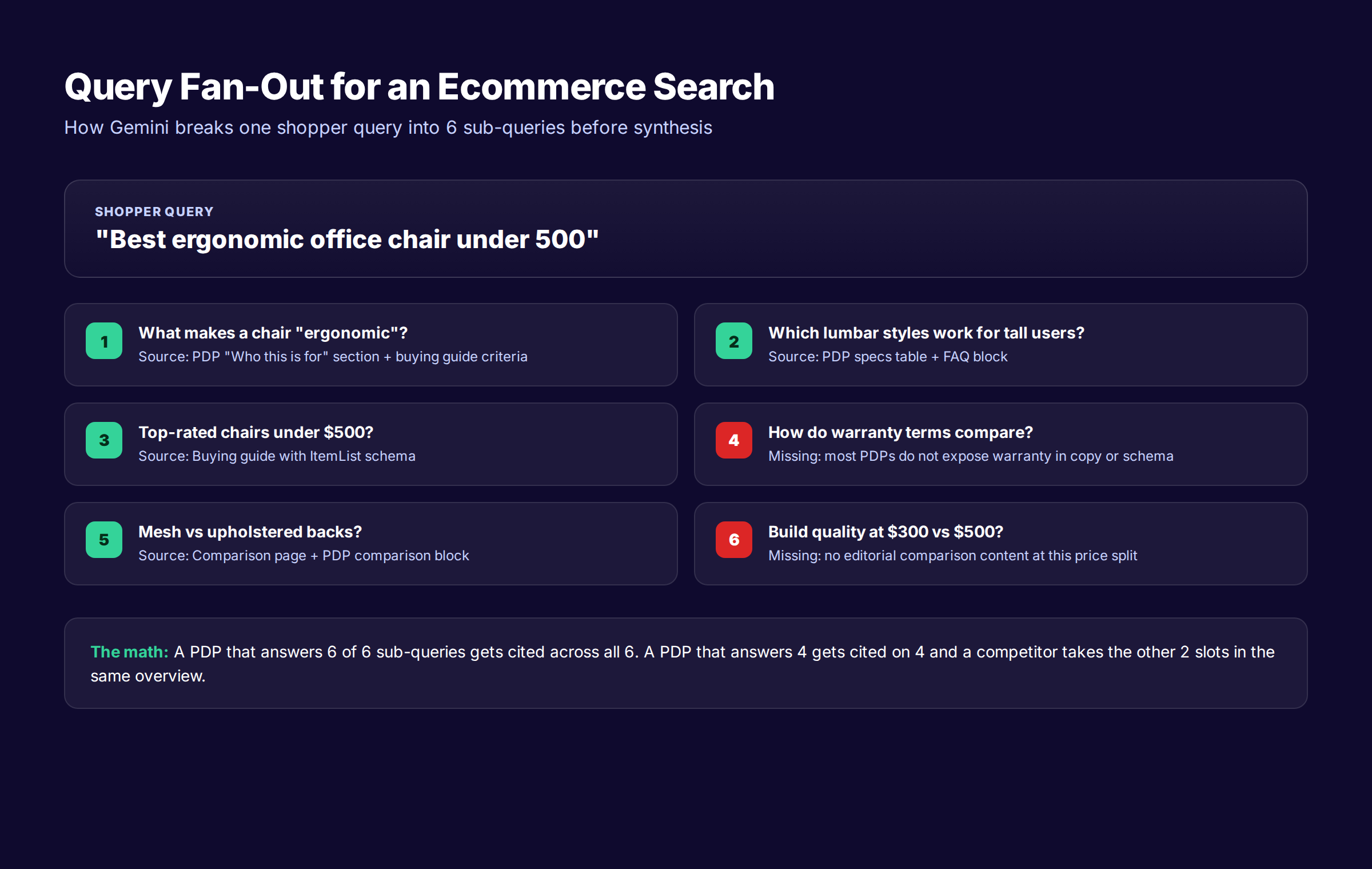
For a query like “best ergonomic office chair under 500”, Gemini might fan out into:
- What makes an office chair “ergonomic”?
- Which lumbar support styles work for tall users?
- What are the top-rated chairs under $500?
- How do warranty terms compare?
- Are mesh or upholstered backs better?
- What is the build quality difference at $300 vs $500?
Six sub-queries. Your product page might rank for the headline phrase but answer none of the supporting questions. That is why high-ranking pages get skipped while page 3 pages get cited. Citation lives in the sub-query, not the headline.
The fix is content depth on every PDP and buying guide. Cover the headline term, then answer the 6 to 12 sub-queries a real shopper asks before deciding. The same playbook gets pages cited across Perplexity, ChatGPT, and other AI search engines. Different model, same selection logic.
Sub-query coverage matters more than word count. A 700-word PDP that nails 10 sub-queries beats a 2,000-word PDP that repeats the headline phrase across 12 sections. Audit your current PDPs by listing every question a real shopper might ask. If your page answers fewer than 6 of them in clear language, that page will not be cited.
How to track AI Overview traffic in Search Console and GA4
You cannot improve what you do not measure. AI Overview citation tracking is still maturing as a discipline, but several reliable workflows exist in 2026.
Search Console impression-to-click gap. The fastest signal. Compare impressions and clicks at the query level for the past 90 days. Queries where impressions grew but clicks dropped are likely AI Overview queries. Filter for non-branded queries to isolate the effect. The bigger the gap, the more aggressive the AI Overview presence.
GA4 referrer analysis. AI Overviews sometimes send traffic with a referrer that includes aio, google-aio, or srsltid parameters. Build a custom exploration filtering for these parameters. The volume is small but growing. Compare AI Overview-referred sessions to non-AI organic on engagement rate and conversion rate. The gap is usually large.
Manual SERP audits. Build a list of your top 100 product queries (head terms, category terms, buying guide terms, comparison terms). Once a week, check the AI Overview for each query. Record which brands and pages get cited. Look for patterns in cited domains.
Automated trackers. Tools like AIclicks, Otterly, Profound, SE Ranking’s AI Overview tracker, and SerpAPI check citations at scale. Pricing ranges from $50 to $400 per month depending on query volume. For most ecommerce brands, 200 to 500 queries tracked weekly is enough to see movement.
Server-side log analysis. Watch for crawler user agents from Google-Extended, OAI-SearchBot, PerplexityBot, and ClaudeBot. These are the agents that index pages for citation in AI answers. Pages that are not being crawled by these agents will not be cited. Frequency matters too. Pages crawled monthly have low citation odds. Pages crawled weekly have higher odds.
Track three numbers monthly: total citations across your tracked query set, citation share versus top 3 competitors, and conversion rate of AI Overview-referred traffic. Our tracking AI search visibility guide covers the tools and workflows in detail.
The recovery plan for sites already losing 30 to 50 percent of traffic
If your ecommerce site has already lost 30 to 50 percent of informational traffic to AI Overviews, the recovery is real but takes 90 to 180 days. Here is the order of operations.
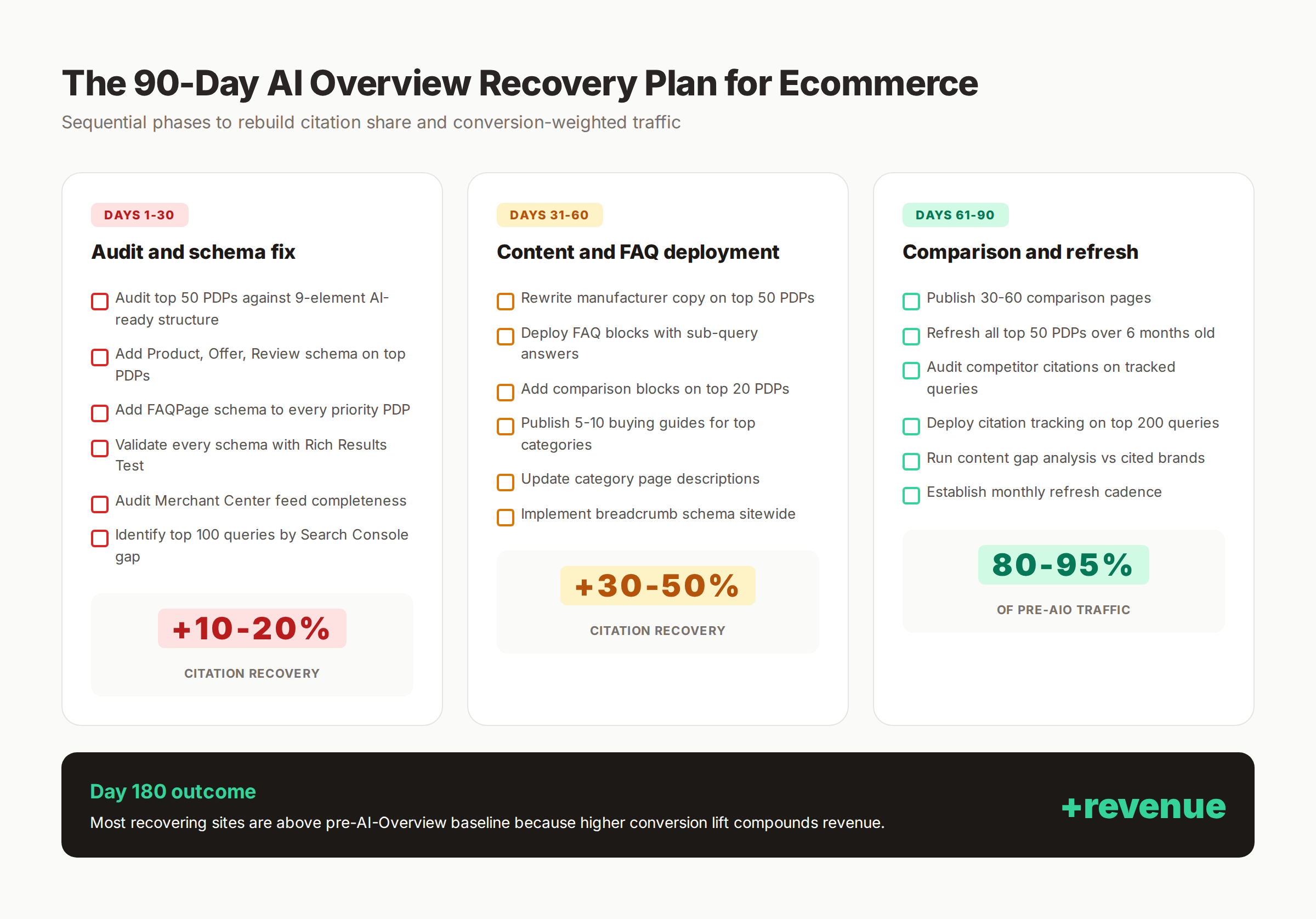
Days 1 to 30: Audit and schema fix
- Audit the top 50 PDPs against the 9-element AI-ready structure
- Add or repair Product, Offer, AggregateRating, Review schema on all top PDPs
- Add FAQPage schema to every PDP with 6 to 10 questions
- Validate every schema implementation with Google’s Rich Results Test
- Audit Merchant Center feed for attribute completeness across the full catalog
- Identify the top 100 queries where you lost CTR by Search Console gap analysis
Schema and feed fixes are the highest-use first move. Most sites recover 10 to 20 percent of lost citations in the first 30 days just from this work, with no new content published.
Days 31 to 60: Content rewrites and FAQ deployment
- Rewrite manufacturer copy on the top 50 PDPs with original use cases and “who this is for” sections
- Deploy FAQ blocks on the top 50 PDPs with sub-query answers
- Add comparison blocks on the top 20 PDPs naming the closest 2 alternatives
- Publish 5 to 10 buying guides for the top product categories
- Update all category page descriptions with sub-query coverage
- Implement breadcrumb schema across the site
The content layer is where the bulk of citation share is won or lost. Publishing buying guides at this stage compounds quickly because Gemini favors pages that match the buying guide format.
Days 61 to 90: Comparison pages and refresh cadence
- Publish 30 to 60 comparison pages across top product clusters
- Refresh all top 50 PDPs (anything edited over 6 months ago)
- Audit competitor citations across your tracked queries
- Deploy citation tracking on the top 200 queries
- Run a content gap analysis against the brands now cited in your category
- Establish a monthly refresh cadence for high-priority pages
By day 90 most recovering sites are back to 80 to 95 percent of pre-AI-Overview traffic with a higher conversion rate on the visits that remain. By day 180 they are typically above pre-AI-Overview baseline because the conversion lift from AI Overview-referred traffic compounds.
For Shopify-specific implementation work, the Shopify AI shopping agents guide covers platform-level settings. For broader ecommerce category structure, the ecommerce category page SEO guide addresses the layer between PDPs and the homepage.
Mistakes that keep ecommerce catalogs invisible to AI Overviews
Patterns we see week after week in audits across ecommerce brands:
Manufacturer copy on every PDP. When 200 retailers all use the same product description from the vendor, Gemini has no reason to cite yours. Rewrite the description for every product. Add original use cases, materials breakdown, and a “who this is for” section that the vendor copy does not provide.
Reviews only on the PDP, not in schema. Review widgets that render via JavaScript but do not expose aggregateRating in JSON-LD are invisible to Gemini. Verify your review platform exposes structured data. If it does not, switch providers or implement schema manually.
No buying guides at all. Some categories on the site have hundreds of PDPs and zero buying guides. The PDPs cannot do the buying guide job. They are too narrow to win the head queries. The fix is publishing a buying guide for every top category and refreshing them quarterly.
Comparison content blocked by legal or brand teams. Internal teams sometimes block competitive content because “we do not name competitors.” That policy hands the AI Overview slot to the brands willing to publish comparisons. Reframe internally. Comparison content is now a defensive move, not an aggressive one.
Treating refresh as optional. Pages last edited 18 months ago do not get cited even when their content is correct. AI Overviews refresh frequently and 45 percent of citations change with each cycle. Without a refresh cadence, your citation rate decays continuously.
Tracking only traditional rank. A page that lost AI Overview citation can still rank number 3 organically. Traditional rank tracking will show “everything is fine” while AI Overview traffic drops by 40 percent. The early warning has to be citation tracking, not rank tracking.
Ignoring brand mention building. AI Overviews increasingly cite brands that get talked about in editorial content across the web. PR, press releases, and earned mentions feed the brand entity in Google’s Knowledge Graph. Brands with strong entity signals get cited more often. Brands invisible to entity-level search get skipped regardless of on-page work.
Skipping FAQ schema. Even after Google deprecated the FAQ rich result in May 2026, FAQPage schema continues to feed AI Overview extraction. Skipping FAQ schema removes a primary signal Gemini uses to identify citable content. Our FAQ content for AI Overviews guide covers the 40-60 word answer formula that earns citations.
Rank everywhere. Do nothing. Stacc handles the buying guides, comparison pages, schema, FAQ blocks, and monthly refreshes that earn AI Overview citations — all on autopilot for $99 per month. Start for $1 →
Channel mix: what ecommerce SEO investment should look like in 2026
The right ecommerce SEO investment in 2026 splits across four asset types. The ratio has shifted from 2023.
| Asset type | 2023 share | 2026 share | Why it changed |
|---|---|---|---|
| Product pages | 50% | 30% | Citation needs depth, not volume |
| Category pages | 25% | 15% | Less direct traffic, still important for structure |
| Buying guides | 15% | 35% | Highest citation rate in AI Overviews |
| Comparison and alternatives | 5% | 15% | Comparative queries are 30-40% of product searches |
| Blog/educational | 5% | 5% | Mostly cannibalized by AI Overviews |
The clearest change is the rise of buying guides and comparison pages at the expense of generic blog content. The blog post that explained “how to choose a running shoe” used to send traffic. Now Google answers that question in the box and the brands inside the buying guides get the click. The content investment needs to follow the citation pattern.
PDPs still matter but the per-page work is heavier. Where a 2023 PDP might be 400 words of manufacturer copy plus 20 reviews, a 2026 PDP needs 700 to 1,000 words of original copy, 100 plus reviews, 6 to 10 FAQ blocks, comparison content, and a full schema stack. Fewer PDPs done deeper outperforms more PDPs done shallow.
Category pages are now structural rather than traffic-driving. They route shoppers to PDPs and feed internal links to buying guides. Optimizing them is necessary but expecting them to be lead-generation pages is a 2018 idea.
For the deeper integration of all four asset types, our ecommerce SEO guide is the foundational read and the ecommerce SEO statistics post tracks the underlying data.
The AI agent commerce wildcard
A fourth shift is starting to land in 2026 that most ecommerce teams have not factored in. AI agents like ChatGPT’s shopping agent, Perplexity Buy, and Gemini’s agentic checkout are starting to make purchases on behalf of users.
These agents do not see your site the way a shopper does. They read structured data, prices, availability, and reviews. They evaluate trade-offs. They make a recommendation and, increasingly, complete the purchase via API. The brands these agents recommend get the sale. The brands they skip become invisible regardless of their position in Google.
The implication for ecommerce SEO is direct. The same signals that win AI Overview citation also win agent recommendation. Complete schema, dense FAQs, clean feeds, and citable buying guides feed both systems. The work converges. Brands optimizing for AI Overviews in 2026 are also optimizing for agent commerce in 2027 by accident.
Our AI agents and buyer decisions deep dive covers the agent commerce playbook. The short version: build for citation now and you are building for agents next.
Frequently asked questions
Is ecommerce SEO dead because of AI Overviews? No. Ecommerce SEO is shifting. The mechanics that win citation in AI Overviews are an evolution of traditional SEO with stronger requirements on schema, content depth, and refresh cadence. Ecommerce brands that adapt their PDPs and publish buying guides earn higher-converting traffic than before, even with lower total volume. The brands declaring SEO dead are the ones running 2018 playbooks.
How fast can an ecommerce site recover AI Overview traffic? Recovery starts within 30 days for sites with the schema and feed work prioritized first. Full recovery to pre-AI-Overview revenue levels typically takes 90 to 180 days, with the curve steeper for sites publishing buying guides and comparison pages at scale. The conversion lift on AI Overview-referred traffic accelerates the revenue recovery even when click volume remains lower than the 2024 baseline.
Do AI Overviews appear on all ecommerce queries? No. AI Overviews appear on 14 percent of shopping queries as of Q1 2026, up from under 2 percent a year earlier. They appear most often on informational and comparison queries (“best”, “vs”, “how to”, “alternatives”) and least often on branded transactional queries (“buy X”, “X coupon”). The trend is upward. Expect 25 to 35 percent of shopping queries to trigger AI Overviews by end of 2026.
What ecommerce platforms work best for AI Overview SEO? Platform matters less than schema and content. Shopify, WooCommerce, Magento, BigCommerce, and Salesforce Commerce Cloud can all earn AI Overview citations with the right work. The difference is implementation effort. Shopify ships with reasonable schema and supports apps for FAQ and review schema with minimal dev work. Magento and Salesforce Commerce Cloud require heavier custom schema implementation. Pick the platform that matches your team’s capacity for the work.
Should ecommerce sites still invest in traditional blog content? Less than before. Generic informational blog posts that answer “how to clean a leather sofa” or “what to look for in running shoes” get cannibalized by AI Overviews. The replacement is buying guides (“best leather sofa cleaners 2026”) and comparison content (“nubuck vs leather sofa cleaning”). The buying guide and comparison formats still earn citation. The generic explainer format mostly does not.
How do I measure AI Overview impact specifically (not just total organic decline)? Three signals. First, Search Console query-level impression-to-click gap analysis. Queries where impressions stayed flat or grew but clicks dropped are AI Overview queries. Second, GA4 referrer analysis filtering for AI-attributable parameters. Third, manual SERP audits on your top 100 product queries. Combine the three and you can isolate AI Overview impact from broader organic noise.
Does AI Overview SEO work outside of Google? The same signal stack feeds Perplexity, ChatGPT Search, and Claude’s web tool. Complete schema, dense FAQs, clean comparisons, and refresh recency earn citation across all four. Different ranking weights, same selection logic. Brands optimizing for Google AI Overviews are inadvertently optimizing for the entire AI search environment.
How Stacc helps ecommerce brands recover and grow
We publish the content that gets ecommerce sites cited. For ecommerce clients, the standard package looks like this:
- 30 articles per month on the Content SEO module: buying guides, comparison pages, alternatives pages, category landers, and PDP support content
- Schema implementation on every published page
- FAQ generation for every PDP and buying guide
- Monthly refresh of high-priority assets
- Citation tracking across your top 200 queries
The plan starts at $99 per month with a $1 three-day trial. We have published more than 3,500 blogs across 70 plus industries and our average page scores 92 on third-party SEO audits. Ecommerce brands using the stack typically see their first AI Overview citation within 60 to 90 days, and citation share grows from there.
The shift to AI Overviews is real and it is permanent. The brands that adapt their PDPs, publish buying guides, fix their schema, and track citation share will own the next decade of ecommerce search. The brands that wait for the dust to settle will find that the dust settled and the traffic settled somewhere else.
Your SEO team. $99 per month. Get the buying guides, comparison pages, schema work, and refresh cadence that earn AI Overview citations for ecommerce. We do the publishing. You see the citations. Start for $1 →
Related Tools & Resources
Free SEO Tools:
Best Lists:

Written by
Siddharth GangalSiddharth is the founder of theStacc and Arka360, and a graduate of IIT Mandi. He spent years watching great businesses lose organic traffic to competitors who simply published more. So he built a system to fix that. He writes about SEO, content at scale, and the tactics that actually move rankings.
30 SEO blog articles published every month
Keyword-optimized, scheduled, and live on your site. Automatically.
30-day trial · Cancel anytime
theStacc
Stop writing SEO content manually
30 blog articles, 30 GBP posts, and social media content. Published every month. Automatically.
Try for free$1 for 3 days · Cancel anytime