
Entity Authority: How Google and AI Decide Who to Trust
Entity authority decides which brands Google AI Overviews, ChatGPT, and Perplexity cite. Learn the 6 signals, schema setup, and 90-day plan. Updated 2026.
A brand can publish 500 articles a year, rank in the top 10 for hundreds of keywords, and still get ignored by Google AI Overviews. Another brand with one-tenth the traffic gets cited every week. The difference is not content quality or domain authority. The difference is entity authority — the level of confidence Google and AI systems have that your brand is a real, distinct, trustworthy thing worth citing.
Google’s Knowledge Graph now contains over 54 billion entities. AI Overviews appear on roughly 25% of all Google searches and over 70% of informational queries. ChatGPT serves 900 million weekly active users. None of these systems work the way classic SEO assumed. They do not rank pages first. They rank entities, then pull supporting passages from pages associated with those entities.
This is what makes entity authority the foundation of AI search visibility. Without it, your content is invisible to the systems people now use to decide what to read, buy, or trust.
We publish 3,500+ articles across 70+ industries with a 92% average SEO score. We track AI citations across ChatGPT, Perplexity, Gemini, and AI Overviews every week. Every signal in this guide is one we operate against in our own production pipeline.
Here is what you will learn:
- What entity authority means and how it differs from domain authority
- How Google’s Knowledge Graph identifies, disambiguates, and corroborates an entity
- The 6 signals AI systems read when deciding whether to cite your brand
- How to build Wikidata, schema, and sameAs structures correctly
- A 90-day roadmap to move from invisible entity to cited authority
- The exact audit checklist we run before every AI search engagement
What Entity Authority Actually Means
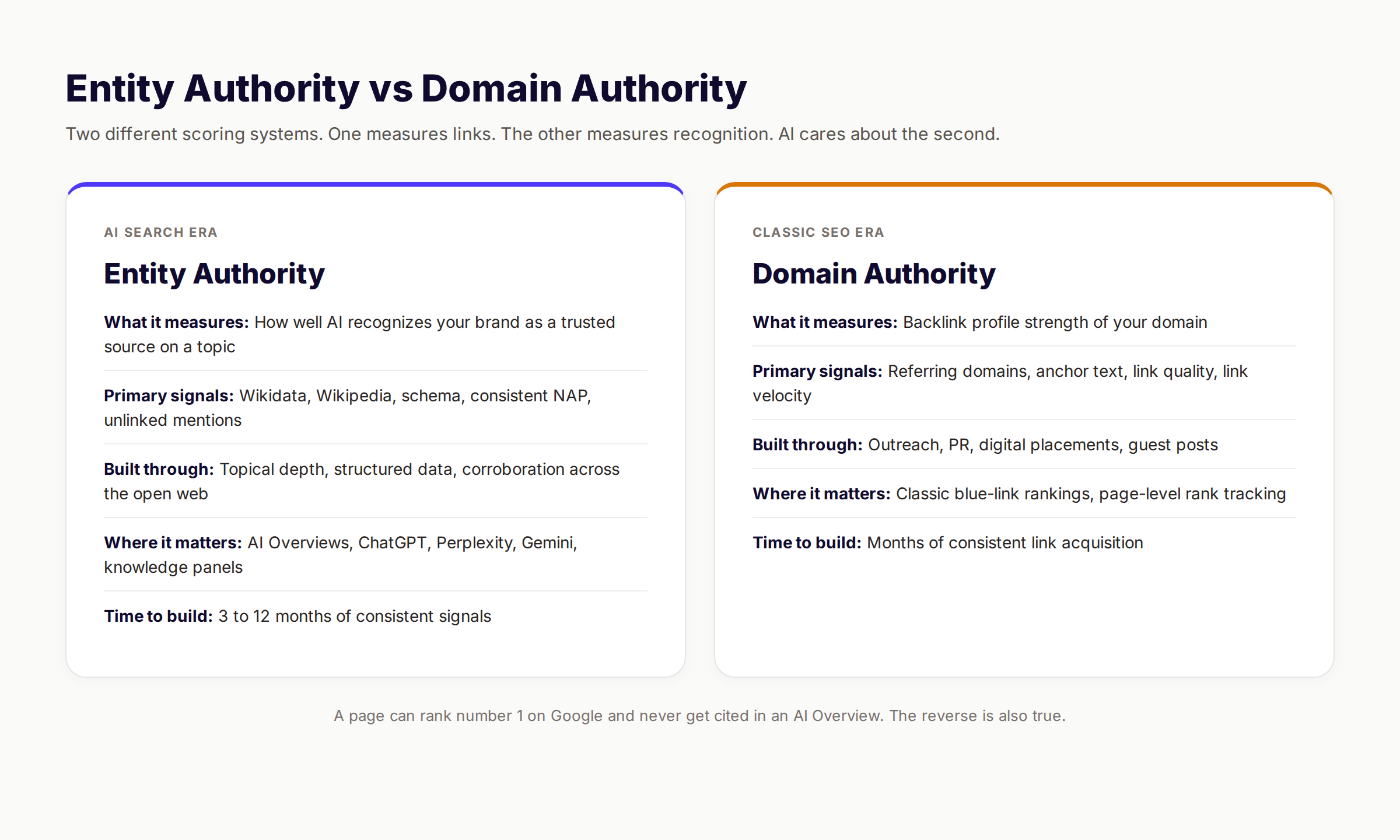
Entity authority is the degree to which AI systems and search engines recognize your brand as a distinct, trustworthy source on specific topics. It measures recognition, not ranking. It measures the confidence a model has in citing your brand without qualifying the citation with “according to some sources.”
The term entity comes from how modern search systems represent knowledge. An entity is a unique thing in the world — a person, place, organization, product, concept, or event. Google assigns each entity a Knowledge Graph Machine ID (KGMID) and stores attributes about it: founders, founding date, location, products, key topics, related entities.
Entity Authority Is Not Domain Authority
Domain authority is a third-party metric based on backlinks. Entity authority is a verification score AI systems compute internally from many signals.
A site with high domain authority can still have weak entity authority. A site with modest domain authority can dominate AI citations for its topic. The reason: AI systems do not crawl backlinks to decide who is trustworthy. They evaluate whether your brand exists clearly enough, consistently enough, and with enough independent corroboration to be cited as a fact rather than a guess.
A widely shared analysis from Foundation Inc. found that fewer than 10% of sources cited by generative engines ranked in Google’s top 10 for the same query. The systems are no longer aligned on a single score. Entity authority is the AI side of that equation.
The Two Questions AI Systems Ask
Before citing any brand, AI systems answer two questions internally. Entity authority is about getting a confident yes to both.
- Identity confidence. Can the AI confirm which entity owns this content? Is the brand machine-readable, named consistently, and disambiguated from similar entities?
- Topical confidence. Has the brand corroborated its association with this topic across multiple independent sources, with consistent attributes and verifiable claims?
A weak yes on either question and the AI pulls from someone else. There is no partial credit in citation systems.
How Google’s Knowledge Graph Builds an Entity
The Knowledge Graph is the substrate underneath every AI surface Google ships. AI Overviews, knowledge panels, AI Mode, and the entity carousels in Discover all source from the same graph. Understanding how it builds an entity tells you exactly where to focus your effort.
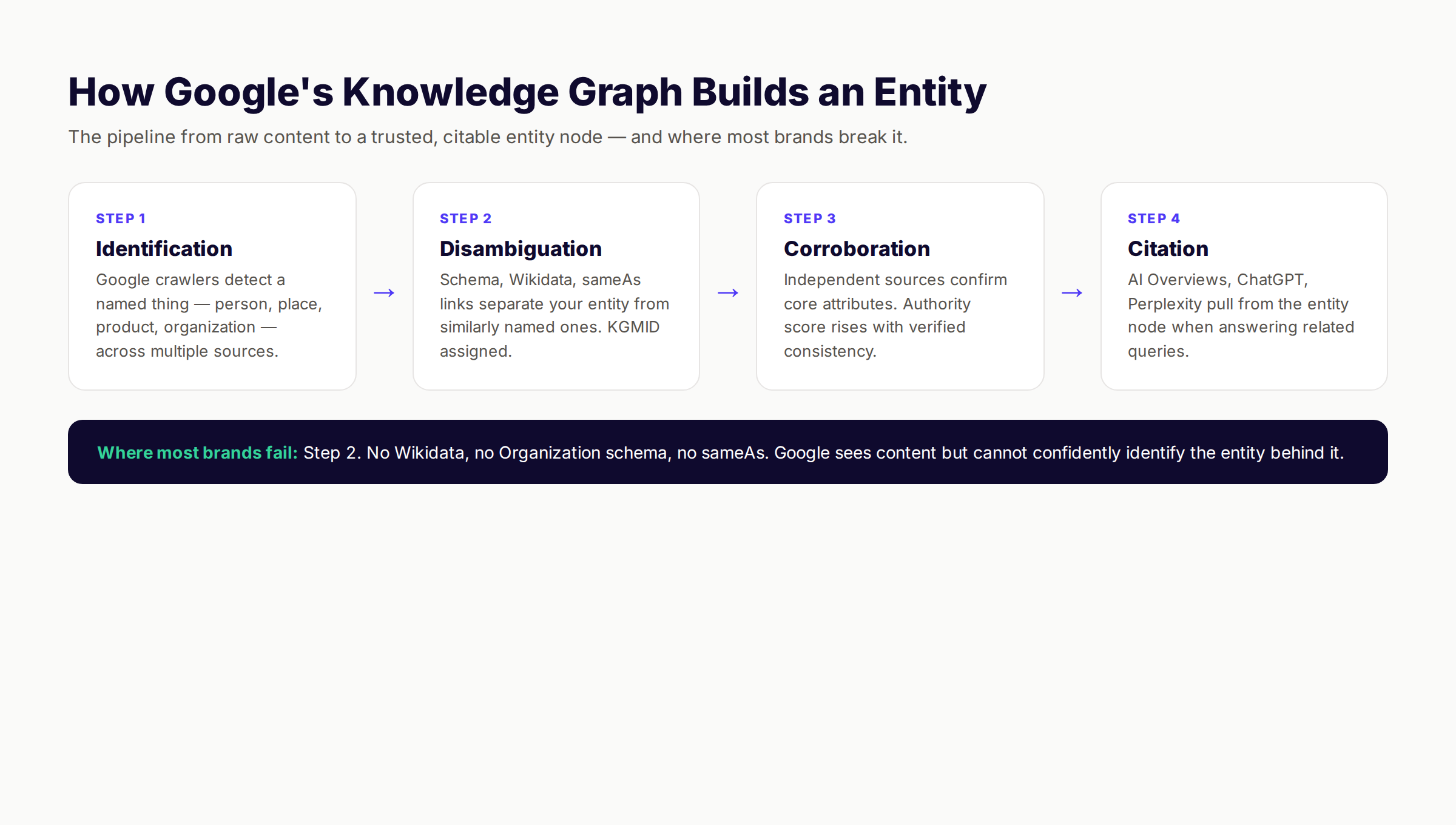
Step 1: Identification
Google crawlers detect a named thing across multiple sources. The first signal is repetition. The same string of words referring to the same kind of thing across multiple pages tells the system there is probably an entity worth tracking. This stage is automatic and rewards consistency.
Step 2: Disambiguation
Many entities share names. There are several “Stripes,” several “Apples,” and a dozen “Acme Corporations.” Google uses schema markup, sameAs links, and Wikidata IDs to separate one from another. Without these signals, your brand may be conflated with another entity or never assigned a stable identity at all.
This is the step where most brands fail. They have content. They have backlinks. They do not have the structured signals required to claim a unique identity in the graph.
Step 3: Corroboration
Once an entity is identified, the graph collects attributes about it. Founders. Founding date. Headquarters. Products. Topics. Each attribute is scored by how many independent sources confirm it. Disagreement reduces confidence. Consistency increases it.
Step 4: Citation
Once corroboration crosses a confidence threshold, the entity becomes citable. AI Overviews, knowledge panels, and conversational answers pull from the graph or from sources associated with the graph node. Citation rate is downstream of identification, disambiguation, and corroboration — never the other way around.
Google’s developer docs on AI features confirm that AI Overviews source from the same systems that rank for organic results, but with additional filtering for clarity, sourcing, and entity verification.
The 6 Signals AI Systems Read to Decide Entity Authority
There are dozens of inputs to an entity score. Six of them carry the most weight in 2026. Get these right and the rest compound.
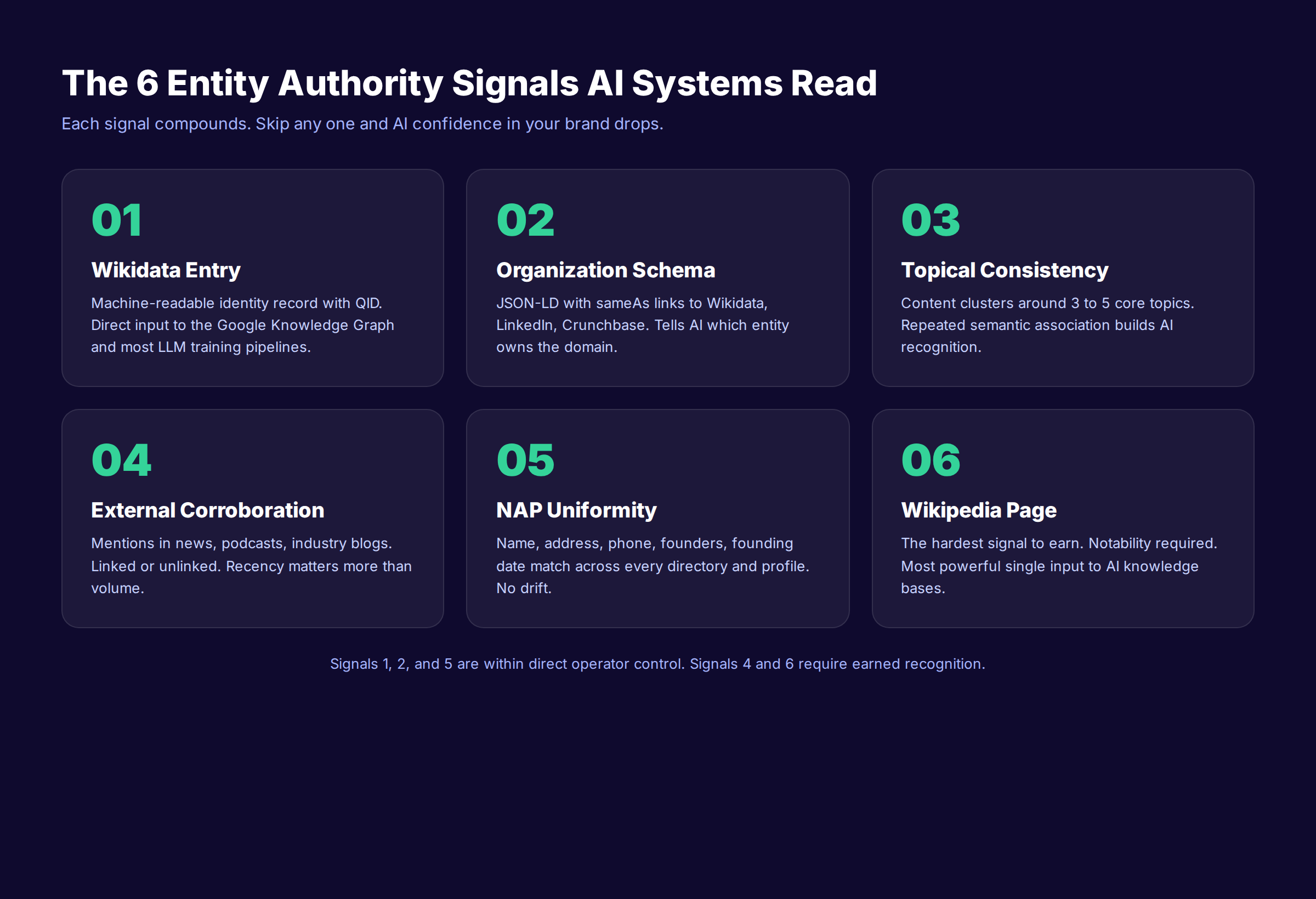
Signal 1: Wikidata Entry
Wikidata is the machine-readable cousin of Wikipedia. It is the most direct line into the Knowledge Graph and into the training pipelines of most large language models. Every Wikidata entry has a unique QID, structured properties, and verifiable references.
Creating a Wikidata entry is one of the most actionable entity authority steps available. Required fields include official name, official website, founding date, founders, headquarters, industry classification, and key products. Each field needs a verifiable reference. Wikidata moderators reject entries with weak sourcing.
Signal 2: Organization Schema with sameAs
Schema markup is how you tell Google directly which entity owns this domain. The Organization schema type, when combined with the sameAs property, creates a machine-readable identity graph that points from your website to every authoritative profile.
The minimum viable Organization schema needs name, url, foundingDate, logo, and a sameAs array linking to Wikidata, LinkedIn, Crunchbase, Google Maps (for local), and any other verified profile. Without sameAs, AI systems guess. With sameAs, they verify. The difference is the citation rate.
Our full breakdown of structured data lives in our schema markup SEO guide and the focused schema markup for blog posts post.
Signal 3: Topical Consistency
Entity authority is topic-specific. A brand can have strong authority for one topic and zero authority for another. The signal that connects entity to topic is repetition of association across content, schema, and external mentions.
Pick 3 to 5 core topics. Publish pillar content on each. Internally link related articles into clusters. Reference the same entity-topic pairings across blog content, About pages, services pages, and structured data. AI systems detect the repeated pattern and adjust their confidence accordingly. We cover the discipline in detail in our guide to building topical authority and the practical playbook for creating a topical map for SEO.
Signal 4: External Corroboration
Entity authority cannot be built only on your own pages. AI systems weigh independent sources higher than self-published claims. The more authoritative sites that reference your brand in the context of your topics, the higher your entity confidence score.
This is where unlinked mentions matter as much as backlinks. AI models trained on web crawls and news corpora recognize brand strings without needing a hyperlink. A news article that names your founder in connection with your topic is an entity signal whether it links to your site or not.
Signal 5: NAP and Attribute Uniformity
Name, address, phone — and by extension, founders, founding date, headquarters, and category — must match across every directory and profile. Inconsistent data triggers what is called entity drift. Entity drift lowers AI confidence and can cause the system to refuse to cite the brand at all.
If your website says you were founded in 2014 and Crunchbase says 2015 and LinkedIn says 2013, you have a drift problem. The fix is a canonical attribute set, documented internally, applied everywhere, and audited quarterly.
Signal 6: Wikipedia Page
Wikipedia is the hardest signal to earn and the most powerful single input to AI knowledge bases. It is also the only one you cannot create on your own without violating Wikipedia’s notability rules.
A Wikipedia page requires significant independent coverage from reliable secondary sources. The page must be written neutrally and cannot be promotional. For most brands, this is a multi-year horizon, earned through genuine industry recognition, not through manufactured PR.
The good news: you do not need a Wikipedia page to build meaningful entity authority. The other five signals carry significant weight on their own. Wikipedia is the cherry on top, not the foundation.
Stop chasing keywords. Start building an entity AI cites. Stacc publishes 30 SEO articles per month across pillar topics, with full schema and topical consistency baked in. Start for $1 →
The Entity Authority Numbers That Matter in 2026
The data behind the discipline tells the story better than the theory does.
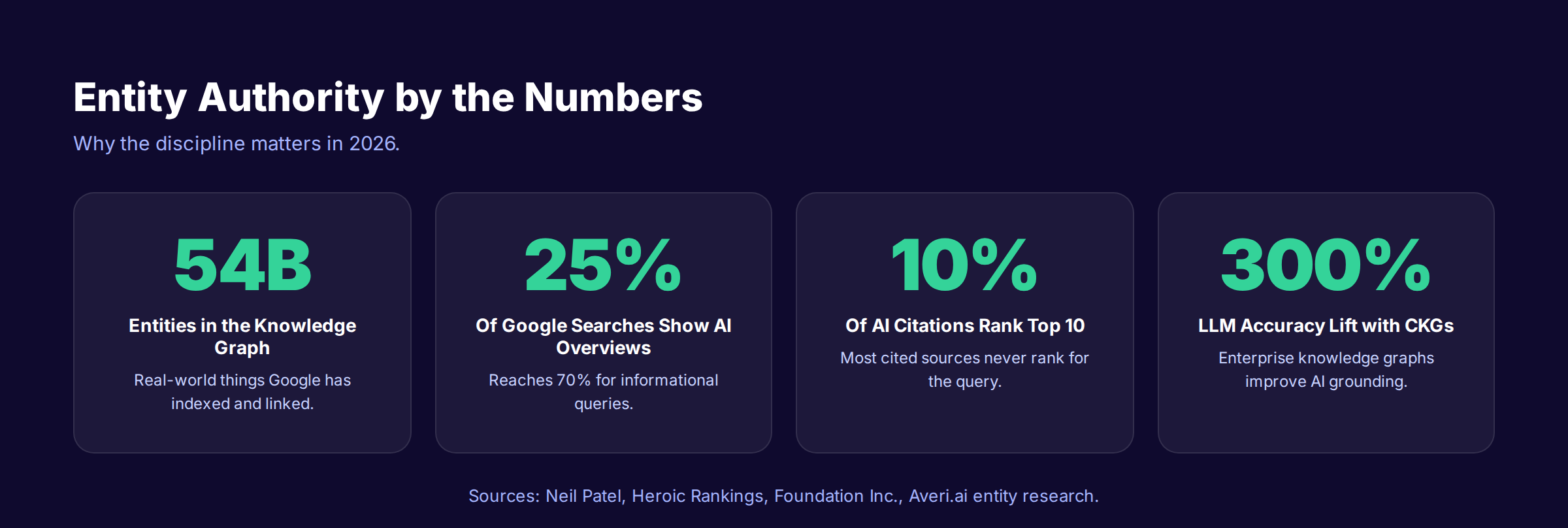
| Metric | Value | What It Tells You |
|---|---|---|
| Entities in Google’s Knowledge Graph | 54 billion | Scale of the system AI search runs on |
| Google searches showing AI Overviews | 25% | Up from 13% in early 2025 |
| AI Overviews on informational queries | 70%+ | Knowledge-intent SERPs are mostly AI now |
| AI-cited sources in Google top 10 | Under 10% | Ranking and citation are decoupled |
| Schema.org entity types available | 800+ | Specific types beat generic Article |
| LLM accuracy lift from enterprise CKG | 300% | Grounding works when the entity is clear |
| Traffic lift from advanced schema | 20 to 40% | Reported across multiple studies |
Two numbers deserve emphasis. First, fewer than 10% of AI-cited sources rank in the top 10 for the same query. AI does not pull from the highest-ranked page. It pulls from the most clearly identifiable entity. Second, AI Overviews are now the default experience on informational queries. If your category is informational — definitions, comparisons, how-to content — your content lives or dies by AI citation, not by organic click.
For deeper data on the AI search shift, see our AI search statistics roundup and our complete breakdown of how AI search is changing SEO.
How to Set Up Organization Schema and sameAs Correctly
Schema is the cheapest, fastest entity authority move available. Most sites either skip it or implement it incorrectly. Both failures cost the same — invisibility to the systems that decide citations.
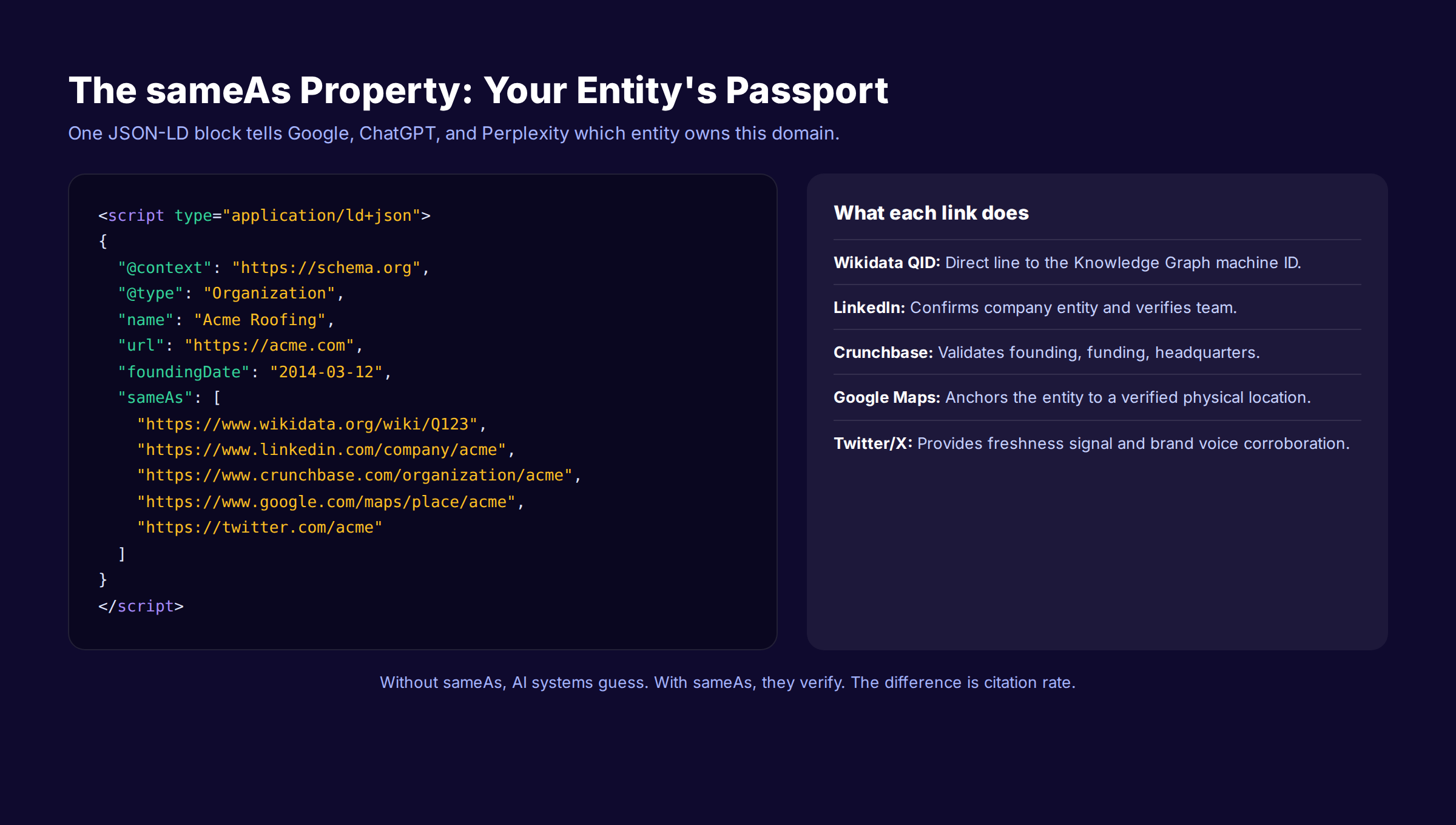
The Minimum Viable Organization Schema
Place this in the head of your homepage and your About page. Update the values to match your verified canonical attributes.
<script type="application/ld+json">
{
  "@context": "https://schema.org",
  "@type": "Organization",
  "name": "Acme Roofing",
  "alternateName": "Acme",
  "url": "https://acme.com",
  "logo": "https://acme.com/logo.png",
  "foundingDate": "2014-03-12",
  "founders": [{ "@type": "Person", "name": "Jane Doe" }],
  "address": {
    "@type": "PostalAddress",
    "streetAddress": "123 Main St",
    "addressLocality": "Austin",
    "addressRegion": "TX",
    "postalCode": "78701",
    "addressCountry": "US"
  },
  "sameAs": [
    "https://www.wikidata.org/wiki/Q123456",
    "https://www.linkedin.com/company/acme",
    "https://www.crunchbase.com/organization/acme",
    "https://www.google.com/maps/place/acme",
    "https://twitter.com/acme"
  ]
}
</script>
What Each sameAs Link Does
Every link in the sameAs array points to a profile where the entity is also represented. Together they form a verification web that AI systems can traverse.
- Wikidata QID — direct line to the Knowledge Graph machine ID
- LinkedIn — confirms company entity and verifies team members
- Crunchbase — validates founding date, funding rounds, headquarters
- Google Maps profile — anchors the entity to a verified physical location
- Twitter or X — provides freshness signal and brand voice corroboration
- GitHub or Behance — extends entity recognition for tech and creative brands
- YouTube channel — adds video corpus to the entity profile
Five to seven sameAs links is the sweet spot. More than ten and the signal-to-noise ratio drops. Less than three and AI systems cannot triangulate identity confidently.
Common Schema Mistakes That Kill Entity Authority
We see these patterns over and over in audits. Each one is a self-inflicted entity authority wound.
- Using @type “Article” everywhere instead of specific types like “BlogPosting” or “NewsArticle”
- Schema present on the homepage but missing on internal pillar pages
- Inconsistent name across schema versus visible page content
- foundingDate in schema does not match Wikidata or Crunchbase
- sameAs links point to profiles with mismatched attributes
- No Person schema for founders or key authors
- FAQPage schema with answers that contradict body copy
Audit your schema against your visible content quarterly. Drift between the two is the single biggest reason AI systems lose confidence in an entity.
How to Build Your Wikidata Entry (Step by Step)
Wikidata is open. Anyone with an account can create an entry. The trick is meeting the notability and sourcing requirements so the entry survives moderator review.
Step 1: Confirm Notability
Wikidata’s notability bar is lower than Wikipedia’s. You need at least one of three things: a Wikipedia article in any language, citations in independent reliable sources, or fulfillment of a structural need (linking other entities together).
For most operating businesses, the second qualifier is the path. Have you been covered by a regional news outlet, an industry publication, or a recognized podcast? That coverage is the basis for the entry.
Step 2: Gather Verified References
Before creating the entry, list every claim you plan to make. Then list a third-party source for each claim. Founding date sourced from a press release on your own site does not count. Founding date sourced from a Crunchbase profile, a state registration filing, or a news article does.
Step 3: Create the Item
Sign in to wikidata.org and choose “Create a new item.” Add the canonical name as the label. Add the official short description. Then add statements one by one. Every statement should attach a reference URL.
Core statements to include:
- Instance of — the type of organization (business, nonprofit, startup, etc.)
- Industry — your primary industry category
- Country — country of headquarters
- Headquarters location — city or city plus country
- Founded by — founders with their own Wikidata QIDs where possible
- Inception — founding date with month and year minimum
- Official website — your canonical URL
- CEO or founder — current leadership
Step 4: Connect the Entity
After publishing, link your Wikidata QID into your Organization schema sameAs array. Update LinkedIn, Crunchbase, and your About page to reference the same canonical attributes. The Wikidata entry becomes the source of truth that all other profiles align with.
The 90-Day Entity Authority Roadmap
Entity authority compounds. It does not arrive in a sprint. It also does not require a year of waiting before any results show. A structured 90-day plan moves a brand from invisible to recognizable.
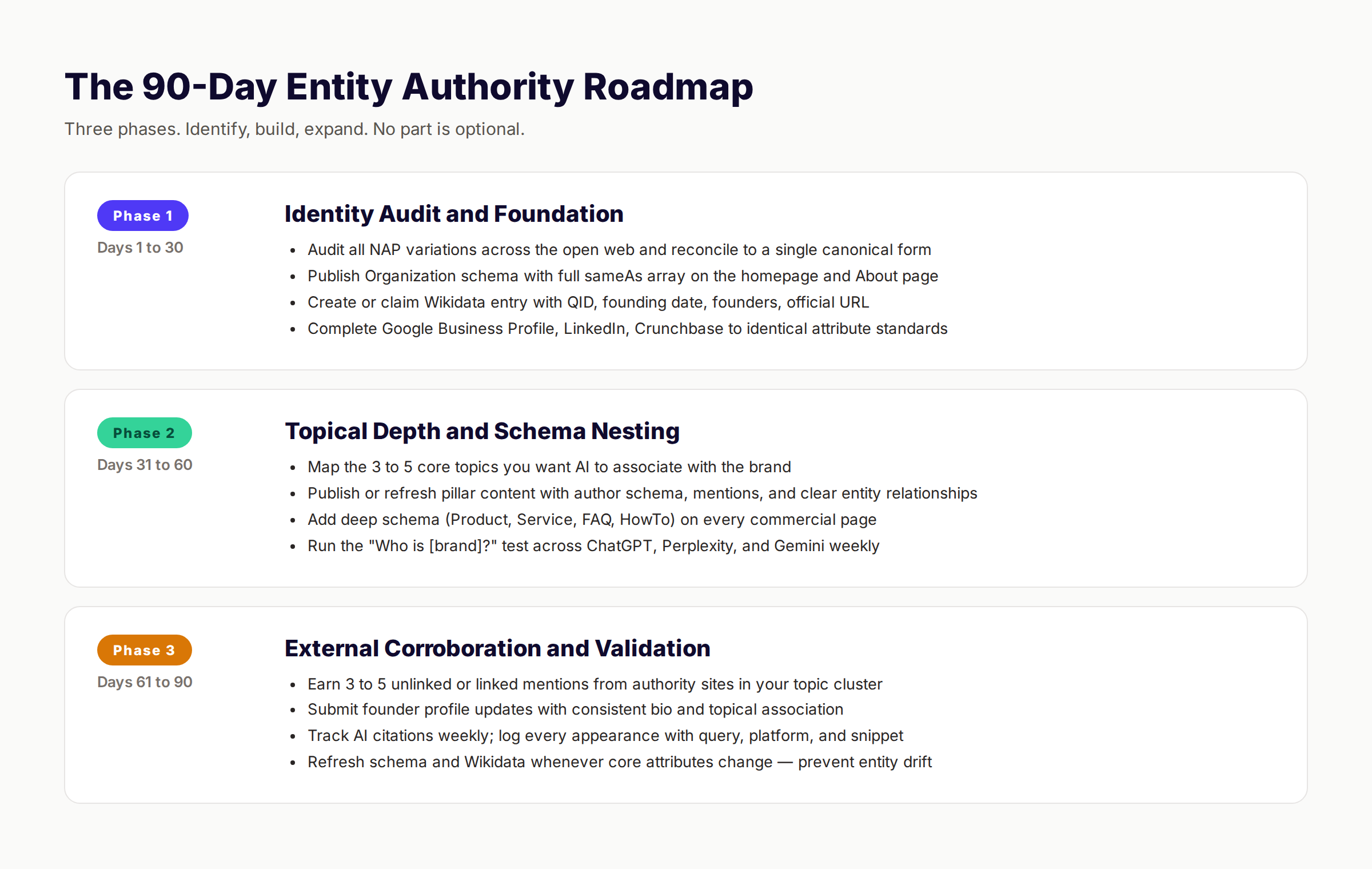
Phase 1: Days 1 to 30 — Identity Audit and Foundation
The first month is about establishing a single, canonical identity that every other signal can align with. Skip this and every later step amplifies noise rather than signal.
- Audit every NAP variation across the web and reconcile to a single canonical form
- Document canonical attributes (name, founders, founding date, headquarters, categories)
- Publish Organization schema on the homepage and About page
- Add Person schema for founders and key executives
- Create or claim the Wikidata entry with QID and 8+ statements
- Complete Google Business Profile to canonical standards
- Complete LinkedIn, Crunchbase, and one industry-specific profile to identical standards
Phase 2: Days 31 to 60 — Topical Depth and Schema Nesting
The second month is about establishing topical association. Identity without topic is recognition without context. Both are required.
- Map 3 to 5 core topics you want AI to associate with the brand
- Publish or refresh one pillar piece per topic with FAQ schema and clear entity references
- Add Service, Product, or Course schema to commercial pages
- Build internal link clusters from each pillar to 8 to 12 supporting articles
- Run the “Who is [your brand]?” test across ChatGPT, Perplexity, and Gemini weekly
- Log every AI response with date, platform, accuracy notes, and topical association
Phase 3: Days 61 to 90 — External Corroboration and Validation
The third month is about earned signal. You cannot self-corroborate. The web has to confirm what you have already claimed.
- Earn 3 to 5 unlinked or linked mentions from authority sites in your topic clusters
- Submit founder profiles with consistent bios to industry directories
- Pitch one podcast or industry publication per topic cluster
- Track AI citations weekly across all relevant platforms
- Refresh schema and Wikidata whenever core attributes change
- Document the citation trajectory and adjust topic priority based on real data
Detailed playbooks for each surface live in our GEO optimization checklist, our blog GEO checklist, and our guide to how to get cited in AI search.
The Entity Authority Audit Checklist
Run this every quarter. Score one point per checked item. Below 14 and AI systems do not have enough signal to cite you confidently. Above 18 and your brand operates with structural advantage.
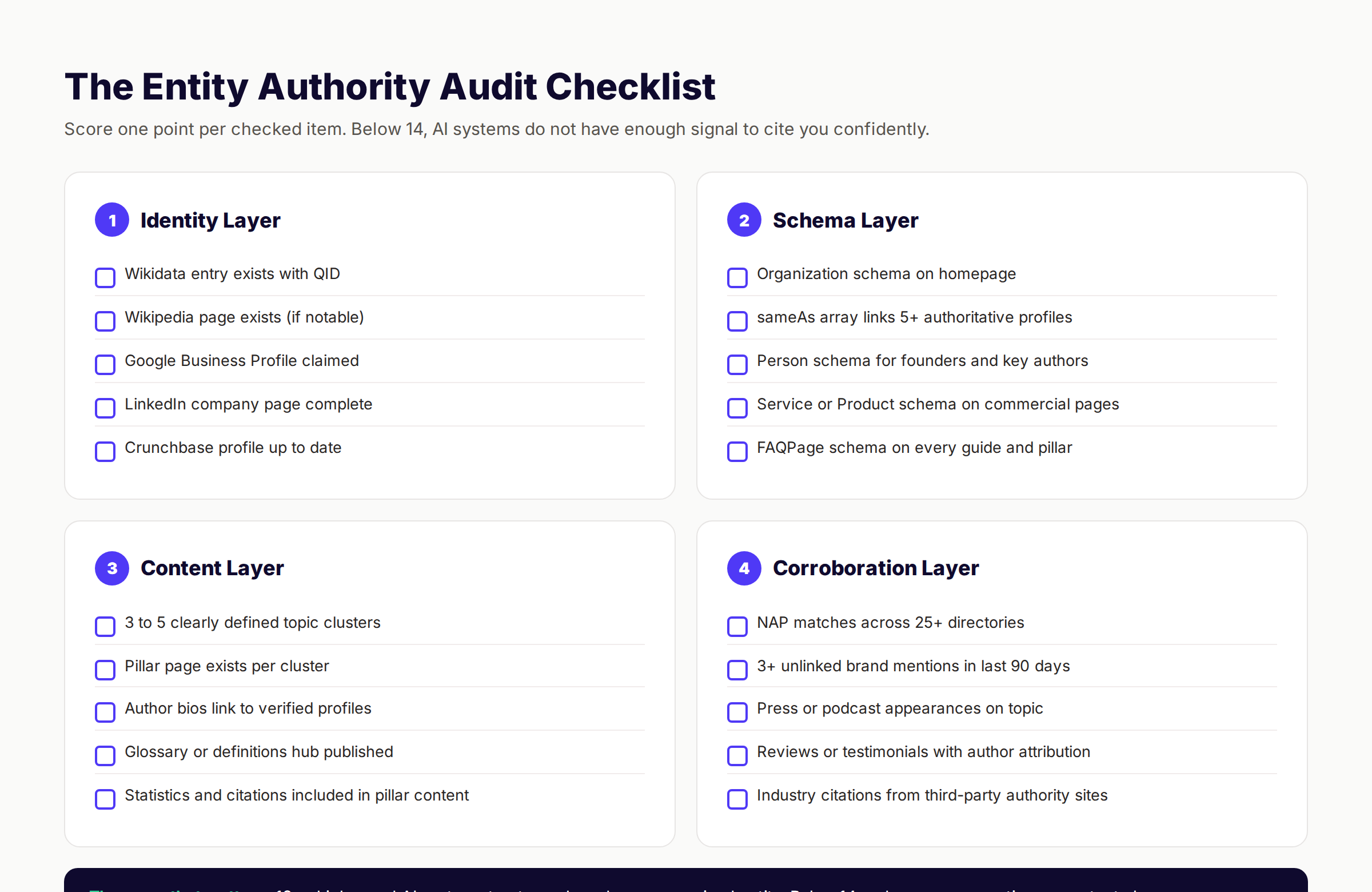
Identity Layer (5 points possible)
- Wikidata entry exists with valid QID
- Wikipedia article exists in at least one language (if notable)
- Google Business Profile claimed and complete (for local)
- LinkedIn company page complete with employees and description
- Crunchbase profile complete with founding info
Schema Layer (5 points possible)
- Organization schema present on homepage
- sameAs array contains 5 or more authoritative profiles
- Person schema for founders and primary authors
- Service or Product schema on commercial pages
- FAQPage schema on every pillar and guide
Content Layer (5 points possible)
- 3 to 5 defined topical clusters with pillar pages
- Author bios link to verified profiles
- Glossary, definitions, or hub page published
- Statistics and citations included in pillar content
- Internal links reinforce entity-topic associations
Corroboration Layer (5 points possible)
- NAP matches across 25 or more directories
- 3 or more unlinked mentions in the last 90 days
- Press or podcast appearances on core topics
- Reviews or testimonials with author attribution
- Industry citations from third-party authority sites
A 14 to 17 score means your entity is recognized but not yet cited reliably. An 18-plus score means you are operating at the level of brands routinely cited by AI Overviews and ChatGPT for their topic clusters.
For ongoing measurement, our guide to tracking AI search visibility walks through the exact dashboards and queries to monitor citation rate week over week.
How Entity Authority Differs from E-E-A-T
People conflate entity authority with E-E-A-T. They overlap but they are not the same.
E-E-A-T (Experience, Expertise, Authoritativeness, Trustworthiness) is a quality rater framework Google uses to assess content. It is a content evaluation model. It applies primarily to Your Money Your Life (YMYL) topics like health, finance, and legal.
Entity authority is a recognition score that applies to any topic. It is a verification model, not a quality model. A brand can have weak E-E-A-T signals on a particular page and still be cited by AI Overviews if its entity authority is strong on the broader topic. The reverse is also true.
The relationship is layered:
- E-E-A-T evaluates whether this specific page is good
- Entity authority evaluates whether this brand is real, distinct, and topically credible
- Topical authority evaluates whether this brand owns this subject across many pages
Strong content with strong E-E-A-T signals reinforces entity authority over time. Strong entity authority makes new content more likely to be cited even before it builds individual page-level signals. The two compound when aligned.
For a deeper view on how E-E-A-T fits the AI search era, see our breakdown of AEO vs SEO and our explainer on what AEO is.
How to Test Whether AI Systems Recognize Your Entity
Theory only goes so far. You need a real test to know whether your work is moving the needle. Three queries reveal the truth in under five minutes.
Test 1: The Identity Query
Type “What is [your brand]?” into ChatGPT, Perplexity, and Gemini. Repeat in a fresh session without prior context.
Score the response on five dimensions:
- Does the AI recognize the brand at all?
- Is the category correct (e.g., SEO platform versus marketing agency)?
- Are the founding date, headquarters, and founders accurate?
- Are the products or services described correctly?
- Is the description aligned with how you would describe the brand yourself?
A score of 4 or 5 means strong identity signal. A score of 2 or 3 means the entity is partially recognized but has drift. A score of 0 or 1 means the brand has no entity authority yet.
Test 2: The Topical Query
Ask “Best tools for [your core topic]?” or “Who are the experts in [your core topic]?” without naming your brand. See whether your brand appears in the response.
If it does, your topical association is working. If it does not, you are not yet linked to the topic in the AI’s internal representation. The fix is more pillar content, more external mentions, and stronger schema alignment around that topic.
Test 3: The Disambiguation Query
If your brand shares a name with any other entity, ask the AI specifically about the version of your brand it might confuse with others. “Is [your brand] the [your category] company or the [other category] company?”
Confusion in this answer means you have a disambiguation problem. The fix is more aggressive sameAs use, more explicit category schema, and more content that makes the distinction clear in plain language.
We document the full testing protocol in our case study on building topical authority and our GEO case study showing real before-and-after data.
Where Entity Authority Goes Wrong (And How to Fix It)
Five failure patterns appear in almost every audit we run. Each one is fixable inside 30 days if caught early.
Failure 1: The Multi-Brand Conflation
A parent company with several products often has all of them living on one domain. AI systems struggle to disambiguate. Each product needs its own entity treatment: dedicated About page, Product schema, sameAs links to verified profiles, distinct topical cluster.
Failure 2: The Founder Without Schema
Many brands list founders by name in copy but never wrap them in Person schema with sameAs links to LinkedIn, Twitter, and (where applicable) Wikidata. The founder is then invisible as an entity, which weakens the parent brand’s corroboration.
Failure 3: The Generic Schema Type
Using “Article” everywhere is the most common schema mistake. There are 800-plus Schema.org types. The more specific type you can use, the stronger the entity signal. BlogPosting, NewsArticle, TechArticle, HowTo, Recipe, Service, Product — pick the closest match and use it.
Failure 4: The Drift Problem
A brand changes its address, hires a new CEO, or launches a new product line. The website updates. The schema does not. Wikidata does not. LinkedIn shows the old data. The AI sees three versions of the truth and lowers confidence in all of them. The fix is a quarterly canonical attribute audit.
Failure 5: The Topical Spread
A brand publishes on 25 topics with no clear core. Each topic gets one or two posts. AI systems cannot associate the brand confidently with any single topic. The fix is brutal: pick 3 to 5 topics, double down on those, and either retire or reframe everything else.
For the editorial discipline behind topic selection, our guide to what topical authority means and the implementation steps in creating a topical map for SEO cover the full process.
Local Entity Authority: A Distinct Discipline
Local brands face an extra layer. Beyond Knowledge Graph recognition, they need Google Business Profile entity validation. The two systems share signals but operate differently.
Local entity authority signals include:
- Verified Google Business Profile with complete attributes
- Consistent NAP across local directories (Yelp, Bing, Apple Maps, BBB)
- Geo-tagged photos and reviews
- LocalBusiness schema on the homepage with geoCoordinates
- Reviews with author entities where possible
- Mentions in local news, chambers of commerce, and industry directories
A local brand with strong national entity authority but weak local signals will still struggle to appear in AI Overviews for local-intent queries. The reverse is also true. Both layers compound.
Our local SEO module and our deep guides on GBP categories, GBP posting frequency, and building online presence for local business cover the local entity authority workflow in detail.
Entity authority compounds. Stop guessing what AI is seeing. Stacc publishes pillar content, schema, and topical clusters across blog and local SEO — for $99 a month. Start for $1 →
Frequently Asked Questions
What is entity authority in the context of Google and AI?
Entity authority is the level of confidence Google and AI systems have that your brand is a real, distinct, trustworthy thing worth citing on a specific topic. It is built through structured signals (Wikidata, schema, sameAs), topical consistency (pillar content, clusters), and external corroboration (mentions, reviews, third-party citations). High entity authority leads to higher citation rates in AI Overviews, ChatGPT, Perplexity, and Gemini.
How is entity authority different from domain authority?
Domain authority is a third-party metric based on backlinks and is used primarily for classic SEO ranking signals. Entity authority is an internal verification score that AI systems compute from structured data, mention patterns, and attribute consistency. A site can rank highly on classic SEO and still get ignored by AI, or vice versa. The two systems are no longer aligned.
Do I need a Wikipedia page to have entity authority?
No. Wikipedia is the most powerful single signal but it is not required. Wikidata, Organization schema with sameAs, complete profiles on LinkedIn, Crunchbase, and Google Business Profile, and consistent NAP across directories together create meaningful entity authority without Wikipedia. Wikipedia compounds the other signals when earned, but you can build a citable entity without it.
How long does it take to build entity authority?
Foundation signals (Wikidata entry, Organization schema, sameAs, NAP reconciliation) can be deployed inside 30 days. Topical authority and external corroboration take 3 to 12 months of consistent publishing and earned mentions. AI citation rates respond on a 60 to 90-day delay from signal change in our internal testing.
What is the role of schema markup in entity authority?
Schema markup is the cheapest, fastest way to declare your entity to AI systems. Organization schema with a complete sameAs array is the single highest-impact move available. Person schema, Service or Product schema, and FAQPage schema reinforce the entity at the page level. Without schema, AI systems guess your identity. With schema, they verify it.
How do I know if AI systems recognize my brand as an entity?
Run three tests. Ask ChatGPT, Perplexity, and Gemini “What is [your brand]?” and score the response for accuracy on category, founders, founding date, location, and core products. Ask “Best tools or experts in [your topic]?” and see whether your brand appears unprompted. Ask a disambiguation question if your name overlaps with other entities. Document the answers weekly and track changes against your work.
Can I build entity authority for a brand-new company?
Yes, but the order matters. Start with canonical attributes and structured signals. Then build pillar content around 3 to 5 topics. Earn 3 to 5 third-party mentions in those topics before expecting strong AI recognition. Most brand-new companies see meaningful AI recognition within 4 to 6 months when this sequence is followed.
The Bottom Line
Entity authority is the foundation layer of AI search visibility in 2026. It is the difference between being a page Google has indexed and being a brand AI confidently cites. The signals are knowable. The work is doable. The compounding starts the moment you publish your first canonical attribute set and ends only when you stop.
Brands that treat entity authority as a one-time setup miss the point. Wikidata drifts. Schema drifts. Topical association weakens without consistent publishing. Entity authority is a discipline, not a project.
If you want pillar content, structured schema, and topical depth published consistently — without managing writers, editors, or developers — Stacc handles all of it. We publish 30 SEO articles per month with schema, internal linking, and topical cluster planning built in.
Start for $1 → See real citations in 90 days
This article was researched and published by Stacc — the same platform we use to publish entity-aligned SEO content across 70+ industries. All claims and frameworks were verified against Google developer documentation, peer-reviewed AI search research, and live SERP testing as of May 2026.
Keep Reading
- What Is GEO? Generative Engine Optimization Explained
- How AI Search Is Changing SEO: The Complete Guide
- GEO Optimization Checklist
- How to Get Cited in AI Search
- Schema Markup SEO Guide
- How to Build Topical Authority
Related Tools & Resources
Free SEO Tools:
Best Lists:

Written by
Siddharth GangalSiddharth is the founder of theStacc and Arka360, and a graduate of IIT Mandi. He spent years watching great businesses lose organic traffic to competitors who simply published more. So he built a system to fix that. He writes about SEO, content at scale, and the tactics that actually move rankings.
30 SEO blog articles published every month
Keyword-optimized, scheduled, and live on your site. Automatically.
30-day trial · Cancel anytime
theStacc
Stop writing SEO content manually
30 blog articles, 30 GBP posts, and social media content. Published every month. Automatically.
Try for free$1 for 3 days · Cancel anytime