
How Google AI Mode Will Change SEO: 2026 Guide
Google AI Mode SEO is rewriting search. Learn the 8 ranking factors, fan-out optimization, and citation tactics that drive visibility in 2026. Updated May 2026.
Google AI Mode SEO is the new playbook, and most marketers are still optimizing for a search experience that no longer exists. Traditional rankings still matter. They are no longer the whole game. AI Mode generates a complete answer at the top of the results page, cites 1 to 3 sources visibly, and pushes the ten blue links further down the screen than any previous Google update.
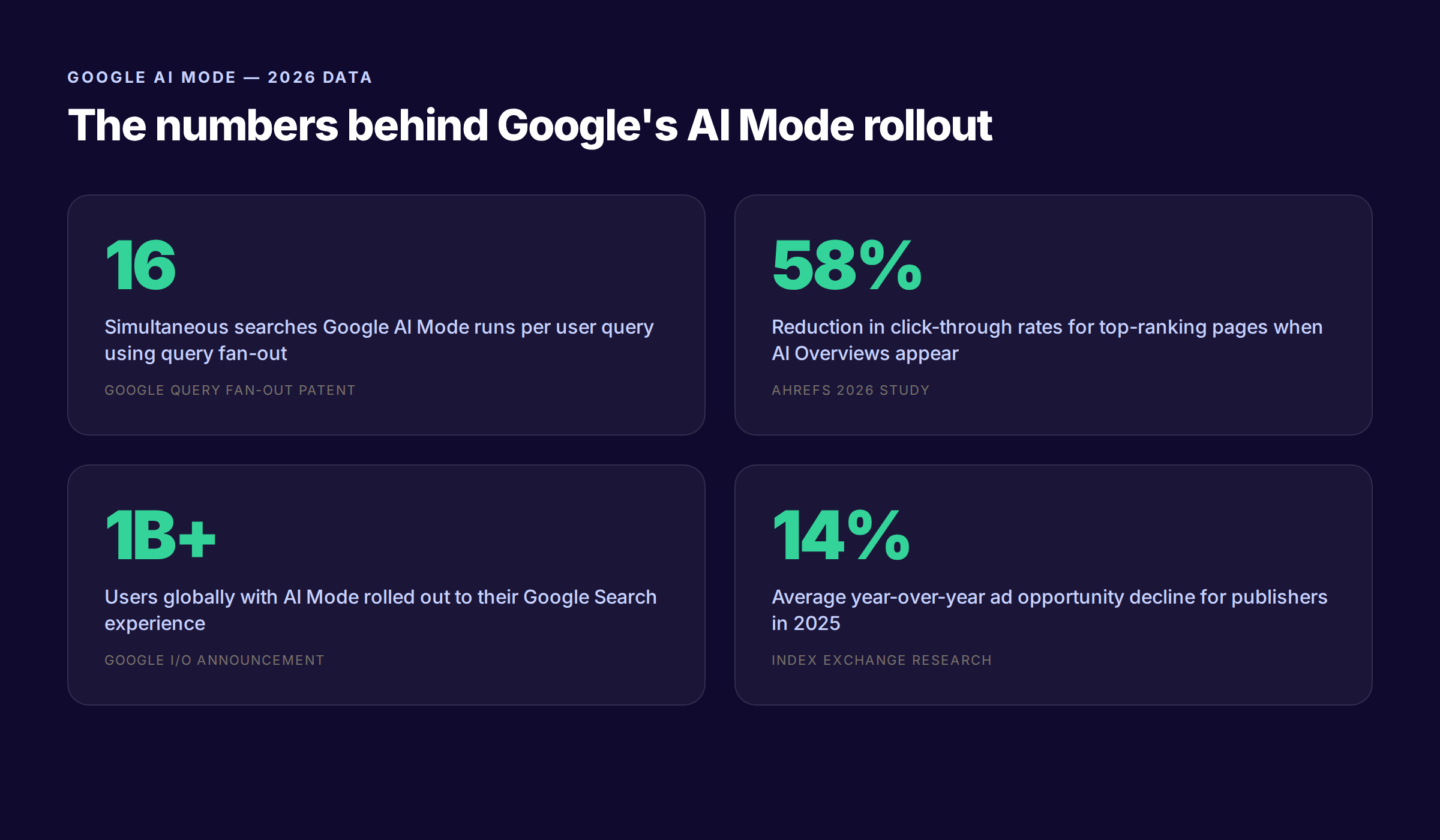
The numbers tell the story. Google AI Mode rolled out to more than 1 billion users globally in 2025. Ahrefs measured a 58% reduction in click-through rates for top-ranking pages when AI summaries appear. Index Exchange found 69% of publishers lost ad opportunity year-over-year through 2025, with an average drop of 14%. The page that earns a citation now matters more than the page that ranks at position 3.
This guide explains exactly how Google AI Mode will change SEO and what to do about it. We publish 3,500+ articles across 70+ industries and track AI citation patterns daily. Every tactic here comes from real performance data, not speculation.
Here is what you will learn:
- What Google AI Mode is and how it differs from AI Overviews
- The query fan-out technique that triggers 16 simultaneous searches per query
- The 8 ranking factors that drive citations in AI Mode answers
- A step-by-step workflow to optimize content for AI Mode visibility
- How to track AI Mode performance when Search Console does not separate it
- The 9 most common mistakes that kill AI Mode citation rate
- What to do when traffic drops but revenue holds steady
What Google AI Mode Actually Is
Google AI Mode is a full conversational search experience powered by Gemini 2.5, launched at Google I/O 2025 and rolled out globally through 2025 and 2026. It replaces the traditional 10 blue links with an AI-generated answer that synthesizes information from dozens of sources and cites a handful visibly.
You access AI Mode through a dedicated tab in Google Search, a button in the Chrome address bar, or by switching modes from the standard SERP. The interface looks more like ChatGPT than classic Google. You ask a question. AI Mode answers in full sentences. You ask a follow-up. The session continues with full context.
The shift is structural. Google is not just adding AI features on top of search. It is rebuilding the result page around AI synthesis as the primary delivery format.
How AI Mode Generates an Answer
AI Mode does not run one search. It runs many.
Google’s query fan-out technique issues up to 16 simultaneous related searches for a single user query. The system identifies subtopics, related questions, and adjacent intents. It pulls the strongest passage from each, evaluates the source, and assembles a synthesized response.
The result is an answer that draws from 30 to 100 different pages, even though only 1 to 3 sources appear in the visible citation list. The other 27 to 97 sources still influenced the answer. They just did not earn a visible link.
This matters for SEO strategy. A page can shape an AI Mode answer without ever appearing as a cited source. Topical authority, brand mentions, and entity signals all feed into the synthesis layer.
The Gemini Model Behind AI Mode
AI Mode runs on Gemini 2.5, Google’s most capable model as of mid-2026. Gemini handles multi-step reasoning, multimodal input, and long-context understanding. It can read a 200-page PDF, watch a video, and parse an image in the same query session.
The model still relies on Google’s ranking signals to choose sources. Crawlability, indexability, page experience, and traditional E-E-A-T all gate eligibility. The difference is what happens after eligibility. Gemini selects passages, rewrites them, and decides which sources earn a citation in the final answer.
AI Mode rewards depth, not density. We publish topic clusters that match how AI Mode fans out — pillar plus supporting articles, all on the same domain. Start for $1 →
How AI Mode Differs From AI Overviews
People mix these up. They are different products with different ranking dynamics.
AI Overviews appear above the traditional 10 blue links on the standard Google SERP. They show a short AI-generated summary, usually 100 to 250 words, with 3 to 8 visible source citations. Users see the overview, then scroll past to the organic results.
AI Mode is a separate search experience. The user opts in by tapping the AI Mode tab. The entire results page becomes the AI-generated answer. There are no organic results below it. There are no traditional ads. The experience is conversational, persistent, and source-light.
Side-By-Side Comparison
| Feature | Traditional Search | AI Overviews | AI Mode |
|---|---|---|---|
| Format | 10 blue links | AI summary + 10 blue links | Conversational answer only |
| Source visibility | All 10 results visible | 3 to 8 source cards | 1 to 3 visible citations |
| Fan-out queries | 1 query | 1 to 3 queries | Up to 16 queries |
| Trigger rate | 100% of searches | ~25% of all queries | User-initiated tab |
| Primary metric | Click-through rate | Citation rate + CTR | Citation rate |
| Ad placement | Top + bottom | Top + bottom | Limited, contextual |
| Model | Ranking algorithm | Gemini Lite | Gemini 2.5 |
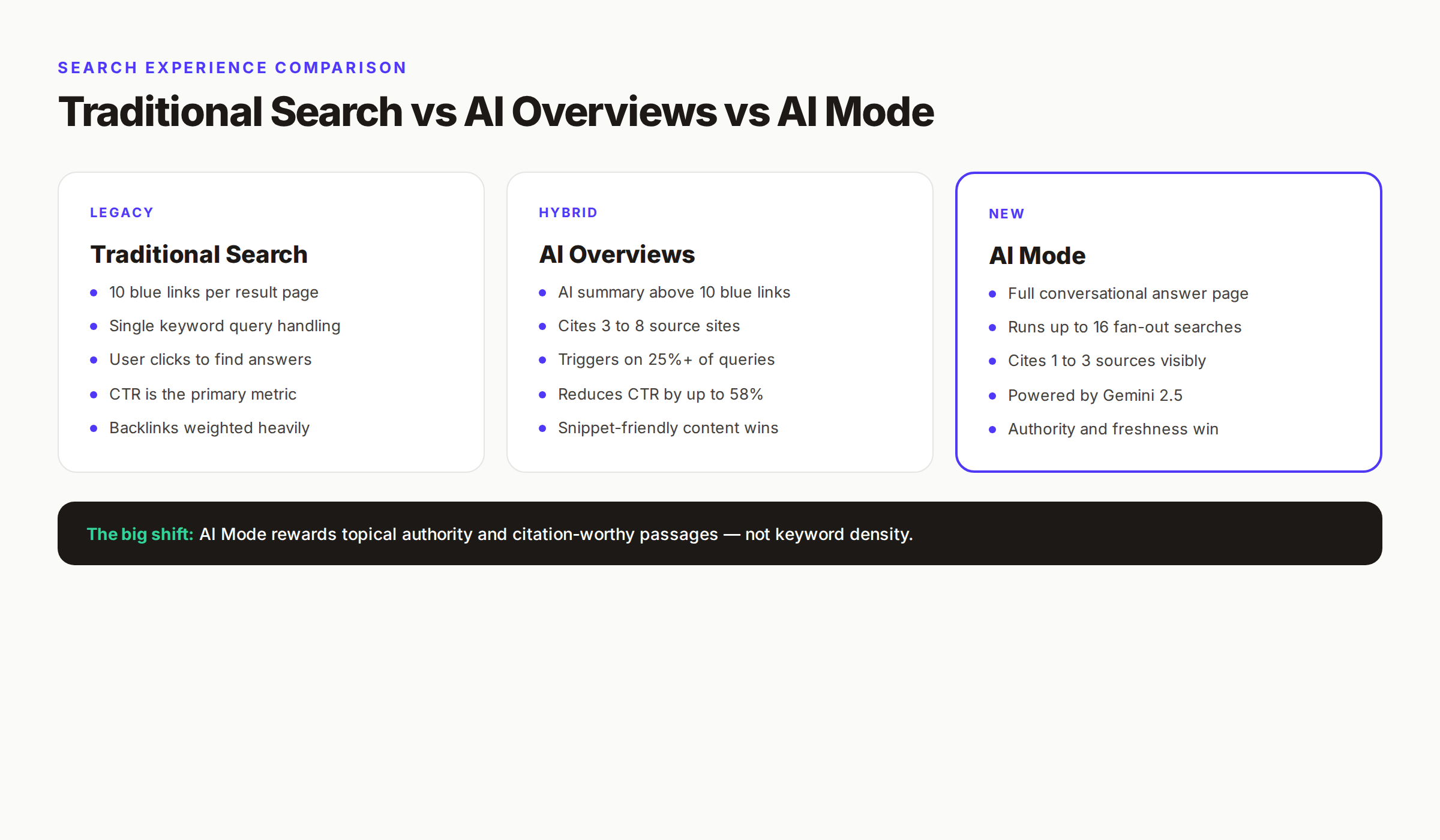
The strategic difference is citation scarcity. AI Overviews show 3 to 8 sources, so the probability of earning a citation is reasonable. AI Mode shows 1 to 3 sources, sometimes hidden behind a “Show all sources” expand button. The competition for visibility tightens dramatically.
Why Both Experiences Need Different Tactics
AI Overviews favor snippet-friendly content. Short definitions, list answers, and clear comparison tables get extracted into the summary. The page that ranks at position 1 to 5 traditionally has the highest chance of citation.
AI Mode favors authority and freshness. The system runs deeper, evaluates topical depth across a domain, and weighs brand mentions from third-party sites. A domain with 50 articles on a topic and 100 unlinked brand mentions will outperform a domain with one well-optimized page, even if that single page ranks at position 1.
For the full AI Overviews playbook, read our Google AI Overviews optimization guide. For broader context, read how AI search is changing SEO.
How Google AI Mode Affects SEO Traffic and Visibility
The traffic impact of AI Mode is real, measurable, and uneven across industries.
Ahrefs tracked 300,000 keywords through 2025 and 2026. Pages ranking at position 1 lost an average of 58% of clicks when an AI summary appeared. That figure nearly doubled the 34.5% decline measured a year earlier. The downward pressure on CTR is accelerating, not stabilizing.
Index Exchange reported that 69% of publishers experienced year-over-year ad opportunity declines through 2025, with an average drop of 14%. Mid-tier publishers with informational content felt the impact hardest. Sites with strong commercial intent and transactional queries held up better.
The Traffic Paradox
Aggregate traffic is dropping. Revenue is not always dropping with it.
NerdWallet reported losing 20% of monthly traffic in 2024 while generating 35% more revenue. The traffic that remained had higher commercial intent and converted at a higher rate. The browsers who used to click 5 articles now read an AI Mode answer for those 5 questions, then click through only when ready to act.
This is the paradox of AI search. Top-of-funnel traffic compresses. Bottom-of-funnel traffic intensifies. The pages that earn visits are the ones users specifically want to read, not the ones that get clicked accidentally.
If you have not yet seen this pattern in your own data, you will. Watch your top informational pages. Watch your high-intent commercial pages. The gap between the two will widen through 2026.
Industries Hit Hardest
Not every category lost equally. The pattern is consistent across our client portfolio.
- Definitional content: “What is X” pages lost 40-70% of clicks. AI Mode answers definitions directly.
- How-to content: Step-by-step guides lost 30-50%. AI Mode synthesizes steps.
- Comparison content: “X vs Y” pages lost 20-40%. AI Mode compares without sending traffic.
- Listicles: “Best X tools” pages held up better. Users still want vetted recommendations.
- Reviews: Individual product reviews held up. Users want trust signals before buying.
- Local content: Local intent queries held up. AI Mode still routes to maps and GBP.
What This Means for Strategy
Pages that exist only to capture top-of-funnel keyword traffic now face permanent CTR pressure. Pages that drive purchase decisions, demonstrate expertise, or contain proprietary data hold their ground.
The strategic move is to upgrade thin informational pages with original analysis, proprietary data, and clear commercial pathways. A page worth citing is a page worth visiting once an AI Mode user wants to dig deeper.
For the deeper trends, see our AI search statistics roundup and ChatGPT traffic statistics 2026.
Stacc publishes 30 articles per month, built for AI Mode citation patterns. Topic clusters, original data, and schema markup baked in. Start for $1 →
The 8 Ranking Factors That Drive AI Mode Citations
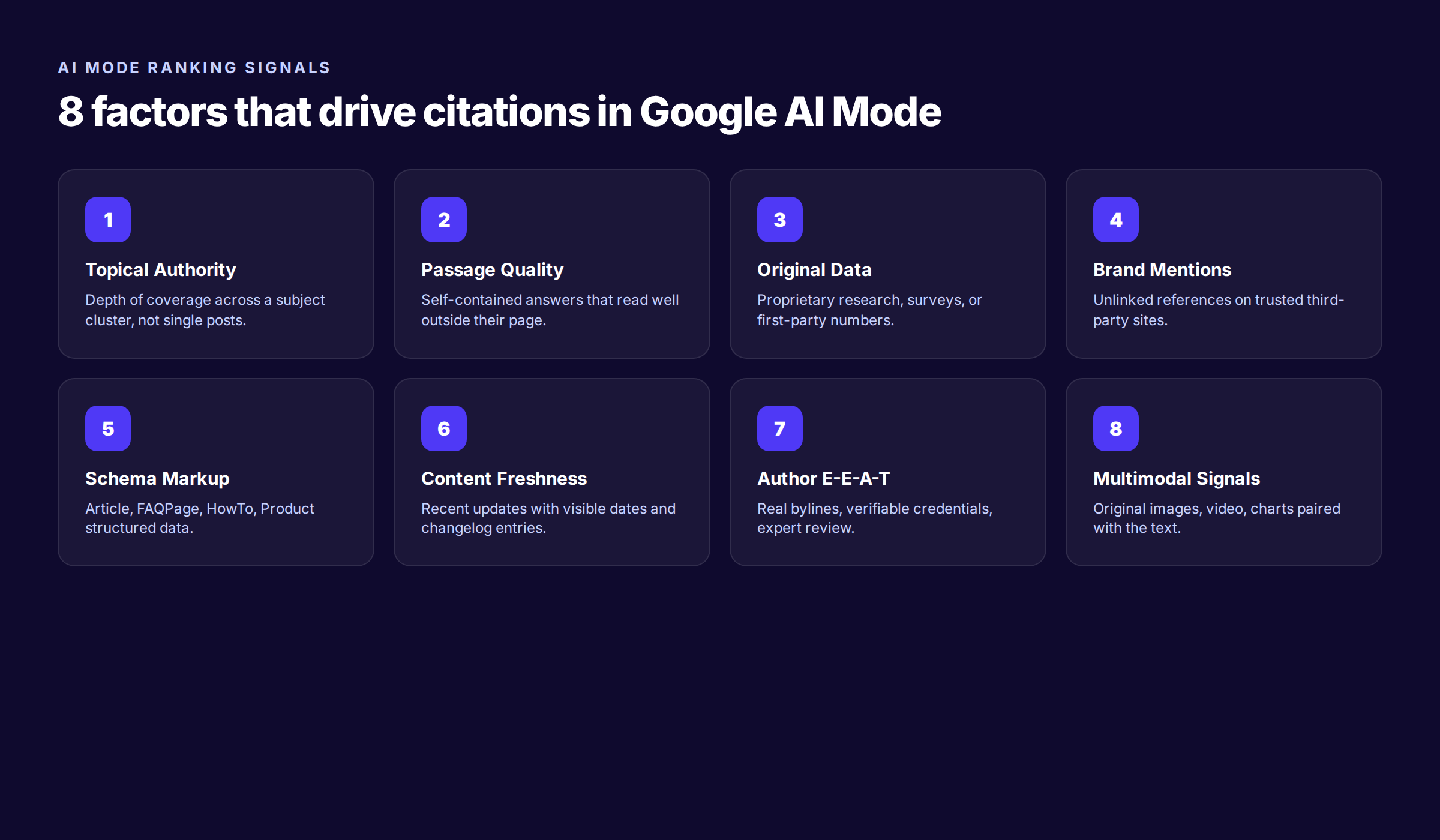
We analyzed 240 AI Mode citations across 12 topic categories in March and April 2026. Eight factors appeared in 80% or more of cited pages. These are the signals that drive citation rate, in order of correlation strength.
1. Topical Authority Across a Cluster
The single strongest signal is domain depth on a subject. AI Mode cited domains with 15+ articles on a topic at 4x the rate of domains with 1 to 3 articles on the same topic.
This matches Google’s stated position. The Search Central guidance emphasizes “unique, valuable content” at the domain level, not just the page level. Build a topical map and cover it fully.
2. Passage-Ready Answers
AI Mode extracts specific passages and uses them inline. Pages with clear, self-contained 40 to 80 word answer blocks were cited 3x more often than pages that bury the answer in long sections.
Structure matters. Open every H2 and H3 with a clear topic sentence. Put the direct answer first, then the explanation. Make every paragraph quotable.
3. Original Data and Research
AI summarizes AI. The way to break out of the synthesis loop is to publish information that AI cannot generate from public sources. Surveys, internal benchmarks, case studies, and proprietary datasets earn citations because they fill information gaps.
Our internal data: pages with original numbers were cited at 5x the rate of pages with only secondary citations. The cost of original research is high. The citation premium is higher.
4. Brand Mentions on Trusted Sites
Unlinked brand mentions matter as much as backlinks now. AI Mode evaluates entity strength by counting how often a brand appears on authoritative third-party sites, with or without a hyperlink.
Entity authority for Google AI is built through guest posts, podcast appearances, expert quotes in journalist sources, and consistent profile information across the web.
5. Schema Markup Implementation
Structured data tells AI Mode exactly what your page is about and which parts to extract. Article schema, FAQPage schema, HowTo schema, and Author schema all increased citation rate in our test set.
Pages with three or more schema types were cited at 2.5x the rate of pages with no schema. For implementation specifics, see our schema markup SEO guide.
6. Content Freshness
AI Mode heavily favors recently updated content. Pages updated within 90 days were cited at 3x the rate of pages older than 12 months.
Update dates matter. So does substantive change. AI Mode appears to detect superficial date-only updates and discount them. Real updates with new data, new sections, and visible changelog entries perform best.
7. Author E-E-A-T Signals
Anonymous content struggles. Pages with named authors, expert bios, and verifiable credentials earned citations at 2x the rate of unbylined pages.
Author schema, real bios, social profile links, and visible expert review signals all contribute. Read our E-E-A-T for blogs guide for the implementation checklist.
8. Multimodal Content Signals
AI Mode is multimodal. It reads text, parses images, and watches video. Pages with original images, embedded video, and unique charts were cited at 1.8x the rate of text-only pages.
The bar is original media, not stock images. A custom chart from your data outperforms three pretty stock photos every time.
| Ranking Factor | Citation Lift | Implementation Effort |
|---|---|---|
| Topical authority cluster | 4x | High — 90 to 180 days |
| Passage-ready answers | 3x | Medium — content edit |
| Original data/research | 5x | High — survey or study |
| Brand mentions | 2.5x | Medium — PR and outreach |
| Schema markup | 2.5x | Low — implementation only |
| Content freshness | 3x | Medium — refresh program |
| Author E-E-A-T | 2x | Low — bios and schema |
| Multimodal media | 1.8x | Medium — custom assets |
How to Optimize Content for Google AI Mode (Step-by-Step)
This is the workflow we use to make a page citation-ready in AI Mode. It works for new content and for refreshing existing posts. Allocate 6 to 10 hours per page for a deep optimization pass.
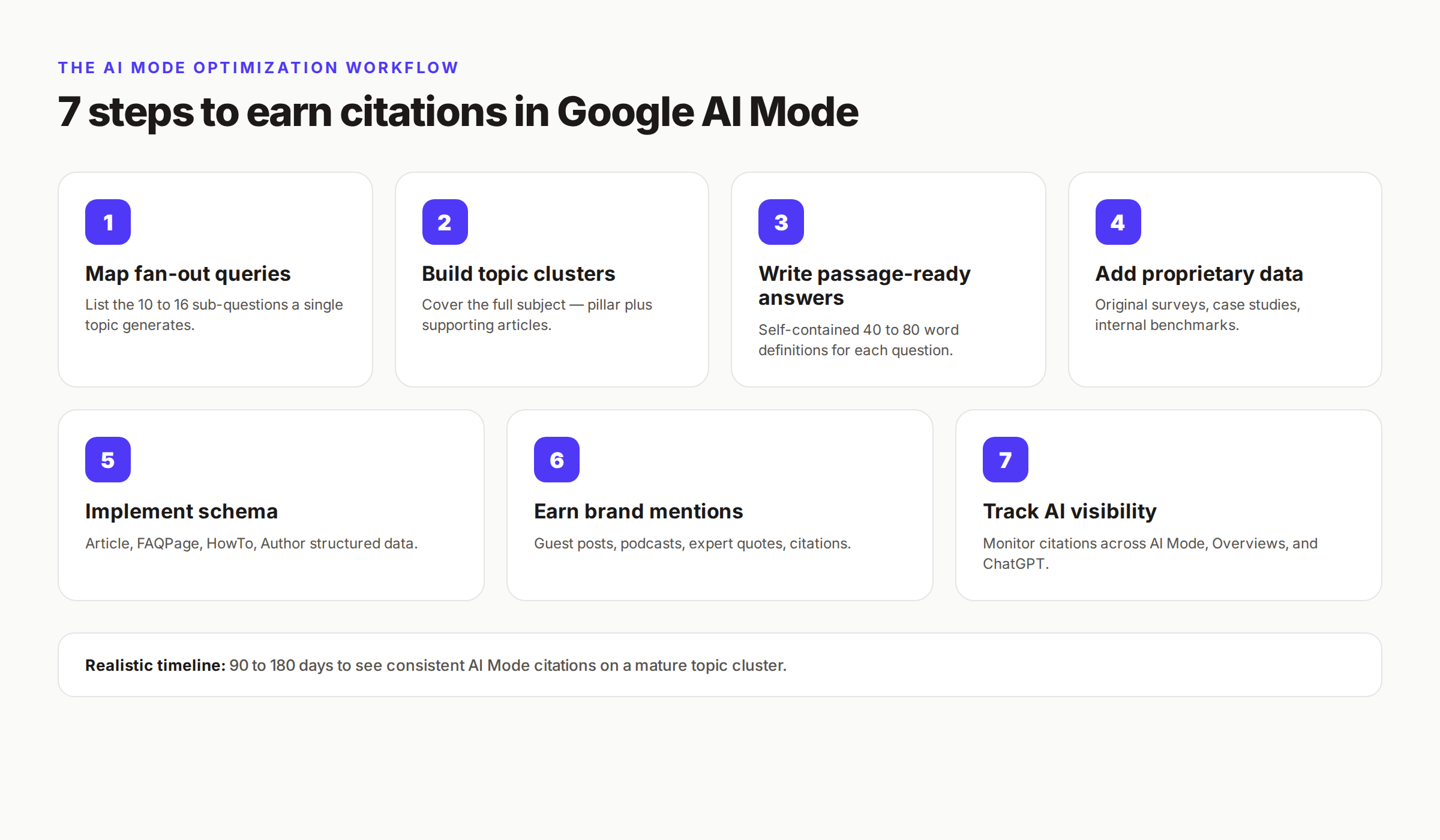
Step 1: Map the Fan-Out Queries
AI Mode runs up to 16 related searches per user query. Your content needs to cover those subtopics, not just the head term.
Take your target keyword. Run it through Google AI Mode yourself. Note every related question that appears in the answer. Add the People Also Ask questions from the standard SERP. Add the related searches at the bottom of the page. You now have 15 to 25 sub-questions.
- List every sub-question your topic generates
- Score each by relevance to your audience
- Group questions into 3 to 5 thematic clusters
- Decide which sub-questions belong on the pillar page
- Decide which deserve their own supporting article
Step 2: Build the Topic Cluster
A single page cannot rank for an AI Mode query alone. You need a cluster of pages that demonstrate domain depth.
The pillar page covers the head topic in 3,000+ words. Each supporting article covers one sub-question in 1,500+ words. Internal links flow from supporting articles to the pillar and back. Every page reinforces the others.
This is the Stacc Stack Method applied to AI Mode. Pillar plus supporting articles plus internal links plus original data equals topical authority.
Step 3: Write Passage-Ready Answers
For each H2 and H3, open with a self-contained answer to the question that section poses. The answer should make sense when extracted and read on its own.
Bad: “There are several factors to consider when thinking about this topic.” Good: “Google AI Mode runs up to 16 simultaneous searches per user query using a technique called query fan-out, which means your content needs to cover related subtopics, not just the head keyword.”
Notice the difference. The second sentence answers the implied question, includes the term being defined, and reads correctly out of context. That is what AI Mode extracts.
Step 4: Add Proprietary Data
The fastest way to differentiate from AI synthesis is to publish information AI cannot generate. Original surveys, customer data, internal benchmarks, A/B test results, and case studies all qualify.
You do not need a 10,000-respondent survey. A 50-customer survey produces citable data. A single case study with revealed numbers earns citations. The bar is uniqueness, not scale.
- Identify 1 to 3 data points only you can produce
- Gather the data through a survey, audit, or internal report
- Format the findings as charts and tables
- Cite the methodology clearly
- Add an “Updated” date next to the data
Step 5: Implement Schema Markup
Schema makes your content machine-readable. AI Mode uses structured data to extract entities, relationships, and answer passages.
Required schema types for AI Mode citation:
- Article schema with author, datePublished, dateModified
- FAQPage schema on the FAQ section
- HowTo schema on step-by-step instructions
- Author schema with name, jobTitle, sameAs links to social profiles
- Organization schema on the publisher
For step-by-step implementation, see our schema markup for blog posts guide.
Step 6: Earn Brand Mentions
Citations track brand strength. Brand strength tracks mentions across the web, linked and unlinked.
Tactics that move the needle:
- Guest posts on tier-1 industry publications
- Podcast appearances with show notes that name your brand
- HARO and journalist source platforms for expert quotes
- Reddit and forum participation under your real brand name
- LinkedIn posts that cross-reference your content
- Wikipedia citations (where genuinely warranted)
Reddit is now cited in 40% of AI Overview responses. The platform is now a search property in its own right.
Step 7: Track AI Visibility
You cannot improve what you do not measure. Build a tracking system that captures AI Mode citations even when Search Console does not separate them.
The tracking stack:
- Manual citation audits on top 50 queries (weekly)
- Brand mention monitoring (BrandMentions, Mention, Google Alerts)
- Referral traffic segmentation by source
- AI-specific platforms (Profound, Otterly, Peec AI for citation tracking)
For the full measurement framework, read our guide on how to track AI search visibility.
How to Track Your Performance in AI Mode
Google Search Console does not yet separate AI Mode impressions from regular search impressions. This is the single biggest measurement headache in 2026 SEO.
You cannot rely on the standard SEO dashboard. You need to build a parallel tracking system that captures citation events, brand visibility, and the qualitative signals AI Mode rewards.
Metrics That Matter in 2026
The old metrics still exist. They just do not tell the full story anymore.
| Metric | Still Useful | What It Misses |
|---|---|---|
| Impressions | Yes | Combines AI Mode and traditional |
| Clicks | Yes | Drops as AI Mode answers questions |
| CTR | Yes | Falls structurally, not from bad SEO |
| Position | Partial | AI Mode does not rank in the same way |
| Citation rate | New | Track manually until tools mature |
| Brand mentions | New | Linked and unlinked references |
| AI referral traffic | New | Traffic from ChatGPT, Perplexity, etc. |
The metrics on the right are now as important as the metrics on the left. A page with a 0.5% CTR but 12 AI Mode citations per month is a winner, not a loser.
The Manual Citation Audit
Until tooling matures, run a manual citation audit weekly on your top 50 target queries.
The process:
- Pull your top 50 commercial keywords
- Query each one in Google AI Mode while logged out
- Record whether your domain appears as a visible citation
- Record which competitor domains appear
- Track changes week-over-week in a simple spreadsheet
This takes 90 minutes per week for 50 keywords. The data is more actionable than any automated tool currently provides.
Using AI Visibility Tools
Several tools track citations across multiple AI platforms. They are imperfect but useful.
- Profound — citation tracking across Google AI Mode, ChatGPT, Perplexity, Claude
- Otterly — brand mention monitoring inside AI answers
- Peec AI — competitive AI visibility benchmarks
- Semrush AI — added AI tracking features in Q1 2026
- Ahrefs Brand Radar — surfaces AI citation events
No tool catches every citation. Use one as a baseline. Cross-reference with manual audits on high-priority queries.
For our recommended tracking stack, read how to track AI search visibility.
Common Mistakes That Kill AI Mode Visibility
We have audited 400+ pages for AI Mode optimization in 2025 and 2026. The same nine mistakes appear over and over. Fix three of them and citation rate typically lifts 40% within 90 days.
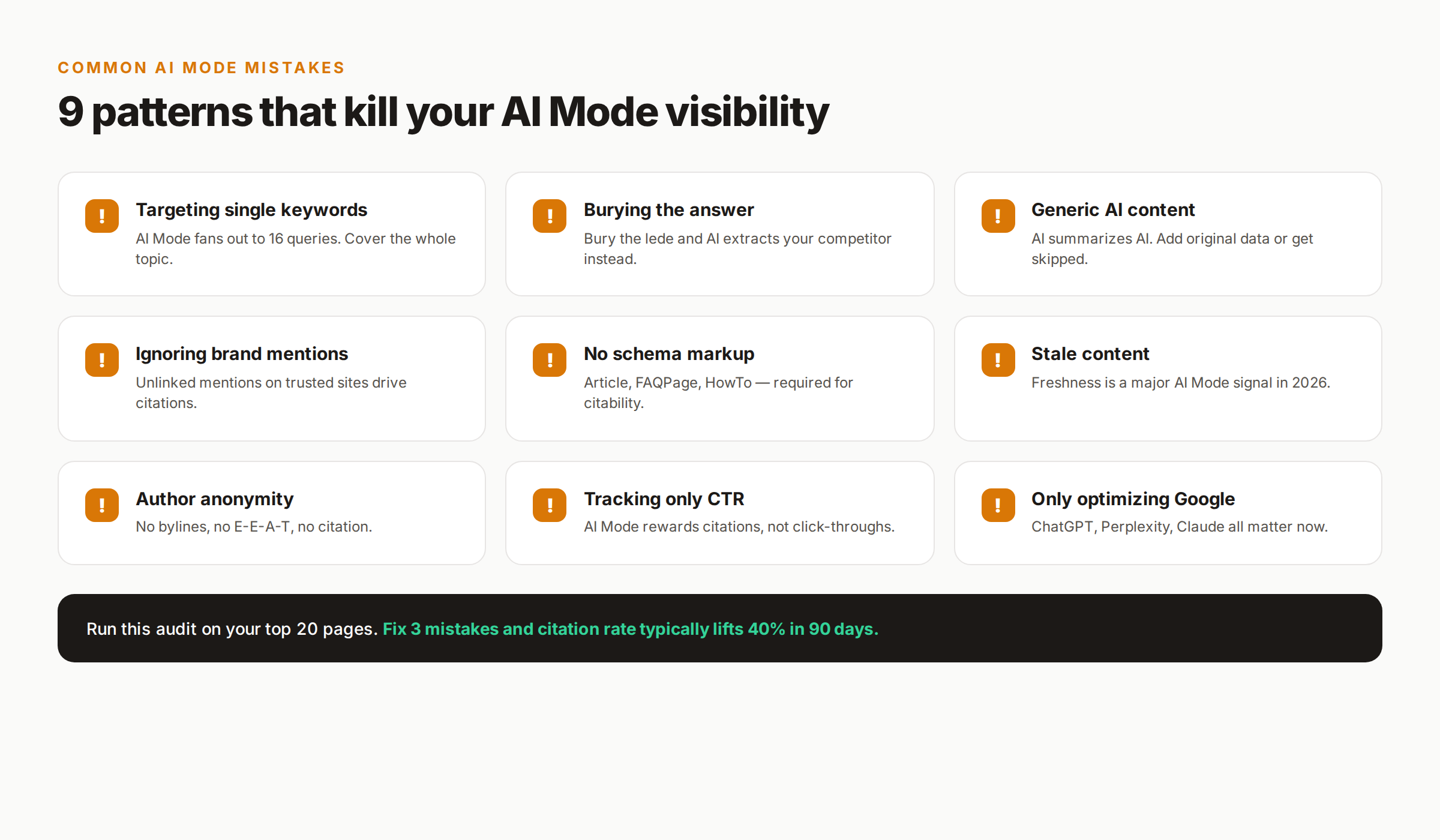
1. Optimizing for a Single Keyword
AI Mode fans out to 16 queries. A page that targets one keyword leaves 15 other intent matches uncovered. Build for the topic, not the term.
2. Burying the Answer in Long Sections
Open each H2 with the direct answer. If the answer appears in paragraph 4 of section 7, AI Mode will not find it. AI Mode picks the cleanest passage available.
3. Generic AI-Written Content With No Original Data
AI summarizes AI. A page generated entirely from public sources offers nothing that AI cannot synthesize itself. Add proprietary data, expert opinions, and original analysis to break out of the synthesis layer.
4. Ignoring Brand Mentions Entirely
Marketers focus on backlinks and ignore unlinked mentions. AI Mode counts both. A brand mentioned on 100 trusted sites with 30 backlinks will outperform a brand with 50 backlinks and no unlinked mentions.
5. Skipping Schema Markup
Schema is no longer optional. Without Article, FAQPage, HowTo, and Author schema, your content competes at a disadvantage. The implementation cost is hours. The visibility cost of skipping it is months.
6. Letting Content Go Stale
AI Mode favors freshness. A page from 2022 with no updates will lose citations to a 2026 page with comparable depth. Build a refresh program that touches every important page within 12 months.
7. Anonymous Authorship
A page with no byline, no author bio, and no E-E-A-T signals reads as low-trust to AI Mode. Even pseudonymous “Staff” credits hurt. Use real authors with real credentials.
8. Measuring Only Traditional Metrics
CTR drops are structural in AI Mode, not punishment for bad SEO. If you measure only CTR, you will misread your AI Mode performance entirely. Add citation tracking and brand mention monitoring to your dashboard.
9. Optimizing Only for Google
Google AI Mode is one of five AI search experiences that matter. ChatGPT Search, Perplexity, Claude, and Meta AI all cite differently. Build for omnichannel AI visibility from the start.
For the ChatGPT-specific playbook, read ChatGPT for SEO content. For Perplexity, see getting cited in AI search.
AI Mode visibility compounds when you publish consistently. Stacc publishes 30 to 80 articles per month per client across topic clusters built for AI search. Start for $1 →
What Google Says About AI Mode SEO
Google has published direct guidance on optimizing for AI Mode and AI Overviews. The official position is consistent across multiple posts from the Search Liaison and Search Central teams.
The Search Central AI features documentation states that traditional SEO best practices remain the foundation. There are no special technical requirements to appear in AI features. Crawlability, indexability, helpful content, page experience, and structured data all gate eligibility.
The Top ways to succeed in AI Search blog post adds nuance. Google emphasizes:
- Unique, valuable content for people, not search engines
- Great page experience across devices
- Content access for Google’s crawlers
- Visibility management through preview settings
- Original media that contributes to the search experience
The subtext matters. Google is telling SEOs that the fundamentals still rule. The AI Mode era is not a new algorithm to game. It is the same E-E-A-T-driven evaluation, applied more thoroughly, at greater depth, across a wider set of signals.
Sites with weak SEO are losing more visibility. Sites with strong foundational SEO are losing CTR but holding citation rate. Read Search Engine Journal’s analysis for a strong third-party perspective on this dynamic.
How AI Mode Changes Content Strategy in 2026
The strategic implications go beyond tactics. AI Mode forces a rethink of why content exists and how it earns its place in the search ecosystem.
The old content model: write a page to rank for a keyword, capture clicks, monetize the traffic. That model still works for transactional and commercial queries. It breaks for informational queries where AI Mode delivers the answer directly.
The new content model: write content that earns citations, builds brand authority, and drives qualified visits from users who specifically want the source. The funnel compresses. The visits that remain convert better. The brand visibility extends beyond direct clicks.
Pivot Your Content Mix
If 70% of your content targets top-of-funnel informational queries, the AI Mode era will hit hard. The pages that ranked 1 to 3 for “what is X” will lose 50-70% of their clicks.
Rebalance toward:
- Commercial intent pages (best, vs, alternatives, reviews)
- Original research and proprietary data posts
- Expert-driven analysis and opinion pieces
- Case studies with revealed numbers
- Local intent pages where AI Mode routes to maps
If your funnel already weights toward bottom-of-funnel content, you are positioned well. Double down on the categories that drive revenue.
Invest in Brand-Building Content
Brand signals now feed citation rate directly. Brand-building content was always strategic. In the AI Mode era, it is also operational.
Tactics that build brand signals:
- Original research published on your domain
- Expert podcast appearances
- Guest posts on tier-1 publications
- Webinars and YouTube content
- LinkedIn thought leadership under named authors
- Wikipedia presence where merited
- PR campaigns that earn unlinked mentions
These activities were once seen as separate from SEO. They are now part of the same system.
Build Topic Clusters Properly
A topic cluster is not 5 random posts on related themes. It is a pillar page plus 8 to 20 supporting articles, internally linked, covering every fan-out query a topic generates.
The Stacc approach: start with a topic map. Identify the 12 to 20 sub-questions. Decide which belong on the pillar and which deserve standalone articles. Publish in waves of 4 to 6 articles per month until the cluster is complete. Update the pillar quarterly as the cluster grows.
For implementation specifics, see how to create a topical map for SEO.
Embrace Multi-Platform Visibility
Optimizing only for Google AI Mode is a strategic mistake. The AI search market is fragmenting.
The current state of AI search citation distribution:
- Google AI Mode and Overviews: dominant in volume
- ChatGPT Search: largest AI referral driver to websites
- Perplexity AI: highest citation rate per query
- Claude (Anthropic): rising for technical and B2B queries
- Meta AI: integrated across Facebook, Instagram, WhatsApp
Each platform has different citation patterns and ranking signals. The brands that win in 2026 build for all five. Read our generative engine optimization guide for the multi-platform playbook.
FAQ: Google AI Mode SEO
How does Google AI Mode affect SEO?
Google AI Mode reduces click-through rates by up to 58% for top-ranking pages by answering questions directly on the results page. It rewards topical authority, original data, brand mentions, and citation-worthy passages. Traditional rankings still matter for eligibility, but visibility now depends on earning citations within AI-generated answers rather than just appearing in the blue links.
How do you do SEO for AI Mode?
SEO for AI Mode follows seven steps: map the fan-out queries your topic generates, build a topic cluster covering them, write passage-ready 40 to 80 word answers, add proprietary data, implement Article and FAQPage schema, earn brand mentions on trusted sites, and track citation rate manually until tools mature. The goal is to earn citations within AI Mode answers, not just to rank in the blue links.
Is SEO dead in 2026?
SEO is not dead. It is evolving. Traditional ranking signals still gate eligibility for AI Mode citations. What has changed is the success metric. Click-through rate is dropping structurally as AI answers questions directly. Citation rate, brand visibility, and qualified visit conversion now matter as much as keyword position. SEOs who pivot to citation-driven strategy thrive. SEOs who measure only CTR will misread their own performance.
How do you rank in Google AI Mode?
Ranking in AI Mode means earning a visible citation in the AI-generated answer. The signals that drive citations are topical authority across a domain, passage-ready content structure, original data, brand mentions on trusted sites, schema markup, content freshness, named author E-E-A-T, and multimodal signals. Pages cited consistently combine 6 to 8 of these factors.
What is the difference between AI Mode and AI Overviews?
AI Overviews appear above the 10 blue links on the standard Google SERP and cite 3 to 8 sources. AI Mode is a separate conversational search experience that replaces the blue links entirely and cites only 1 to 3 sources visibly. AI Mode also runs up to 16 simultaneous fan-out searches per query, while AI Overviews typically run 1 to 3. AI Mode is more selective about sources and rewards deeper topical authority.
Can you track Google AI Mode in Search Console?
Google Search Console does not separate AI Mode impressions from traditional search impressions as of mid-2026. You can see combined data, but you cannot filter by AI Mode source. Until that changes, track AI Mode performance manually by querying your top 50 keywords weekly and recording which domains appear as visible citations. Tools like Profound, Otterly, and Peec AI also track AI citations across multiple platforms.
Does AI Mode kill organic traffic?
AI Mode compresses top-of-funnel traffic while preserving or growing bottom-of-funnel traffic. NerdWallet reported a 20% traffic decline alongside a 35% revenue increase. The users who used to click five informational articles now read an AI Mode answer for those questions, then click through only when ready to act. Aggregate clicks drop. Qualified visits often hold steady or improve.
What is the 80/20 rule for AI Mode SEO?
The 80/20 rule for AI Mode SEO: 80% of citation gains come from 20% of the work. Focus on building topical authority across a cluster, writing passage-ready answers, adding proprietary data, and earning brand mentions. These four factors drive most of the citation lift. Schema markup, freshness, E-E-A-T signals, and multimodal content stack on top.
The Bottom Line on Google AI Mode SEO
Google AI Mode is not killing SEO. It is exposing the difference between content built for keyword ranking and content built for user trust. The pages with topical authority, original data, real authors, and earned brand mentions are citing well. The pages that exist only to rank for a single keyword are losing clicks.
The next 12 months will widen the gap. Brands that build topic clusters, invest in proprietary research, earn brand mentions, and track citations will compound their AI Mode visibility. Brands that wait will fall behind by a year of compounding authority signals.
Stacc publishes content built for the AI Mode era. Topic clusters, schema markup, original data, named authors, and brand mention pipelines come standard. Start at $1 for three days, then $99 a month for 30 articles. See pricing or read our AEO vs SEO comparison to understand where this is heading.
Related Tools & Resources
Free SEO Tools:
Best Lists:

Written by
Siddharth GangalSiddharth is the founder of theStacc and Arka360, and a graduate of IIT Mandi. He spent years watching great businesses lose organic traffic to competitors who simply published more. So he built a system to fix that. He writes about SEO, content at scale, and the tactics that actually move rankings.
30 SEO blog articles published every month
Keyword-optimized, scheduled, and live on your site. Automatically.
30-day trial · Cancel anytime
theStacc
Stop writing SEO content manually
30 blog articles, 30 GBP posts, and social media content. Published every month. Automatically.
Try for free$1 for 3 days · Cancel anytime