
The Rise of AI Search: What It Means for SEO in 2026
The rise of AI search is reshaping how people find information. See the numbers, the playbook, and what comes next for SEO in 2026. Updated May 2026.
The rise of AI search is the most important shift in search since Google launched in 1998. In 24 months, ChatGPT grew from a research demo into a 900 million weekly user product. Perplexity tripled query volume. Google AI Overviews now appear on a majority of informational searches. Apple confirmed Google search volume declined for the first time in 22 years.
This is not a forecast. This is the current state of search.
The rise of AI search has already moved past the speculation phase. The data is in. User behavior changed. And every marketing team, SEO professional, and business owner now faces the same question: how do you stay visible when search engines stop sending traffic and start giving answers?
We publish 3,500+ articles per month across 70+ industries and track AI citation data in real time. This guide is built from that data. No predictions. No vendor talking points. Just what is happening and what to do about it.
Here is what you will learn:
- What the rise of AI search actually means in 2026
- The platforms driving the shift and how each one operates
- The statistics behind AI search adoption, growth, and conversion
- Why this shift is happening now and not 5 years ago
- How user behavior is changing across age groups and intents
- What the rise of AI search means for traditional SEO strategy
- The 6-part playbook to stay visible across both old and new search
- What comes next as search moves toward agentic AI
What the Rise of AI Search Actually Means
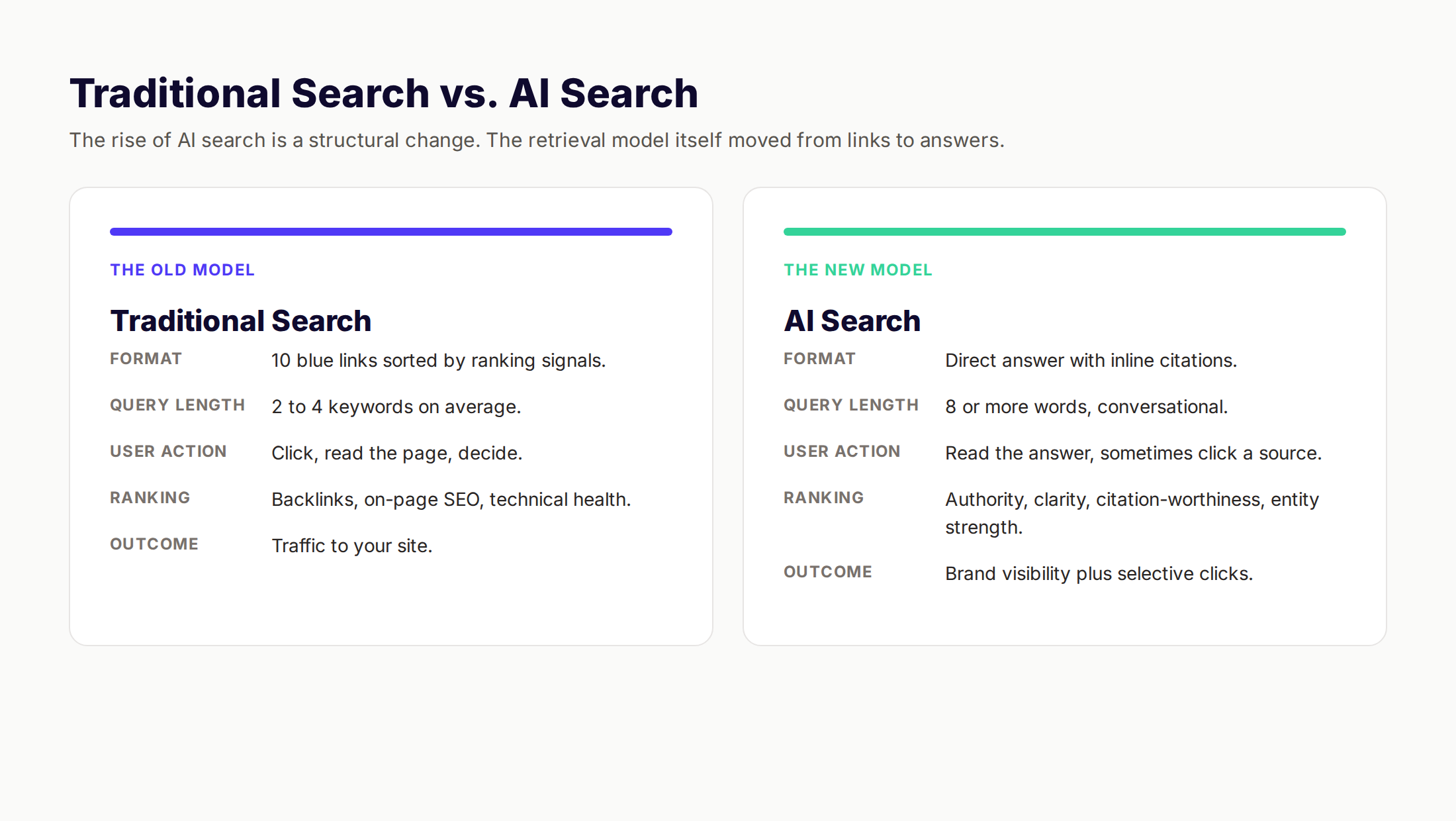
The rise of AI search is the move from retrieval to generation. Traditional search retrieves a list of pages. AI search generates a direct answer.
That single change cascades through every part of how people find information online. Query length grew. Click-through rates collapsed on certain query types. Ranking signals shifted. The competition is no longer for position 1. The competition is for being cited inside the answer itself.
From 10 Blue Links to a Single Paragraph
For 25 years, Google trained users to expect 10 blue links. You typed a query. You scanned the results. You clicked one. You read the page.
AI search collapses those 4 steps into 1. You type a question. The AI reads dozens of pages. You see a synthesized answer at the top of the screen. Sometimes you click a source. Often you do not.
Search Engine Land reports that 60 to 80 percent of searches with AI Overviews now end without a click, compared to roughly 60 percent for traditional search. The zero-click gap is widening every quarter.
The 4 Platforms Driving the Rise of AI Search
Four products dominate the current market. Each one operates differently and each one creates a distinct opportunity for visibility.
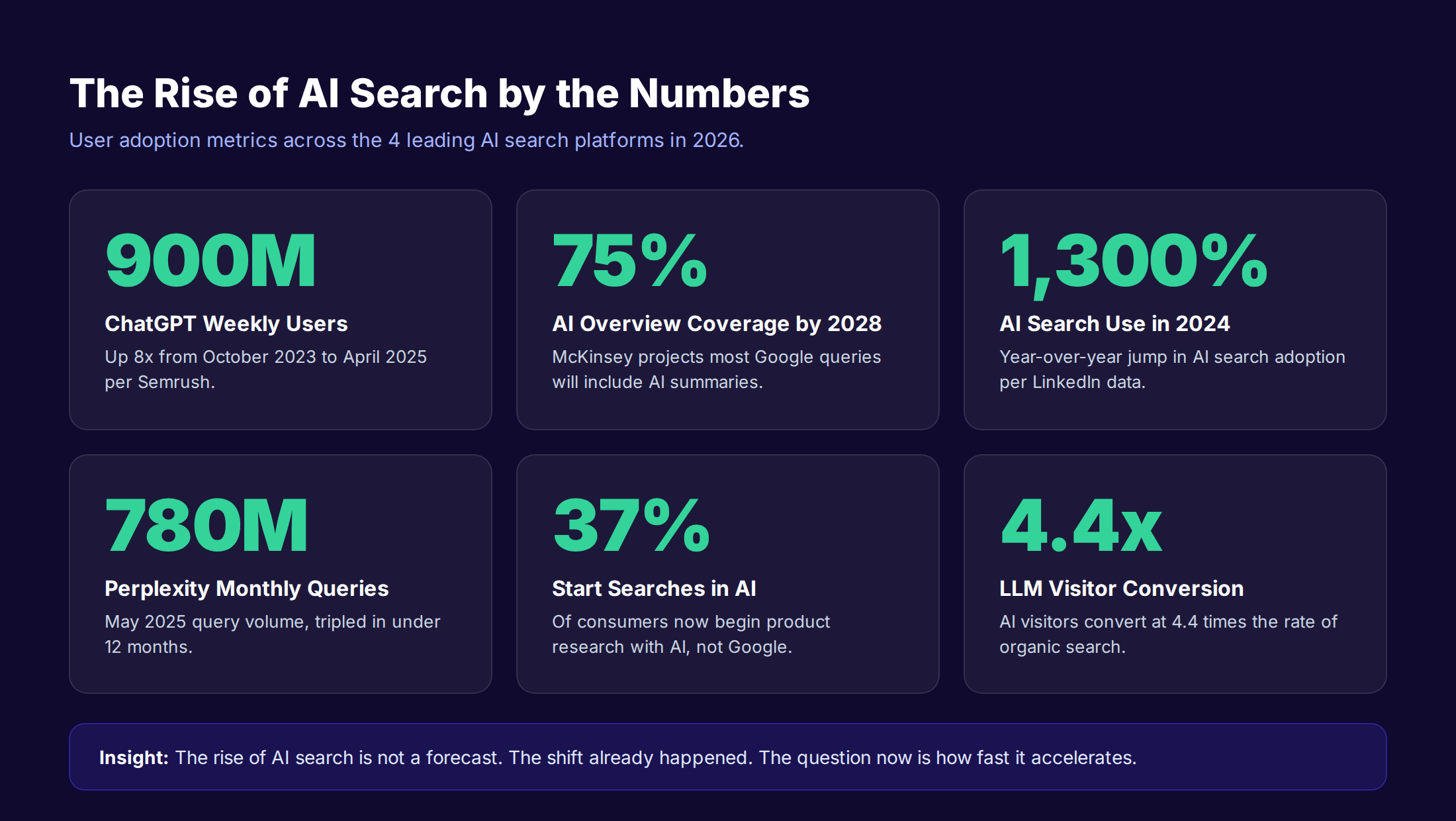
ChatGPT Search. OpenAI’s flagship product reached 900 million weekly active users by late 2025. ChatGPT drives the majority of AI referral traffic to websites. It cites sources inline. It also frequently surfaces pages that rank position 21 or lower in traditional search, which means a strong on-page SEO foundation is not enough.
Google AI Overviews. Google’s AI summaries now appear on around 25 percent of all searches and over 70 percent of informational queries. McKinsey projects AI summary coverage will reach more than 75 percent of Google searches by 2028. AI Overviews are inside the same SERP your team already optimizes for, but they answer above your link.
Perplexity AI. Perplexity processed 780 million queries in May 2025, triple the volume from 12 months earlier. Perplexity is built around source citation. Every answer shows the pages it drew from, which makes Perplexity the cleanest direct-traffic driver in the AI search ecosystem.
Google Gemini and Microsoft Copilot. Both products operate as conversational assistants layered on top of traditional search. Gemini is integrated across Google’s product suite. Copilot lives inside Bing, Edge, and Microsoft 365. Together they extend AI search into workflow software, not just standalone websites.
To understand how each platform changes SEO strategy, our team tracks citation patterns daily. The platforms behave differently. ChatGPT favors high-authority publishers. Perplexity rewards structured, fresh content. AI Overviews lean on traditional Google ranking signals plus extracted passages.
The Numbers Behind the Rise of AI Search
Statistics matter here because the rise of AI search is fast enough that intuition cannot keep up. The data tells a clearer story than any headline.
User Adoption Has Already Crossed the Tipping Point
| Platform | Key Metric | Source |
|---|---|---|
| ChatGPT | 900M weekly active users (8x growth in 18 months) | Semrush study |
| Perplexity | 780M monthly queries in May 2025 | Semrush study |
| Google AI Overviews | Present on 25% of all searches, 70%+ on informational queries | McKinsey analysis |
| AI search use, 2024 vs 2023 | Up 1,300% year over year | LinkedIn report |
| Consumers starting with AI | 37% now begin searches in AI, not Google | Search Engine Land |
These are not edge-case adopters. ChatGPT growth alone moved faster than any consumer product in history. It took Google about 10 years to reach a billion users. ChatGPT got there in roughly 3.
For full context across every platform, our AI search statistics post tracks more than 60 numbers with source links, refreshed monthly.
Conversion Rates Tell a Different Story
The traffic loss narrative misses the bigger point. AI search visitors convert at much higher rates than traditional search visitors.
Semrush reports that the average LLM visitor converts at 4.4 times the rate of a traditional organic search visitor. That number is not a fluke. AI search filters intent. By the time someone clicks through, they have already read the answer, evaluated the sources, and decided your page is worth a deeper look.
Lower volume. Higher quality. That is the trade-off the rise of AI search is forcing on every site.
Google’s Market Share Cracked in Late 2024
Apple confirmed in 2024 that Google search volume inside Safari declined for the first time in 22 years. Around the same time, Google’s global search market share dropped below 90 percent for the first time since 2015, according to multiple industry analyses.
Google did not collapse. The 14 billion daily searches did not stop. But the trend line bent for the first time in a generation. Some of that volume moved to ChatGPT. Some moved to Perplexity. Some moved to TikTok and Reddit for product research. The monolith cracked.
A Timeline of the Rise of AI Search
The rise of AI search did not happen overnight. It compressed into a sequence of distinct events between late 2022 and mid 2026.
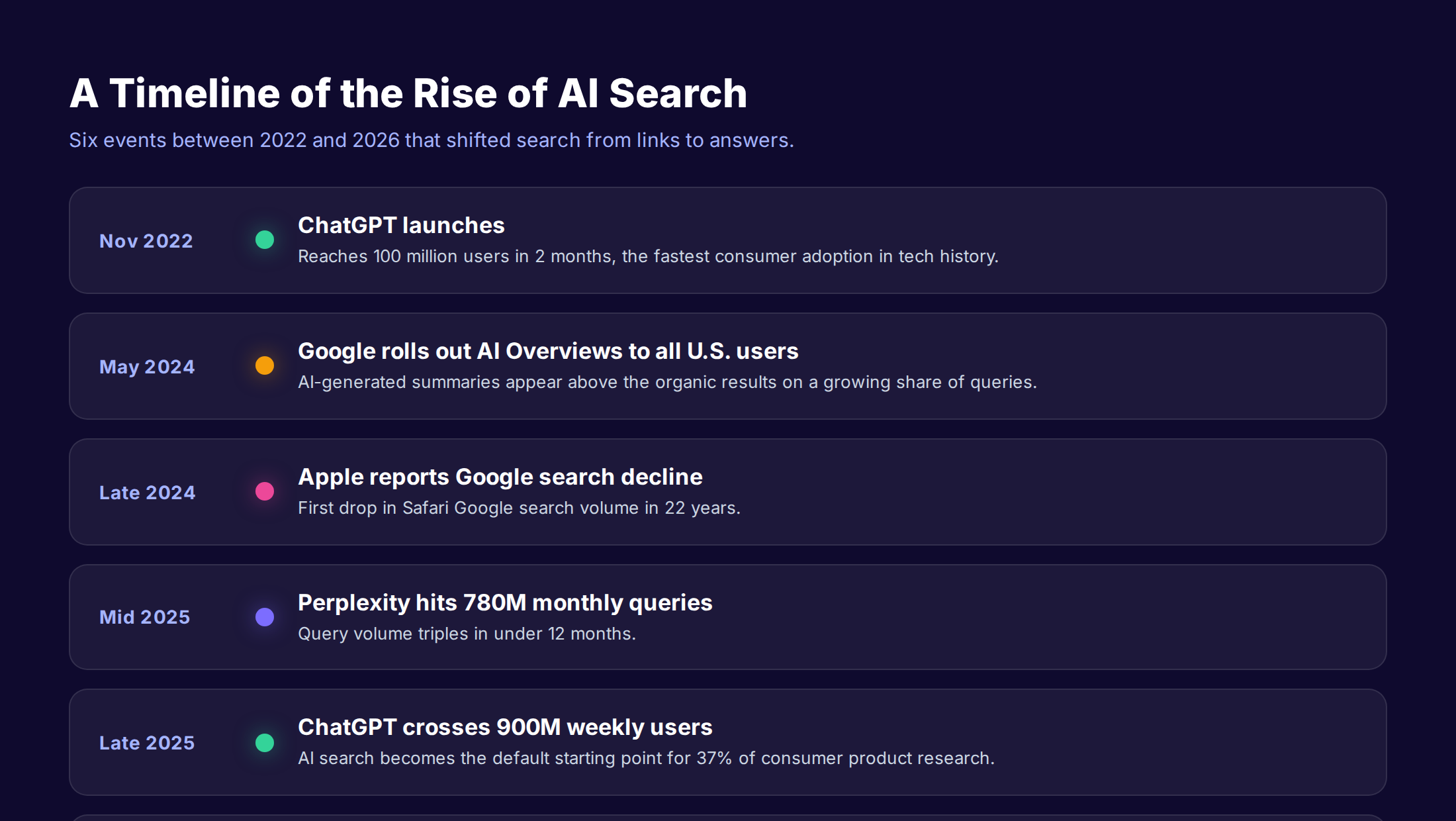
November 2022. OpenAI launches ChatGPT. The product reaches 100 million users in 2 months, the fastest consumer adoption in technology history. Google declares a code red.
May 2024. Google rolls out AI Overviews to all U.S. users. AI-generated summaries appear above organic results on a growing share of queries. The initial rollout draws criticism for hallucinations, but coverage expands every quarter.
Late 2024. Apple reports the first decline in Google search volume in 22 years. AI search use grows 1,300 percent year over year. Perplexity raises a billion dollars at a 9 billion dollar valuation.
Mid 2025. Perplexity hits 780 million monthly queries. ChatGPT Search launches as a standalone product. Semrush publishes a study projecting AI search visitors will surpass traditional search visitors by 2028.
Late 2025. ChatGPT crosses 900 million weekly active users. Search Engine Land reports that 37 percent of consumers now start product research in AI tools rather than Google.
2026. Google launches AI Mode globally. Anthropic, Meta, and Microsoft accelerate their own AI search products. The market is no longer a 2 horse race.
The pattern is consistent. Each phase compressed faster than the previous one. The rise of AI search now moves at a quarter-by-quarter pace, not a year-by-year pace.
AI search visibility starts with consistent, high-quality content. Stacc publishes 30 SEO articles per month across both traditional and AI search optimization. No writers. No managers. Just published. Start for $1 →
Why the Rise of AI Search Is Happening Right Now
The technology has existed for years. Transformer models were published in 2017. So why did the rise of AI search compress into a single 36 month window? Five forces converged.
1. Large Language Models Crossed a Quality Threshold
GPT-3 was impressive in 2020 but factually unreliable. GPT-4 in 2023 was the first model good enough that consumers trusted it for real questions. Claude, Gemini, and Llama followed. Once quality crossed a threshold, adoption became inevitable.
2. Search Quality Declined at the Same Time
Google search results have been getting worse for years. SEO spam, affiliate sites, AI-generated junk pages, and aggressive ads degraded the experience. By 2024, the average Google SERP had 3 to 5 ads above the organic results on a desktop screen. Users were ready for an alternative.
The Semrush study found that the top citation sources inside Google AI Overviews are now Quora and Reddit. The fact that Google’s own AI prefers third-party community content over the open web tells you how much trust has eroded.
3. Mobile Conversational Interfaces Normalized Long Queries
Siri, Alexa, and Google Assistant trained users to ask full questions instead of typing keywords. By the time ChatGPT launched, an entire generation was already speaking to machines in complete sentences. The leap from “best Italian restaurant Brooklyn open late” to “what is a good late-night Italian spot in Brooklyn that takes reservations on Resy” felt natural, not novel.
4. The Cost of Generation Dropped 90 Percent
In early 2023, running a single AI search query cost roughly 10 times more than a traditional search query. By late 2025, that gap had closed to under 2x and continues to narrow. Inference cost was the gating factor. Cheaper inference unlocked free or low-cost AI search for hundreds of millions of users.
5. Distribution Is Now Built In
ChatGPT is on every iPhone through the Apple Intelligence integration. Gemini lives inside every Android device and every Google product. Copilot ships in Windows 11 and Microsoft 365. AI search is no longer a separate destination. It is a default surface inside operating systems.
When a feature moves from “you have to download an app” to “you already have it open,” adoption stops being a choice and starts being the path of least resistance.
How User Behavior Is Changing
The rise of AI search is not just changing what tools people use. It is changing how people search in the first place.
Queries Are Getting Longer and More Specific
Traditional Google queries averaged 2 to 4 keywords. AI search queries average 8 or more words and often include context, constraints, and intent.
A traditional query: “running shoes flat feet”
An AI query: “I have flat feet and I run 20 miles a week on pavement. What running shoes give the best arch support without feeling stiff?”
Heroic Rankings analysis found that queries with 8 or more words are 7 times more likely to trigger AI Overviews. The longer the question, the more AI takes over.
Younger Users Lead the Shift
Adoption is not uniform. Younger demographics moved first and moved hardest. Search Engine Land reports that adoption of AI as a primary search tool is highest among users under 35, with 37 percent of that group starting product research in AI rather than Google.
For B2C brands, this means the next 5 years of customer acquisition is decided by whether you appear in AI answers, not by where you rank in Google.
Intent Splits Into 2 Distinct Modes
The rise of AI search has split user intent into 2 separate modes.
Quick answers. Factual questions, definitions, how things work. These queries shift fastest to AI because AI delivers a direct answer with no friction.
Deep research. Comparison shopping, decision making, vendor selection. These queries stay in traditional search longer because users want to evaluate multiple sources side by side.
The implication for SEO is that your strategy should map to the intent split. Short, definition-heavy content competes for the AI summary. Long, comparison-heavy content competes for the deeper clicks that follow.
For more on this split, see our deep dive on generative engine optimization and how GEO differs from traditional SEO.
Zero-Click Searches Now Dominate the SERP
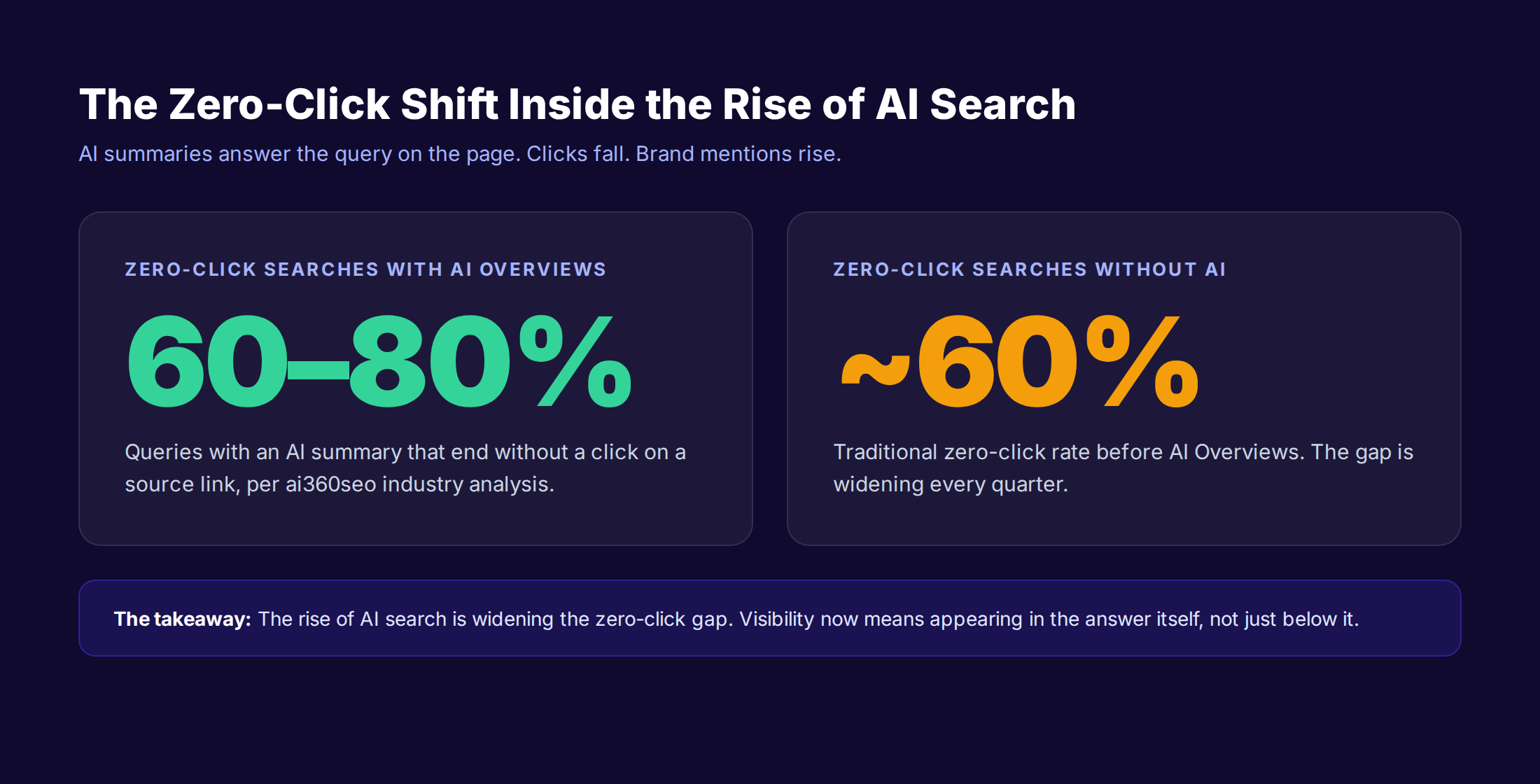
Zero-click searches were already a problem before AI. The rise of AI search made them the default outcome. Industry analysis from ai360seo found that 60 to 80 percent of queries with an AI Overview now end without a single click, compared to roughly 60 percent on traditional SERPs.
This is the single most disruptive shift for traffic-based businesses. Pages that used to drive 10,000 clicks a month now drive 4,000 with the same ranking. The page did not get worse. The interface in front of it changed.
For full context on this shift, see our zero-click search SEO guide and zero-click statistics report.
What the Rise of AI Search Means for SEO
SEO is not dead. Almost every credible analysis, including the Search Engine Land study, reaches the same conclusion. AI search uses traditional search infrastructure to retrieve sources. Strong SEO fundamentals still drive visibility. The signals have shifted, but the foundation has not collapsed.
That said, SEO is no longer one discipline. It is splitting into 2.
Traditional SEO Still Drives Foundational Visibility
Backlinks. Page speed. Schema markup. Internal linking. Keyword targeting. All of these still matter because AI engines pull from search indexes that rank on those signals.
If your site cannot rank on Google, your odds of being cited by an AI Overview drop sharply. The same applies to ChatGPT Search, which heavily favors high-authority publishers that already win in traditional search.
Generative Engine Optimization Is the New Layer on Top
Generative engine optimization, also called GEO or AEO, is the practice of optimizing for AI-generated answers rather than blue links. The skills overlap with traditional SEO but the tactics differ.
| Discipline | Goal | Primary Signals | Measurement |
|---|---|---|---|
| Traditional SEO | Rank pages | Backlinks, on-page, technical | Clicks, ranking position |
| Generative Engine Optimization | Get cited in AI answers | Entity authority, citability, freshness | Citation rate, brand mentions |
To understand the framework in depth, see our what is GEO guide and our AEO versus SEO breakdown.
The Skills That Matter More Now
The rise of AI search has elevated certain skills and quieted others.
Skills rising in value:
- Writing in clear, direct passages that AI can extract as standalone answers
- Building entity authority through consistent presence on Reddit, Quora, YouTube, and trade publications
- Publishing at high frequency to stay in the freshness window AI engines prefer
- Structuring content around questions a user would actually ask in conversation
- Tracking brand mentions in AI tools rather than only tracking Google rankings
Skills declining in value:
- Keyword density and exact-match optimization
- Long lead-in paragraphs before the answer appears
- Content that buries the conclusion 1,200 words into the post
- Generic listicles with weak unique insight
For tactics, our optimize for AI Overviews and optimize for Perplexity guides walk through specific implementation steps.
Brand Becomes the Moat
The rise of AI search rewards brand recognition more than any past algorithm change. AI engines cite brands users trust. Reddit and Quora dominate citations because users have spent 15 years building trust there. Wirecutter and Consumer Reports show up in AI Overviews because both names carry decades of reputation.
For a no-name site with thin authority, getting cited is now significantly harder. Brand becomes the foundation that everything else builds on.
The New Playbook: 6 Shifts to Make in 2026
The rise of AI search is too important to react to passively. Every SEO team needs a structured response. The 6 shifts below are what our content team applies to every project.
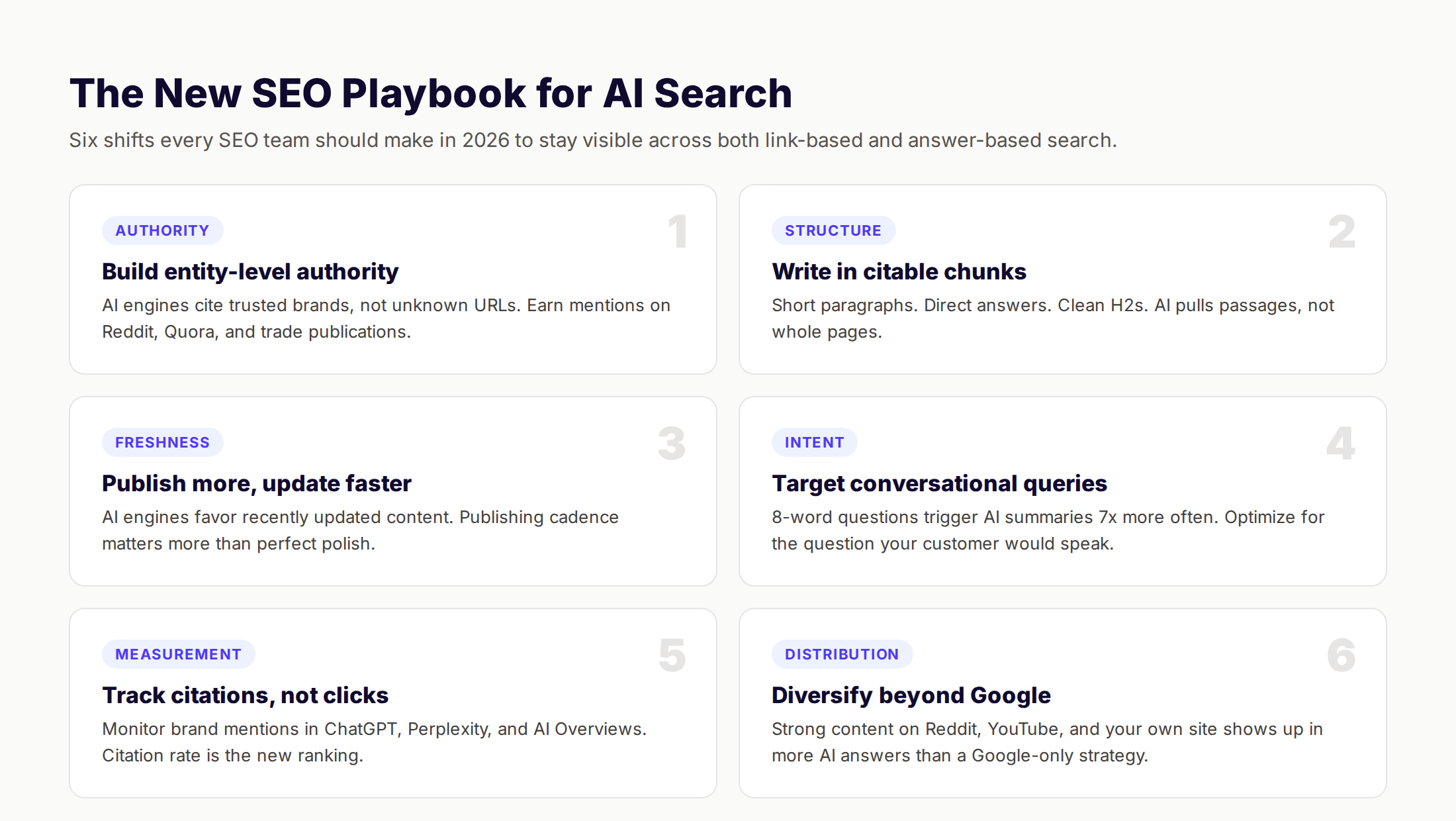
Shift 1: Build Entity Authority, Not Just Page Rankings
AI engines pull from entities, not just URLs. An entity is a brand, person, or product that the model recognizes as a coherent thing. Building entity authority means appearing consistently across the surfaces AI engines learn from.
Practical steps:
- Maintain accurate, complete profiles on Wikipedia, Wikidata, Crunchbase, Google Business Profile, and Apple Business Connect
- Publish on third-party platforms where AI engines crawl heavily (Reddit, Quora, Medium, LinkedIn, YouTube)
- Earn brand mentions in industry trade publications, not just backlinks
- Use consistent author names, headshots, and bio links across every site you publish on
For a deeper framework, see our guide on entity authority for Google AI.
Shift 2: Write in Citable Chunks
AI engines extract passages, not whole pages. The format that wins inside AI Overviews and ChatGPT is short, direct, and structured.
Apply this everywhere:
- Lead every section with the answer in the first sentence
- Keep paragraphs to 2 to 3 sentences maximum
- Use H2 and H3 headings that match how users phrase questions
- Format key information as tables, bullet lists, or numbered steps
- Define terms inline so AI can extract them as standalone definitions
Our blog GEO checklist walks through this format applied to a full post.
Shift 3: Publish More, Update More
Freshness is a stronger signal in AI search than in traditional search. AI engines prefer recently updated content because the underlying model has a training cutoff and users want current information.
The implication for content teams is that publishing cadence matters more than perfect polish. A team publishing 30 articles a month at 92 percent quality will beat a team publishing 4 articles a month at 98 percent quality in AI visibility. Volume creates surface area. Surface area creates citations.
This is exactly why we built Stacc as a service. Most teams cannot scale to 30 articles a month with internal resources. We publish that volume for $99 a month. No writers to manage. No editors to chase.
Shift 4: Target Conversational Queries
Optimize for the question your customer would actually speak, not just the keyword they would type. Conversational queries trigger AI summaries far more often, and they map to higher intent.
A few practical examples:
- Replace “ai seo tools” targeting with “what are the best ai seo tools for a small marketing team”
- Replace “404 errors” targeting with “how do I fix 404 errors on a shopify site after migration”
- Replace “schema markup” targeting with “what schema markup do I need for a local service business”
Long-tail, conversational keywords are 7 times more likely to trigger AI Overviews. They also face less competition because most older content was written for the 2 to 4 word keyword era.
Shift 5: Track Citations, Not Just Clicks
The most important metric in the rise of AI search is citation rate. How often does your brand appear in AI answers? Across which queries? On which platforms?
Set up tracking for:
- Brand mentions in ChatGPT, Perplexity, Claude, and Gemini for your top 20 priority queries
- Source citations in Google AI Overviews for your category keywords
- Referral traffic from AI domains in Google Analytics
- Conversion rate of AI-referred visitors compared to organic search visitors
Our team uses our own track AI search visibility framework to monitor this monthly across every account.
Shift 6: Diversify Beyond Google
The single biggest mistake teams make right now is assuming the rise of AI search is a Google problem. It is not. ChatGPT, Perplexity, and Claude all draw from a wider source mix than Google does. Strong presence on Reddit, YouTube, and your own site appears in more AI answers than a Google-only strategy.
Diversification looks like:
- A consistent YouTube channel with even modest publishing (1 to 2 videos per month)
- Active participation in 2 to 3 relevant subreddits where your audience already hangs out
- A regular newsletter or LinkedIn presence under a named author
- Guest posts on 3 to 5 trade publications per year
Every surface you build on is a surface AI can cite. The cost is low. The compounding benefit is enormous.
The rise of AI search makes consistent publishing more valuable, not less. Stacc publishes optimized content for AI visibility across 70+ industries at $99 a month, with no writers to manage. See pricing →
What Comes Next: Conversational Search Becomes Agentic Search
The rise of AI search is not a finished story. The current generative phase is the first chapter, not the final state.
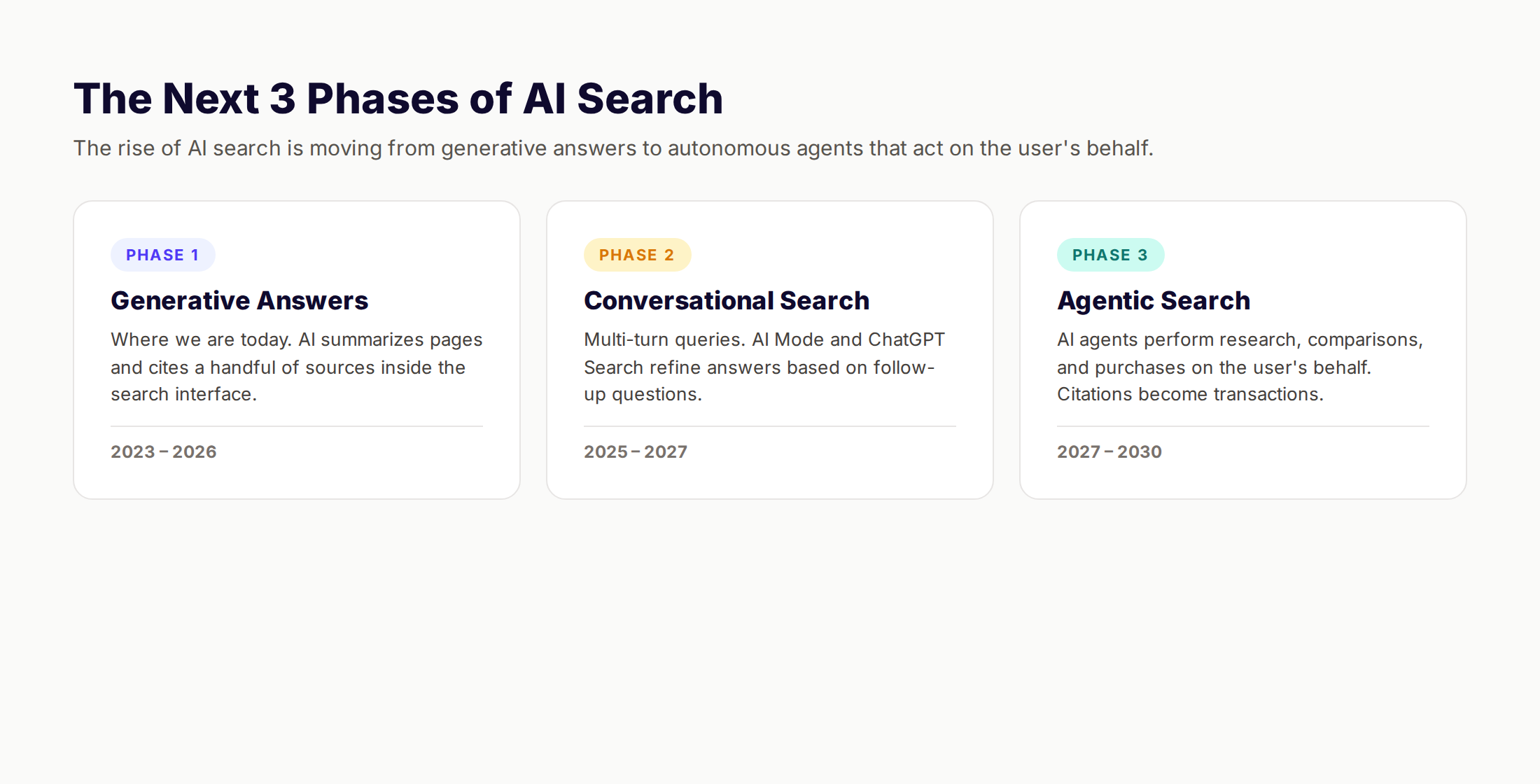
Phase 1: Generative Answers (2023 to 2026)
This is the phase we are living in. AI summarizes pages and cites a handful of sources inside the search interface. Users still type queries. The output is a paragraph with links.
Phase 2: Conversational Search (2025 to 2027)
Multi-turn queries become the norm. Google AI Mode and ChatGPT Search already operate this way. Users refine answers across 3 to 5 follow-up questions. The first answer is rarely the final answer. SEO strategy has to consider the entire conversation, not just the initial query.
Phase 3: Agentic Search (2027 to 2030)
AI agents perform research, comparisons, and purchases on the user’s behalf. The user does not see a SERP at all. They give the agent a goal. The agent reads dozens of pages, evaluates options, and returns a recommendation or completes a transaction.
This phase changes everything. Citation becomes transaction. The brands that AI agents trust will win shelf space inside automated decisions. The brands they do not trust will be invisible.
To prepare, see our analyses on AI agents in buyer decisions and agentic commerce SEO.
What Stays the Same
Even through agentic search, three things stay constant:
- AI engines need to read content somewhere. Strong written content remains the foundation.
- Brand authority compounds over time. Building it now pays off across every future phase.
- Distribution diversity wins. The brands present on more surfaces show up in more AI answers and more agent decisions.
The rise of AI search rewards teams that build for the long arc, not just the current quarter.
Frequently Asked Questions
What is the rise of AI search?
The rise of AI search is the shift from link-based search results to AI-generated answers. It includes Google AI Overviews, ChatGPT Search, Perplexity, Gemini, and Copilot. As of 2026, AI summaries appear on a majority of Google informational searches and 37 percent of consumers start product research in AI tools rather than Google.
Is the rise of AI search killing traditional SEO?
No. Traditional SEO fundamentals still drive AI search visibility because AI engines pull from existing search indexes. The rise of AI search has added a new layer on top of traditional SEO called generative engine optimization, but it has not replaced the foundation. Strong on-page, technical, and authority signals still matter.
How fast is AI search growing compared to Google?
Very fast in relative terms, still small in absolute terms. ChatGPT grew 8x in weekly users between October 2023 and April 2025. Perplexity tripled query volume in 12 months. But Google still processes around 14 billion searches per day, roughly 90 times the volume of ChatGPT. The growth rate is what matters. Semrush projects AI search visitors will surpass traditional search visitors by 2028.
Which AI search platforms should I optimize for first?
Start with Google AI Overviews and ChatGPT Search. AI Overviews matter because they sit inside the Google SERP you already optimize for. ChatGPT Search matters because it drives the majority of AI referral traffic to websites. Perplexity and Gemini come next. Each platform has different ranking signals. Our GEO optimization checklist covers all four.
Do AI search engines hurt my organic traffic?
In the short term, yes, especially for informational queries with high zero-click potential. Industry analysis shows 60 to 80 percent of queries with AI Overviews end without a click. In the long term, the picture is more mixed. AI search visitors convert at 4.4 times the rate of traditional organic visitors. Lower volume, higher quality. Total economic value is projected to stay roughly even.
What is the difference between AI search and a chatbot?
A chatbot answers questions from its training data, which has a cutoff date. AI search retrieves current information from the live web and synthesizes an answer with citations. ChatGPT operates as both. When ChatGPT uses Search mode, it pulls live web data. When it uses standard mode, it relies on training data.
Will AI search replace Google?
Not in the next 5 years. Google still holds about 90 percent of global search market share. The rise of AI search is more accurately described as a layer on top of search, not a replacement for it. Google itself is the largest AI search provider through AI Overviews and AI Mode. The bigger shift is that search itself is no longer a single Google-owned surface.
The Bottom Line
The rise of AI search is the most consequential shift in search since 1998. ChatGPT, Perplexity, Gemini, and Copilot are now baseline surfaces, not experiments. AI Overviews sit on top of a majority of Google informational results. Conversion rates from AI visitors run 4.4 times higher than traditional organic. By 2028, AI search visitors are projected to surpass traditional search visitors.
The teams that adapt fastest will win. Build entity authority. Write in citable chunks. Publish at a cadence that creates surface area. Track citations, not just clicks. Diversify beyond Google. These are the shifts that matter in 2026.
If you do not have the team or time to do all of this manually, Stacc handles it. We publish 30 SEO articles a month optimized for both traditional and AI search at $99. No writers to hire. No editors to chase. No agency retainer. Just published.
Start for $1 → See the difference in 3 days
This article was researched and published by Stacc. We publish 3,500+ SEO articles per month across 70+ industries and track AI citation data daily. All statistics and quotations were verified against public sources as of May 2026.
Related Tools & Resources
Free SEO Tools:
Best Lists:

Written by
Siddharth GangalSiddharth is the founder of theStacc and Arka360, and a graduate of IIT Mandi. He spent years watching great businesses lose organic traffic to competitors who simply published more. So he built a system to fix that. He writes about SEO, content at scale, and the tactics that actually move rankings.
30 SEO blog articles published every month
Keyword-optimized, scheduled, and live on your site. Automatically.
30-day trial · Cancel anytime
theStacc
Stop writing SEO content manually
30 blog articles, 30 GBP posts, and social media content. Published every month. Automatically.
Try for free$1 for 3 days · Cancel anytime