
SEO in the Age of AI: 2026 Guide
SEO in the age of AI explained. Citation tactics, GEO, AEO, AI Overviews, and the operator playbook to win across ChatGPT, Perplexity, and Google. Updated May 2026.
SEO in the age of AI is not the same job it was 18 months ago. The mechanics changed. The metrics changed. The list of surfaces you have to win on multiplied. Most teams are still optimizing for the version of Google that died in 2024.
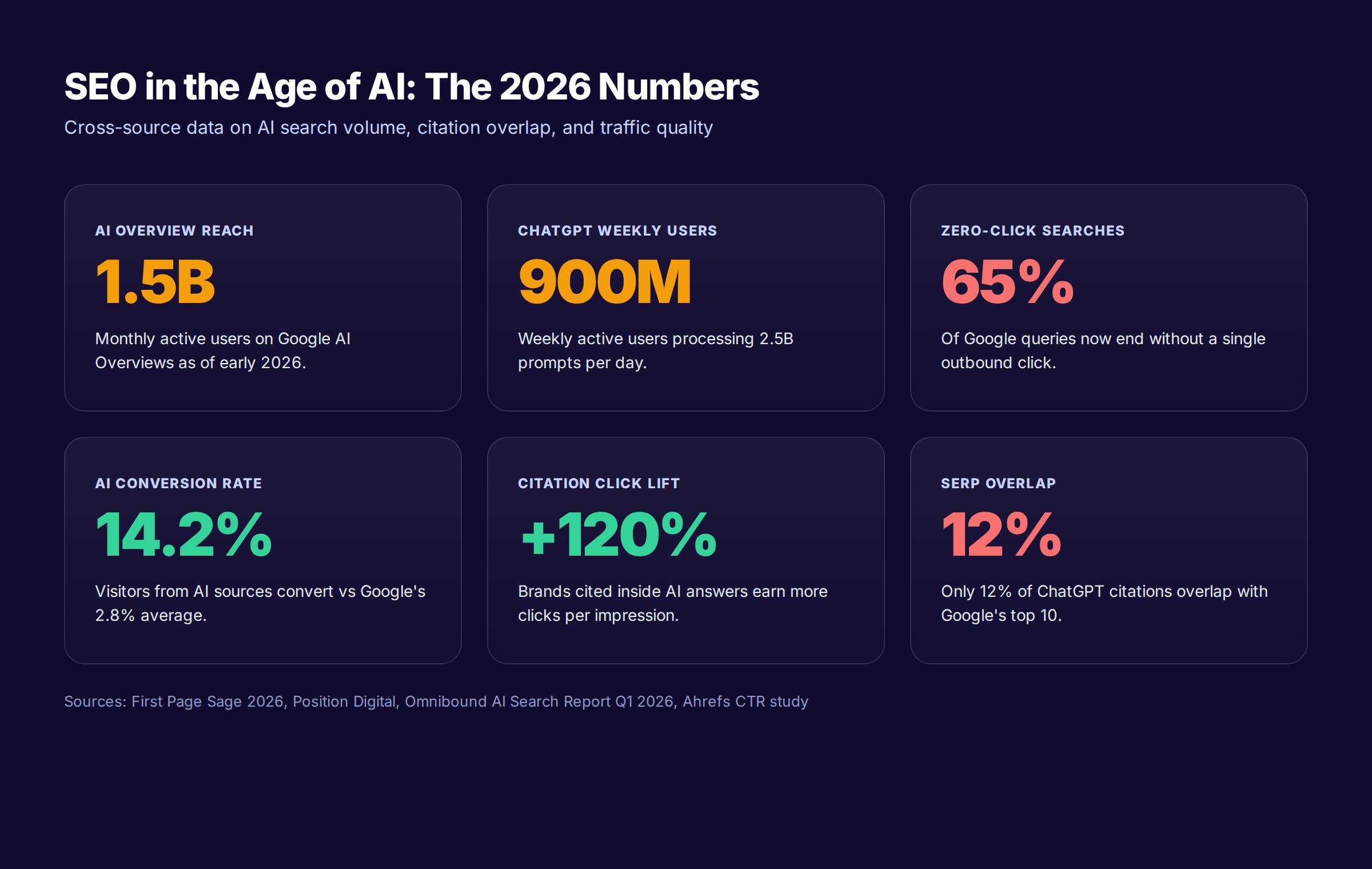
Google AI Overviews now serve 1.5 billion monthly users. ChatGPT processes 2.5 billion prompts a day across 900 million weekly active users. Perplexity handles 50 million weekly queries. Roughly 17 percent of all global search queries now flow through an AI-first interface. That is the first double-digit dent in Google’s monopoly in two decades.
This guide explains SEO in the age of AI from the ground up. We publish 3,500+ blog posts across 70+ industries and track AI citation visibility weekly. Every tactic here is backed by data we run or by sourced studies, not vibes.
Here is what you will learn:
- What SEO in the age of AI actually means in 2026
- Why traditional ranking signals still matter, just less than before
- How AI Overviews, ChatGPT, and Perplexity decide who to cite
- The six-step playbook to grow citation share in 90 days
- How to measure AI visibility without traditional rank tracking
- What is dead, what is alive, and what is coming next
Chapter 1: What SEO in the Age of AI Actually Means
SEO in the age of AI means optimizing your content to win two surfaces at once. The first surface is traditional Google search results. The second surface is the answer layer above and inside those results — AI Overviews, ChatGPT, Perplexity, Gemini, Claude, and the next ten engines that will exist by year-end.
The mechanics overlap by about 60 percent. Schema, fast pages, helpful content, and quality backlinks still matter. But the other 40 percent is new. AI models weigh entity authority, unlinked brand mentions, first-party data, and answer-first formatting in ways the classic algorithm did not.
The shortest correct definition is this. SEO in the age of AI is the practice of becoming the answer, not just the link. You earn the citation. You earn the brand mention inside the synthesized response. The click is a bonus, not the prize.
Why the change is real and permanent
Three structural forces locked this shift in place.
First, zero-click search now exceeds 65 percent of all Google queries. The 10 blue links model was already weakening before AI arrived. AI Overviews accelerated a trend that started with featured snippets in 2016.
Second, AI assistants are sticky in a way search engines never were. ChatGPT users return 8.6 times per week on average. They develop trust in answers, not in source pages. Once a user converts to AI-first behavior, they rarely scroll a SERP again.
Third, Google itself is leaning into the change. Search Generative Experience graduated to AI Overviews. AI Mode became opt-in default for many query types. The company is choosing to keep more searchers on Google, not send them to your site.
What you are actually optimizing for now
The old goal was rank in position 1. The new goal is citation share. You measure how often your brand appears as a source inside AI answers, on what queries, and what conversions come from those mentions.
Cited brands earn 120 percent more clicks per impression than uncited competitors on the same query. AI-referred visitors convert at 14.2 percent versus 2.8 percent for Google. The economic math has flipped. Fewer visitors. Higher intent. Better unit economics if you do the work.
For the strategy fundamentals that still apply, our SEO trends for 2026 guide covers the broader algorithmic shifts. For a tactical view of the click-through impact, read how AI search is changing SEO.
Stop chasing rankings nobody clicks. Build content AI engines actually cite. Start for $1 →
Chapter 2: What Has Changed and What Has Not
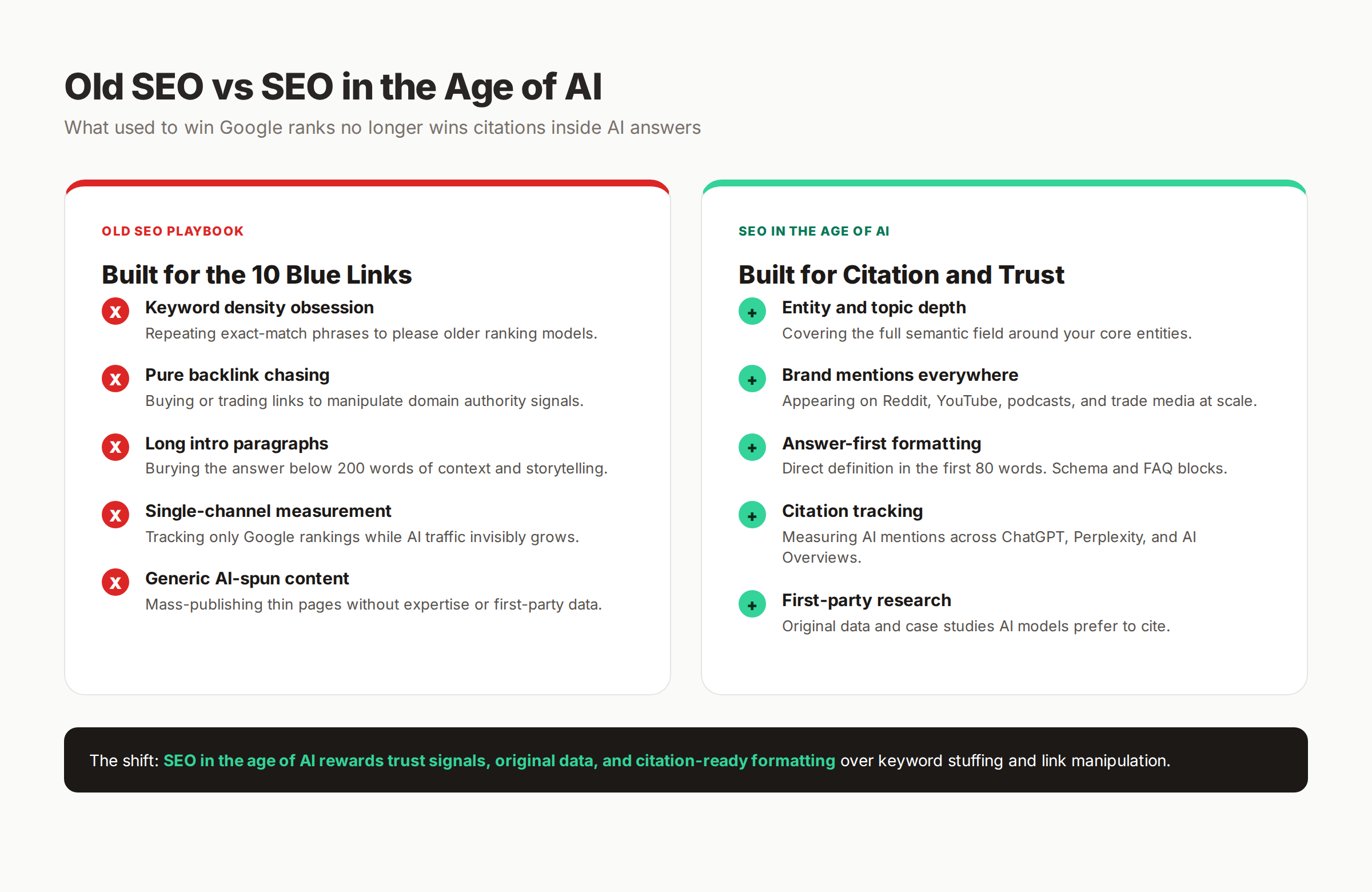
The fastest way to understand SEO in the age of AI is to separate the moves that died from the moves that survived.
What died in the last 18 months
The keyword density era ended for real. Older ranking models rewarded exact-match phrase repetition. Modern AI models penalize it. They flag pages as low-quality when the same noun phrase appears 30 times in 1,500 words.
Pure backlink chasing also lost its grip. Links still matter. They just no longer carry the disproportionate weight they had in 2019. AI models can read your site and decide if you are credible based on the text itself, the named author, the data you cite, and how your brand appears across the open web.
Long meandering intros died too. The reader who opens your page does not want a story. The AI crawler that decides whether to cite you does not want one either. Both want the answer, then the proof, then the depth.
Generic AI-spun content collapsed last. Google rolled out site-level quality signals throughout 2025 that flag low-effort programmatic and AI mills. Indexing rates on these sites dropped 70 to 90 percent. That experiment is over.
What still works exactly the same
Helpful, original, deeply researched content still wins. The bar got higher. The principle did not change. Pages that solve a real problem with real expertise still earn traffic and citations.
Fast, mobile-first, technically clean sites still win. Core Web Vitals still matter. Schema still matters. A page that loads in 1.2 seconds with proper structured data is favored over one that loads in 4.8 seconds with broken markup.
Strong internal linking still works. Topic clusters and pillar pages still work. The structure of authority still flows the same way through your site. AI models read that structure and use it to understand what you are an expert in.
E-E-A-T still matters more than any other off-page signal. Experience, Expertise, Authoritativeness, and Trustworthiness now serve as the central framework AI uses to filter sources. The named author with a real bio outperforms the anonymous “team” byline every single time.
What is genuinely new
Brand mentions across the open web now carry weight independent of links. AI models trained on Reddit, YouTube transcripts, podcast notes, and trade media learned to associate brand strings with topical authority. A high-volume of unlinked mentions in the right communities can move citation share faster than any backlink campaign.
First-party data became a citation magnet. Original surveys, proprietary benchmarks, and unique case studies get cited far more often than generic summaries of public knowledge. The McKinsey and First Page Sage reports get cited every week because they publish numbers nobody else has.
Answer-first formatting moved from nice-to-have to mandatory. The first 80 words of your page must define the term, answer the question, or deliver the key insight. AI models pull from the opening of pages disproportionately. Bury your answer and you lose the citation.
For a deeper look at how the algorithmic side is moving, the Search Engine Land 2026 forecast lays out where standards are tightening. For the dataset on AI citation versus organic visibility, the Omnibound AI search report has the most rigorous numbers we have seen.
Chapter 3: How AI Engines Decide Who to Cite
You cannot optimize for SEO in the age of AI without understanding the citation logic. Each engine works slightly differently. The overlap is what you can act on.
How Google AI Overviews choose sources
AI Overviews use a hybrid retrieval system. The model first generates a candidate set of sources from the existing Google index, then synthesizes an answer using a subset of those sources, then attaches citations to the synthesis.
The candidate set heavily overlaps with the top 20 organic results. Roughly 43 percent of pages ranking number 1 on Google get cited in AI Overviews. The rate drops to 12 percent for pages ranked outside the top 20. Classic rank still matters here.
What changes the citation decision after the retrieval step is structure. Pages that lead with a direct answer, include a definition or list near the top, and use clear semantic HTML get pulled more often than pages of equivalent quality without that structure.
How ChatGPT chooses sources
ChatGPT browsing is powered by Bing under the hood. But the overlap between ChatGPT citations and the Bing SERP is only 26 percent. The overlap with Google’s SERP is just 12 percent.
That gap is the model’s choice. ChatGPT prefers sources that match a stricter set of trust signals. Named authors. Recent updates. Outbound citations to authoritative third parties. Long-form coverage of the entity, not just the keyword.
Almost 30 percent of ChatGPT’s most-cited pages have zero organic visibility on Google. That is the single most important data point in this guide. Citation share is its own metric now. Earning it is a different game.
How Perplexity chooses sources
Perplexity is the most transparent of the three engines. It links every source inline and tells you exactly what it pulled where. Reverse-engineering its preferences is easier as a result.
Perplexity weights three things heavily. First, recency. Pages updated in the last 12 months get a strong boost over older pages on the same topic. Second, source diversity. Perplexity rarely cites three pages from the same domain in one answer. Third, schema. Pages with clean Article, FAQ, and Author schema get pulled into answers at higher rates.
What works across all three engines
Five signals predict citations across every major AI engine we test against.
Answer-first formatting. A direct definition, list, or numerical answer within the first 80 words.
Named author with credentials. A real bio with a real LinkedIn link beats every anonymous editorial byline.
Original data or unique perspective. Quoted numbers from your own research, customer interviews, or audit work. AI engines reward what they cannot find elsewhere.
Topic depth at the cluster level. AI models trust domains that have published 30 to 60 pages on a single topic over domains with one big “ultimate guide” and nothing else.
Brand mention frequency across the open web. Unlinked mentions in Reddit threads, YouTube descriptions, podcast show notes, and trade publications all count.
For the topic-cluster mechanics, our topical map guide breaks down how to build entity depth. For the publishing volume side, the scale blog content with AI walkthrough shows our process.
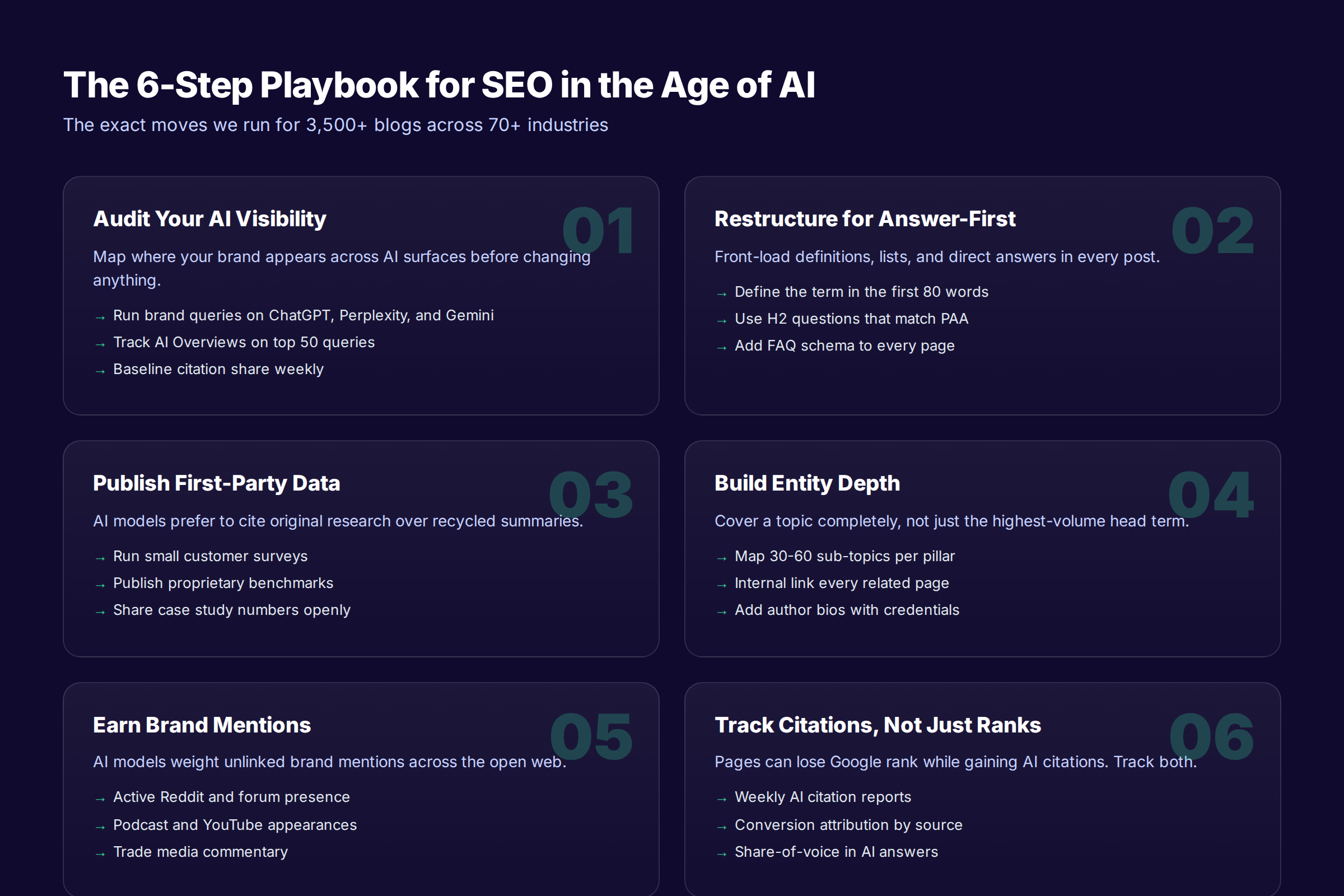
Chapter 4: The Six-Step Playbook for SEO in the Age of AI
The strategy below is the exact playbook we run for our own site and for client portfolios across 70+ industries. Every step is operational, not theoretical.
Step 1: Audit your current AI visibility
You cannot improve what you have not measured. Before changing a single page, baseline where your brand appears across AI surfaces.
Pick your top 30 commercial queries. For each, run the prompt manually on ChatGPT, Perplexity, Gemini, and Claude. Note whether your brand appears in the answer, whether your domain is cited, and what the surrounding context says about you.
Score each query on a simple scale. Cited and positive. Cited and neutral. Mentioned but not cited. Not present. The distribution across those four states is your starting line. Re-run the audit every 30 days.
For AI Overviews specifically, use Ahrefs or Semrush to track which of your indexed pages now show an AI Overview above them. Both tools added this in 2025.
Step 2: Restructure existing pages for answer-first
This is the fastest win. Most established sites have 50 to 500 indexed pages that already rank reasonably well. Restructuring them for AI citation is cheaper than writing new ones.
For each priority page, rewrite the first 80 words to deliver a direct definition or answer. Add a clear H2 question structure that mirrors the People Also Ask block on Google. Add a 4 to 6 question FAQ block at the bottom with schema markup.
Move tables and bulleted lists higher in the document. Push storytelling, anecdotes, and context further down. AI crawlers pull from the top of the page disproportionately.
Add an author bio with a real LinkedIn link. Add a “Last updated” date that you actually maintain. Add 2 to 3 external citations to authoritative sources to demonstrate research depth.
Step 3: Publish first-party data
The single biggest move in this playbook is publishing original data. AI models prefer to cite unique research over recycled summaries.
You do not need a McKinsey research budget to do this. Three forms of first-party data work consistently.
Customer surveys with sample sizes of 100 to 500 generate citable numbers within 30 days. Pick a question your industry has no public answer for. Survey your audience. Publish the data with methodology disclosed.
Proprietary benchmarks from your own platform. If you have any data your tool produces, normalize it into a benchmark report. Publish the percentile distribution. Update it quarterly.
Case study numbers published openly. Most case studies hide the numbers behind a sales gate. The ones published with raw numbers earn 10 to 20 times more citations.
Step 4: Build entity depth
AI models trust domains that have covered a topic completely, not just the highest-volume keyword.
Pick your 5 core pillar topics. For each, map 30 to 60 sub-topics that an expert would cover. Publish the depth. Internal link aggressively from the pillar page down to every sub-topic page and back up.
Add structured data at the entity level. Use the about and mentions properties in Schema.org. Reference Wikipedia and Wikidata identifiers where they exist. This helps AI engines map your content to known entities.
For a working framework, our topical map guide shows the exact methodology. For the publishing side, how to write SEO blog posts covers the per-post structure.
Step 5: Earn brand mentions off-site
Unlinked brand mentions are the most underrated SEO asset of 2026. AI models trained on the open web learned to weight these mentions as quality signals.
The three best surfaces are Reddit, YouTube, and trade media.
Reddit is the highest-citation source for ChatGPT. Build a real, helpful presence in your industry subreddits. Comment thoughtfully. Mention your brand only when it is genuinely relevant. Get cited as an expert.
YouTube transcripts feed every major AI model. Appear on industry channels. Mention your work. Get tagged in descriptions. The transcript becomes training data and retrieval material.
Trade media commentary works the same way. HARO, Qwoted, and Featured.com still operate. Get quoted in 2 to 4 stories a month. Each quote becomes a brand-entity association in the training corpus.
Step 6: Track citations, not just rankings
Traditional rank tracking is now one metric among many. Build a dashboard that tracks four things weekly.
Citation count by engine. How many times you appear in AI answers across ChatGPT, Perplexity, and Gemini for your priority queries.
Share-of-voice in AI answers. Your citation count divided by the total possible citations on your tracked queries.
Conversion attribution by source. GA4 segments for AI-referral traffic. The conversion rate from this segment should run 4 to 6 times your Google average.
Brand search trend. Branded query volume on Google Search Console. Rising brand search is a leading indicator of rising AI citations.
Want this done for you? We publish 30, 50, or 80 articles a month built for AI citation. Start for $1 →
Chapter 5: The SEO in the Age of AI Audit Checklist
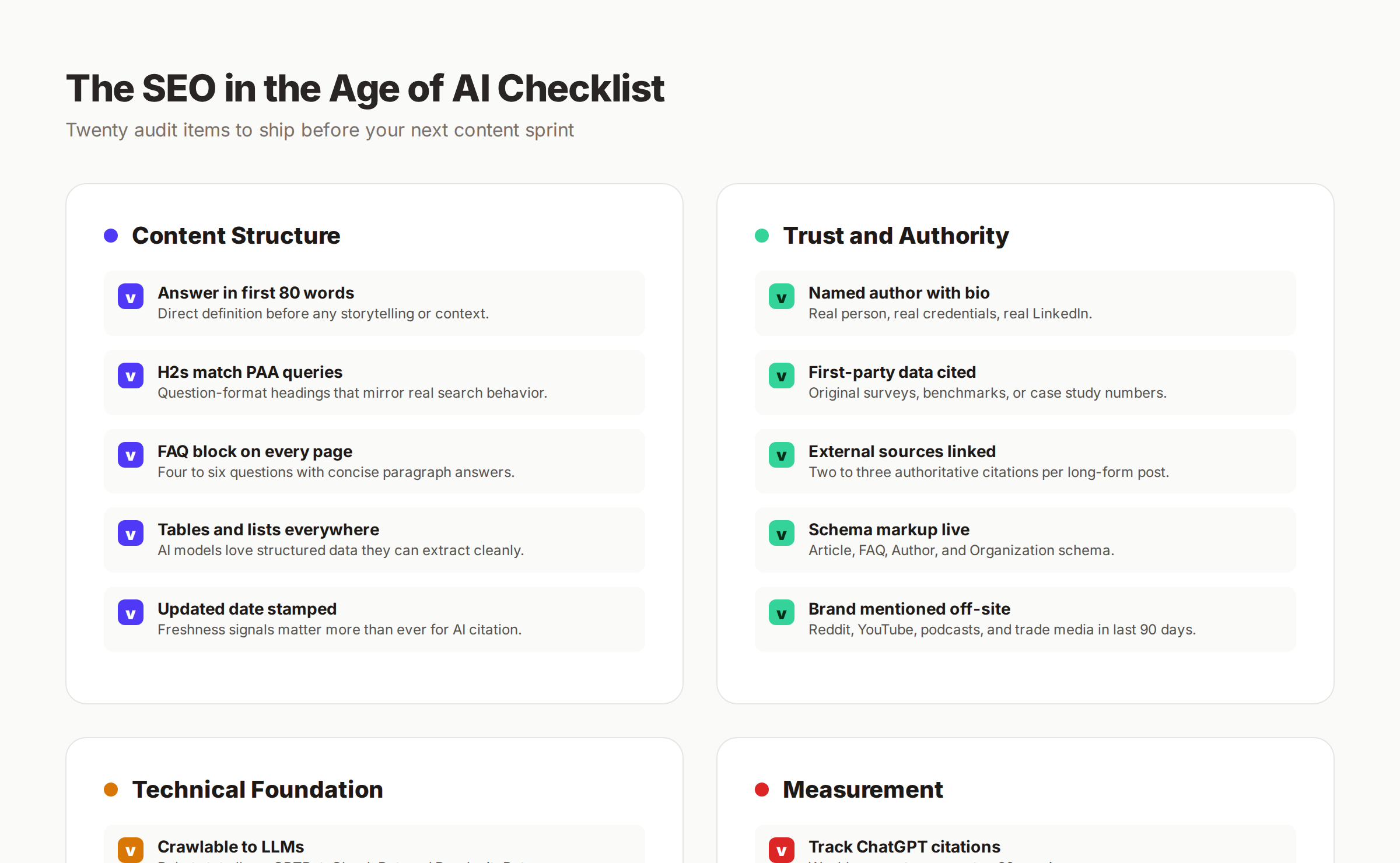
Use this 20-point audit before your next content sprint. Every item is operational. Every item is testable.
Content structure checklist
| Audit item | Why it matters | How to verify |
|---|---|---|
| Answer in first 80 words | AI crawlers pull from top of page | Read the opening of each priority page |
| H2s match PAA queries | Mirrors real search behavior | Compare H2s to Google PAA box |
| FAQ block with schema | AI engines extract FAQ blocks at high rates | Validate with Schema.org markup tool |
| Tables and lists above the fold | AI models prefer structured data | Confirm at least one table or list in first 600 words |
| Updated date visible and recent | Freshness boosts AI citation | Set monthly review cycle |
Trust and authority checklist
| Audit item | Why it matters | How to verify |
|---|---|---|
| Named author with real bio | E-E-A-T signal AI models weight heavily | Each post needs a named author |
| First-party data cited | Original data outranks summaries for AI | Publish 1 unique data point per pillar page |
| External authoritative sources | Demonstrates research depth | 2 to 3 outbound links to .edu, .gov, or top-tier media |
| Schema markup live | Article, FAQ, Author, Organization | Run schema validator on top 50 pages |
| Off-site brand mentions in last 90 days | AI models trained on open web mentions | Track via Google Alerts and Brand24 |
Technical foundation checklist
- Robots.txt allows GPTBot, ClaudeBot, PerplexityBot, Google-Extended
- Server-rendered content available without JavaScript execution
- Sitemap contains only canonical, high-quality URLs
- Core Web Vitals green on top 100 pages (LCP under 2.5s, INP under 200ms, CLS under 0.1)
- Internal links use descriptive anchor text mapped to topic, not just keyword
- No JavaScript-rendered hero text on key pages
- HTTPS valid and HSTS enabled
- Hreflang correct for multi-language sites
- No accidental noindex on canonical pages
- Pagination handled with proper rel=“next” or full pages
Measurement checklist
- Weekly ChatGPT citation check on top 20 queries
- Weekly Perplexity citation check on top 20 queries
- AI Overview tracking via Ahrefs or Semrush
- GA4 segments for AI-source traffic (ChatGPT, Perplexity, Gemini)
- Share-of-voice dashboard versus top 5 competitors
- Branded search volume trended monthly
- Conversion attribution by AI source
- Citation report shared with stakeholders monthly
For the deeper technical side, our technical SEO guide covers the foundation. For schema specifically, the schema markup SEO guide walks through every type you need.
Chapter 6: Generative Engine Optimization and Answer Engine Optimization
Two new acronyms now sit beside SEO. Generative Engine Optimization, or GEO, refers to optimizing for AI answer engines like ChatGPT and Perplexity. Answer Engine Optimization, or AEO, refers to optimizing for any answer-format surface including featured snippets, voice assistants, and AI Overviews.
Some practitioners argue these are distinct disciplines. We disagree. They are the same discipline applied to different surfaces, all of which now overlap.
What GEO actually requires
GEO is mostly a content and brand-signal play. The technical surface is small. The content surface is large.
Content moves that work for GEO. Lead with the definition. Use entity-rich language. Cite sources inline. Maintain factual accuracy AI models can verify. Update regularly.
Brand moves that work for GEO. Get mentioned across the open web. Appear in podcast transcripts. Get quoted in trade media. Build a Wikipedia entry if you qualify.
What AEO actually requires
AEO leans more technical than GEO. The optimization is closer to classic SEO with a stronger schema discipline.
FAQ schema, How-To schema, Article schema with author and date, and Speakable schema for voice surfaces all matter. The right schema unlocks the right surfaces.
Question-format H2s help every answer engine. Concise paragraph answers immediately under each question help even more. Direct, unambiguous language helps most of all.
How GEO, AEO, and SEO fit together
The honest answer is that they collapse into one practice for any team doing the work seriously. You cannot win GEO without strong SEO foundations. You cannot win AEO without classic on-page work. And classic SEO without GEO and AEO leaves citations on the table.
We treat them as three layers of the same job. Layer one is the foundation. Layer two is the answer-first structure. Layer three is the brand-and-mention work that compounds across surfaces.
For a deeper comparison of these frameworks, our AEO vs SEO post breaks down the differences. For GEO specifically, the GEO vs SEO comparison covers what is genuinely different.
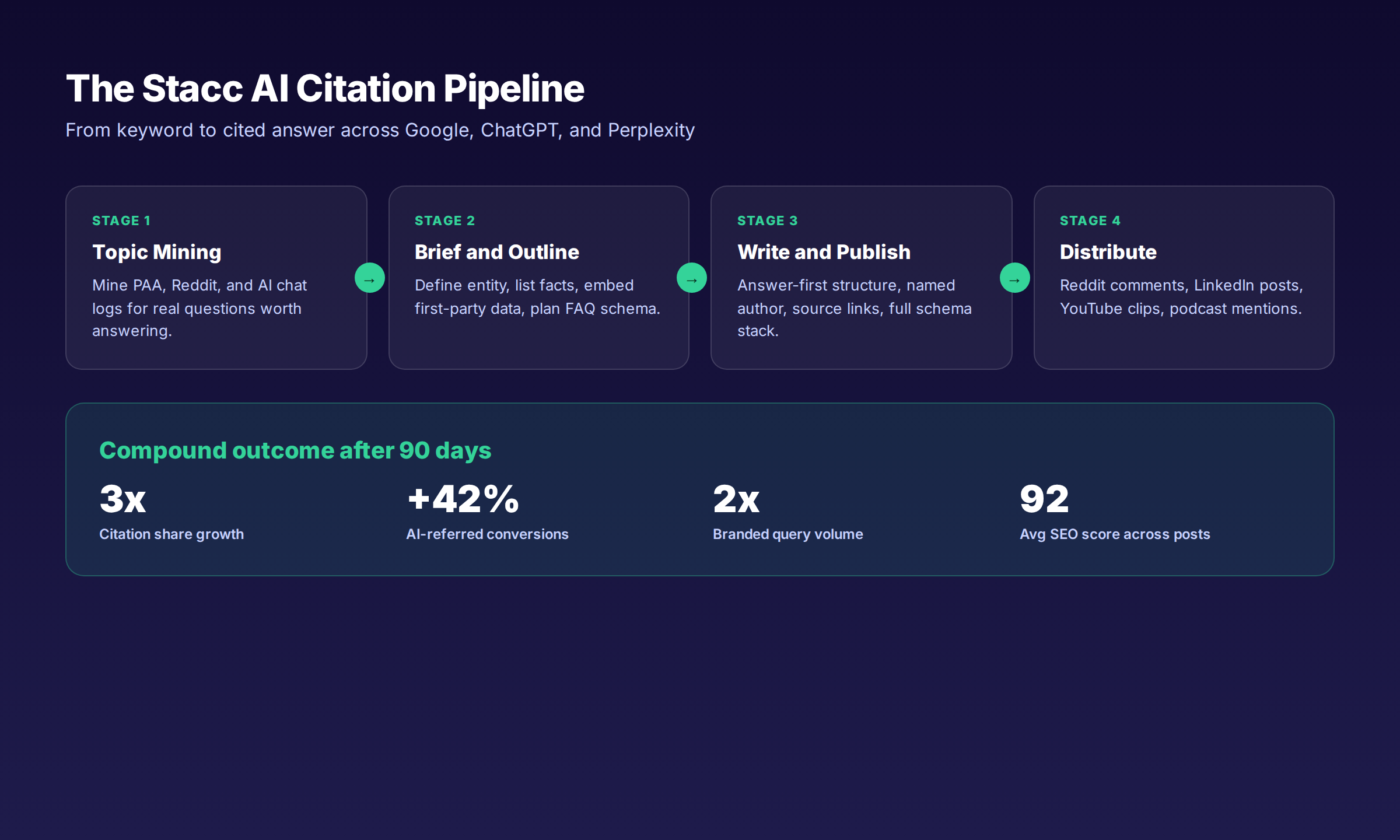
Chapter 7: Measuring SEO Success When Half the Clicks Disappear
Rank tracking still has a role. It is no longer the headline metric. Building a measurement stack that captures AI visibility is the most underrated investment in SEO right now.
The four metrics that actually matter
Citation share. The percentage of your priority queries where your domain appears as a source in AI answers. Track weekly across at least three engines.
Branded search volume. Rising brand searches on Google Search Console signals rising brand recognition, which feeds rising AI citations. This is the cleanest leading indicator.
AI-referred conversion rate. Visitors from ChatGPT, Perplexity, and Gemini convert at 4 to 6 times the rate of Google organic visitors. Tracking this segment as a separate channel reveals revenue most teams miss.
Share of voice in AI answers. Your citation count divided by the total possible citations on your tracked query set. This is your competitive scorecard.
Tools that work in 2026
The tooling market changed fast. As of May 2026, the tools we use most.
Ahrefs and Semrush both added AI Overview tracking in 2025. They report which of your indexed pages have an AI Overview above them and which competitors are cited.
Profound, Otterly, and AthenaHQ all built dedicated AI citation tracking platforms. They run scripted prompts on a schedule and report which sources get cited across engines.
Manual tracking still has a role for the top 30 priority queries. Nothing beats running the prompt yourself and reading the answer in context.
GA4 with custom channel groupings for AI sources reveals the conversion side. Pair that with SEO reporting discipline and you have a complete picture.
What to deprioritize
Position tracking on the long tail. Tens of thousands of long-tail queries used to be the bedrock of SEO reporting. Most of them now resolve in an AI answer. Tracking them in detail is wasted effort.
Pure traffic volume reporting. Total sessions can fall while revenue rises. Optimize for the metric that converts.
Domain rating chasing. DR still matters as a directional signal. Spending budget purely to move DR is no longer a sensible strategy. The budget goes further on first-party data and brand mentions.
For the broader measurement framework, our SEO statistics roundup covers the industry-wide numbers. For tracking AI search specifically, see track AI search visibility.
Chapter 8: Industry-Specific Considerations for SEO in the Age of AI
The shift is universal. The application is not. Some industries are seeing 70 percent traffic drops. Others are barely affected. The variance is mostly explained by query type.
Informational query industries (hardest hit)
Industries built on informational traffic took the heaviest blows. Health publishers, finance content sites, definition-style B2B blogs, and “how to” sites have lost the most clicks to AI answers.
The strategy here is to migrate up the funnel. Stop competing for “what is X” queries. Start competing for “best X for Y” and “X vs Y” queries where users still want to evaluate options. Push into branded and comparative search where AI Overviews are less dominant.
Our ecommerce SEO after AI Overviews post covers the ecommerce-specific recovery playbook. For SaaS, see SaaS SEO guide.
Local and service industries (mostly stable)
Local businesses are relatively insulated. AI Overviews appear less frequently on local intent queries. Google Business Profile, local pack rankings, and review velocity still drive most local search outcomes.
The new move for local is to optimize for AI assistants that surface local recommendations. ChatGPT and Gemini increasingly answer “best plumber near me” queries with cited business names. Earning those citations becomes the new “rank in the map pack.”
For the operational side, our local SEO guide covers the foundation. For multi-location, see multi-location SEO.
High-consideration B2B (modest impact, big opportunity)
B2B SaaS, enterprise consulting, and professional services see modest traffic impact and significant citation opportunity. Buyers researching $50,000+ purchases still read deeply. They also increasingly start with ChatGPT for vendor discovery.
The play is to win citation share on category-defining queries. “Best CRM for [industry],” “[Competitor] vs alternatives,” and “How to evaluate [product type]” are now answered first by AI. Being cited there shapes the consideration set.
For tactical guides, our SEO for SaaS companies and done-for-you SEO walkthroughs cover the operator side.
Ecommerce and product (mixed impact)
Ecommerce is bifurcating. Top-of-funnel product education content is losing clicks fast. Bottom-of-funnel transactional queries still drive direct revenue.
The recovery play for ecommerce is to win review-style and comparison citations. AI engines cite product reviews, comparison guides, and buying advice extensively. Sites that produce structured, schema-rich, original review content are gaining citation share.
The Shopify SEO guide and ecommerce SEO guide cover the practical implementation.
Your industry has a unique playbook. We have published in 70+ industries and can run yours. Start for $1 →
Chapter 9: The Next 18 Months in SEO
Predicting search has been a humbling exercise for two decades. The directional bets below are based on infrastructure already shipping, not speculation.
Agentic search will normalize
ChatGPT Tasks, Perplexity Pages, and Gemini Deep Research are early versions of agentic search. The user gives the agent a goal. The agent runs multiple queries, reads multiple sources, and returns a structured answer.
For SEO, this changes the game in two ways. First, the agent reads more pages than a human ever would per query. Your page might get pulled into a research session even if you never would have ranked on the head query. Second, the agent can act. It can fill forms, sign up for trials, book meetings. Optimizing your site to be agent-readable is a 2026 priority.
Content quality bars will keep rising
Google rolled out three rounds of quality updates in 2025 that disproportionately punished low-effort programmatic and AI-only content. Every signal points to that direction continuing.
The teams winning in 18 months will be running smaller, deeper, more original content programs. Not larger, thinner ones. The math has reversed.
First-party data will become standard
Today, publishing original research is a competitive advantage. In 18 months, it will be table stakes for citation-driven sites. The teams that build a research function into their content team will pull ahead. The teams that keep recycling public sources will fall behind.
Brand will become the new domain rating
The clearest signal we see across our portfolio is that branded query volume predicts AI citation share with surprising accuracy. Brand becomes the new DR. The teams investing in PR, podcasts, communities, and trade media will benefit twice — once in brand equity, once in AI visibility.
For the broader prediction set, the Search Engine Land 2026 forecast lays out where the industry consensus is converging. For the brand-as-SEO thesis, the McKinsey AI search report makes the most rigorous case.
Frequently Asked Questions
Does SEO matter in the age of AI?
Yes. SEO matters more than ever, just differently than before. AI engines pull from the open web to answer questions, and they preferentially cite trusted, well-structured, well-linked sources. The pages that win classical SEO signals are also the pages most likely to get cited inside AI answers. Roughly 43 percent of pages ranking number 1 on Google get cited in AI Overviews. The work compounds across surfaces.
How do you do SEO in the age of AI?
Start with answer-first structure on existing pages. Lead each post with a direct definition or answer in the first 80 words. Add a question-format H2 structure that mirrors People Also Ask. Add a FAQ block with schema. Publish first-party data when possible. Build entity depth by covering a topic with 30 to 60 sub-topic pages. Earn brand mentions across Reddit, YouTube, and trade media. Track citation share, not just rankings.
What is SEO content in the AI age?
SEO content in the AI age is content engineered to win two surfaces. The first surface is traditional Google search. The second is the AI answer layer including AI Overviews, ChatGPT, Perplexity, and Gemini. The content leads with the answer, demonstrates first-party expertise, includes structured data, and earns brand mentions that AI models weight as trust signals.
Is SEO dead or evolving in 2026?
SEO is evolving. It is not dead. The total addressable surface for organic visibility expanded, not shrank. Traditional Google results still matter. AI answer surfaces matter on top of that. The teams that adapt the playbook to cover both surfaces are growing organic-source revenue. The teams that did not adapt are losing traffic at 30 to 70 percent rates.
What is the 80/20 rule for SEO in the age of AI?
Twenty percent of the work drives 80 percent of the citation share. The high-use 20 percent: answer-first structure on top 50 pages, first-party data on top 10 pillar pages, named authors with real bios, FAQ schema everywhere, brand mentions earned on Reddit and YouTube monthly, weekly citation tracking. The other 80 percent of typical SEO work matters less than it used to.
Will AI replace SEO entirely?
No. AI is changing how search results are presented and how citations are weighted. It is not replacing the underlying retrieval and ranking infrastructure. Search engines still need to crawl, index, and evaluate the open web. The pages they pull from to generate AI answers still need to exist, be discoverable, and be trustworthy. SEO is the practice of being on the right side of that retrieval. It does not go away.
How long does AI-era SEO take to show results?
The same range as classic SEO. First citation wins typically appear in 60 to 90 days after restructuring high-priority pages. Compound citation share growth shows up at 4 to 6 months. The teams that publish 30 to 80 high-quality articles per month see the fastest results. The teams running thin or sporadic publishing see flat results regardless of optimization.
What to Do This Week
If you read this far, here is the prioritized action list. Do not try to run everything at once. Pick the top three this week.
- Run a citation audit on your top 30 queries across ChatGPT, Perplexity, and Gemini
- Restructure your top 10 pages for answer-first format (80-word opening, question H2s, FAQ block)
- Set up GA4 segments for AI-source traffic and start the conversion tracking
The shift is not optional. Brands that adapt this year compound visibility for the next decade. Brands that wait will spend twice as much catching up in 2027.
Run the playbook with us. Stacc publishes 30, 50, or 80 SEO blogs per month engineered for AI citation. Real authors. Real schema. Real first-party data. Start for $1 →
Related Tools & Resources
Free SEO Tools:
Best Lists:

Written by
Siddharth GangalSiddharth is the founder of theStacc and Arka360, and a graduate of IIT Mandi. He spent years watching great businesses lose organic traffic to competitors who simply published more. So he built a system to fix that. He writes about SEO, content at scale, and the tactics that actually move rankings.
30 SEO blog articles published every month
Keyword-optimized, scheduled, and live on your site. Automatically.
30-day trial · Cancel anytime
theStacc
Stop writing SEO content manually
30 blog articles, 30 GBP posts, and social media content. Published every month. Automatically.
Try for free$1 for 3 days · Cancel anytime