
SEO Predictions: What Is Next for Search in 2026
12 data-backed SEO predictions for 2026 and beyond. AI agents, zero-click, GEO, brand signals, and the metrics replacing rank tracking. Updated May 2026.
SEO predictions used to be easy. Every year, the same three forecasts: more mobile, more video, more voice. Almost no one was wrong, because almost nothing fundamental was changing. The pipes shifted. The plumbing did not.
That is over. In 2026, organic clicks on the top result are down 34.5 percent on queries with AI Overviews. Zero-click hit 64.82 percent of all Google searches. Agentic shopping pilots are running on three major platforms. The plumbing is being rebuilt in public, and most teams are still optimizing for the old one.
This post lays out 12 specific SEO predictions for the next 18 to 36 months. Each one is tied to data we can actually point at, a confidence rating, and a clear action your team can take this quarter. No vague “AI will change everything” filler. No prediction without a number behind it.
We publish 3,500+ blog posts per month across 70+ industries. We watch ranking data, citation data, and AI Overview behavior every day. The forecasts below are the ones we are actually betting our content roadmap on.
Here is what you will learn:
- Which 12 SEO predictions are most likely to play out by 2028
- The new KPIs replacing rank tracking and organic CTR
- What zero-click and AI Overviews do to traffic over the next 24 months
- Why brand mentions and Reddit citations now matter more than backlinks
- The exact prep work to do before agentic search becomes the default
The Baseline: Where SEO Actually Stands in May 2026
Every prediction starts with a baseline. Otherwise you are guessing.
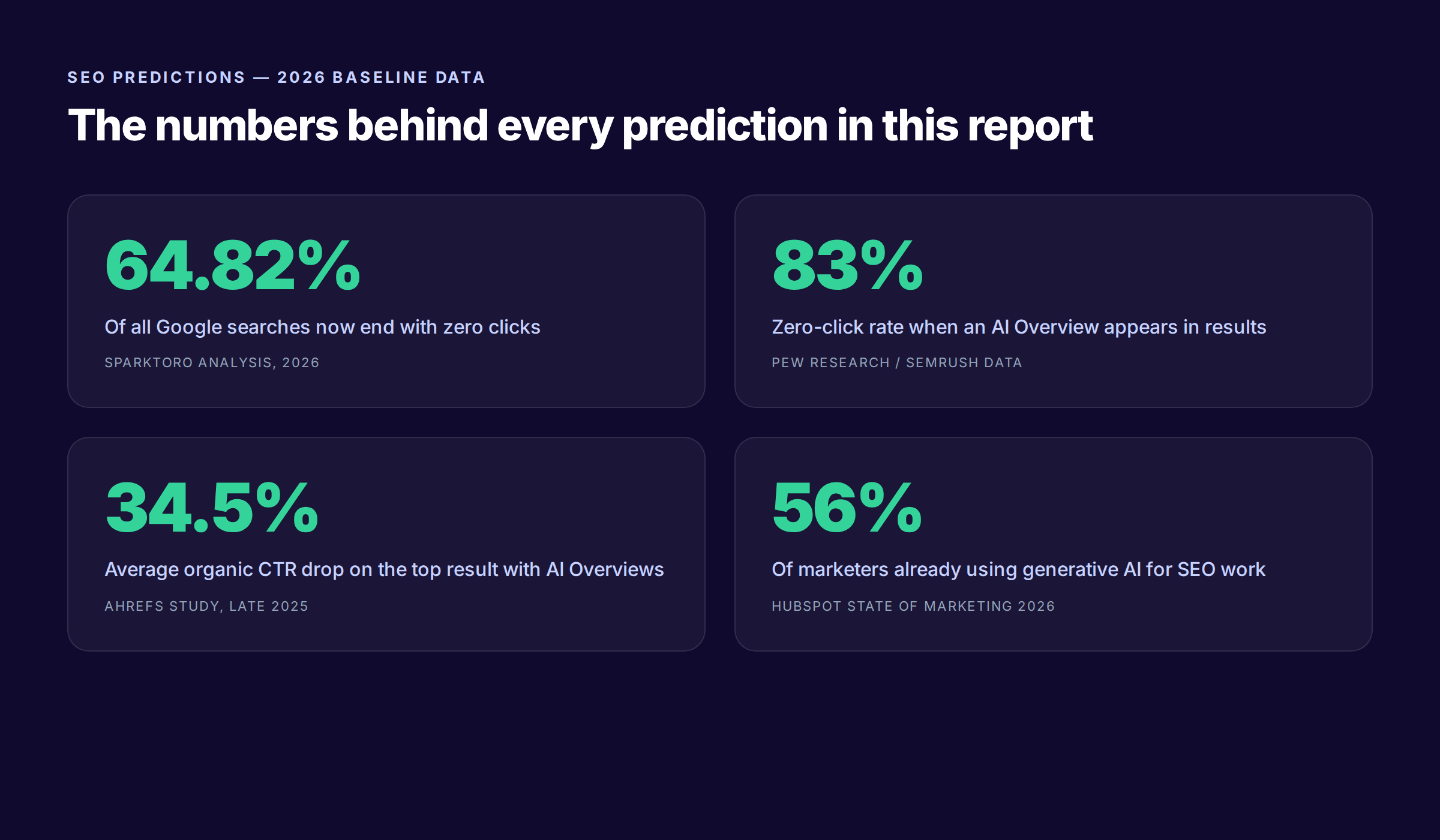
Here is what the data shows right now, drawn from SparkToro, Ahrefs, Semrush, BrightEdge, and Pew Research:
- 64.82 percent of all Google searches end with zero clicks (SparkToro)
- AI Overviews appear on roughly 48 to 60 percent of informational queries
- Organic CTR on the top result drops 34.5 percent when an AI Overview is present
- 83 percent of AI Overview queries end without a click
- 56 percent of marketers already use generative AI inside their SEO workflow
- 91 percent more paid clicks land on brands cited inside AI Overviews
That is the starting line. Every prediction in this post is built on top of these numbers. If you do not believe the baseline, you will not believe the forecast. Read the sources first, then read the predictions.
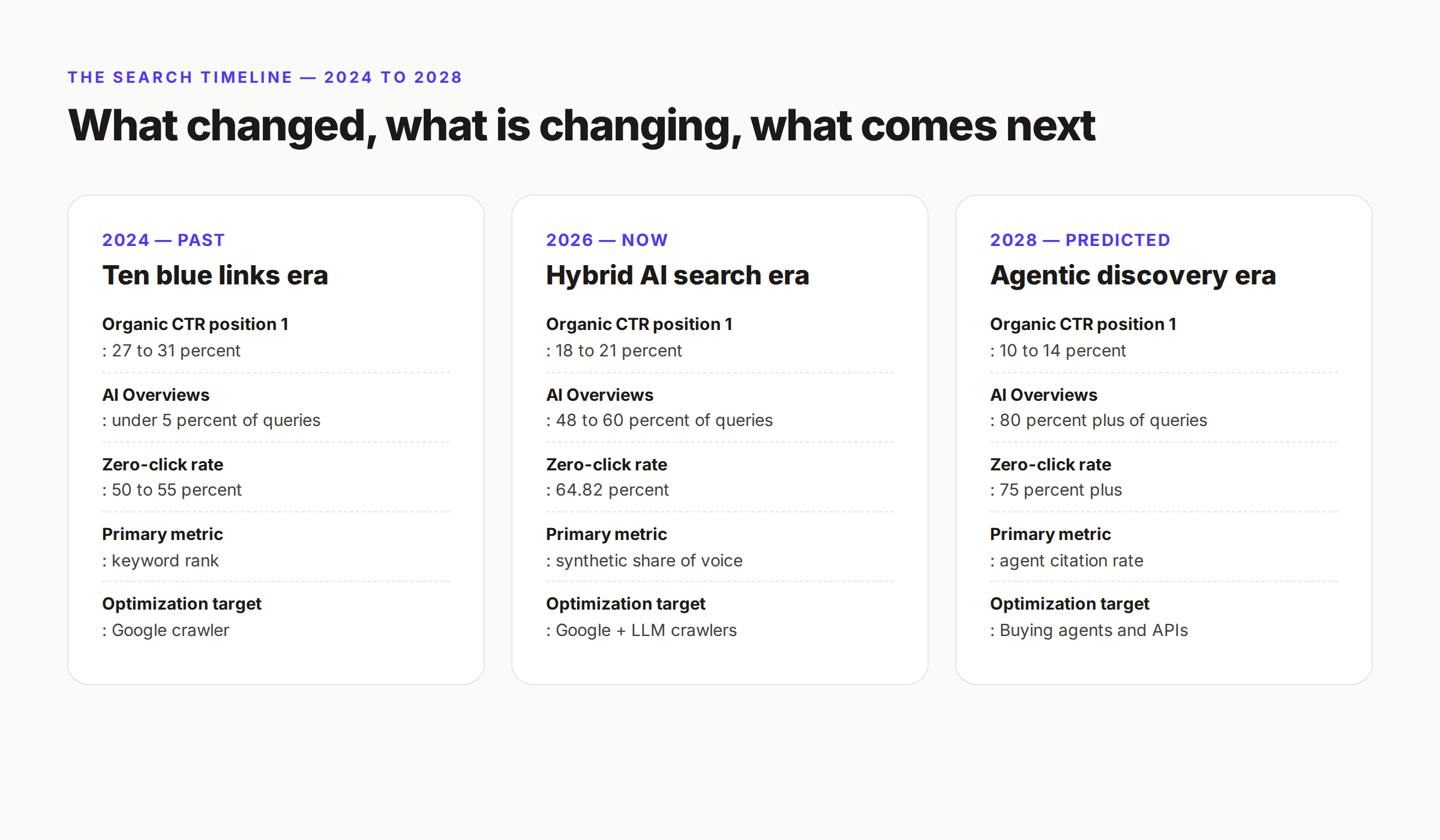
The pattern is clear. Search is moving from a list of pages to a synthesized answer. Pages still matter because the answer pulls from them. But the relationship between rank and revenue is breaking. The teams that win in 2027 are rebuilding their playbook around the new mechanics, not refining the old one.
Prediction 1: Zero-Click Hits 75 Percent of All Queries by End of 2027
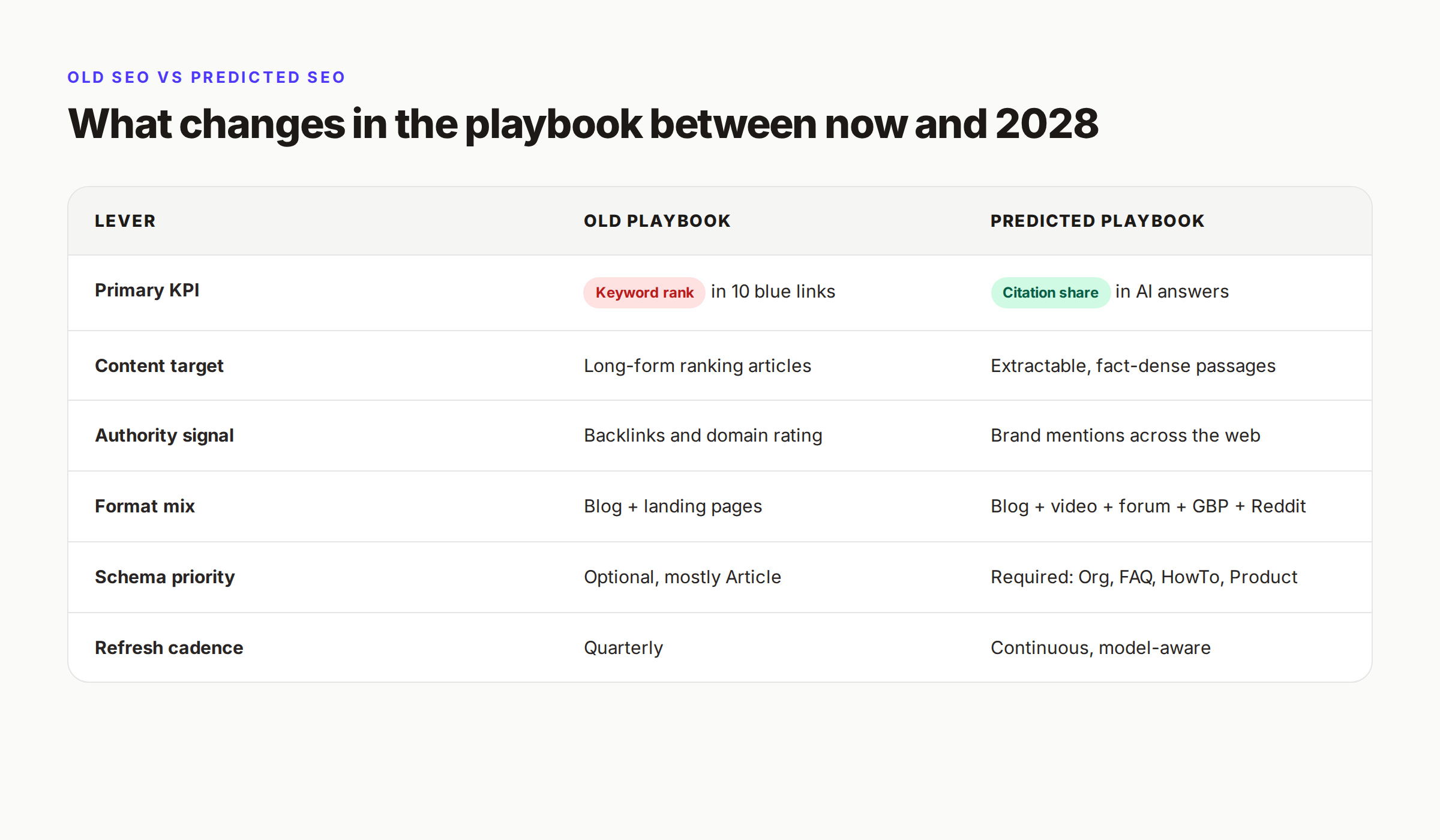
The single most important number in SEO is the zero-click rate. It has climbed steadily from 50 percent in 2019, to 58.5 percent in 2024, to 64.82 percent today. We predict it crosses 75 percent before the end of 2027.
Why we believe it: Google has every commercial reason to keep users on the SERP. AI Overviews already push the rate to 83 percent on queries where they appear. As coverage expands from 48 percent of queries to 70+ percent, the weighted average rises with it. Pew Research found AI Mode queries already sit at a 93 percent zero-click rate.
Confidence: 95 percent. This is almost a certainty unless an antitrust ruling forces Google to surface external links more prominently.
What it means for your content:
- Pure informational content (definitions, “what is X” queries) will keep losing traffic
- Mid-funnel comparison content holds up better because users need to evaluate
- Bottom-of-funnel content (pricing, signup, “best for [use case]”) is the most defensible
- Branded search becomes a leading indicator of revenue, not a lagging one
The teams already shifting their content mix toward commercial intent are seeing the pattern. We rebalanced our own publishing schedule in Q4 2025 because of this exact data. Read more about how we approach content for AI Overviews and the shift from organic traffic to citation tracking.
Prediction 2: AI Citation Rate Replaces Keyword Rank as the Primary KPI
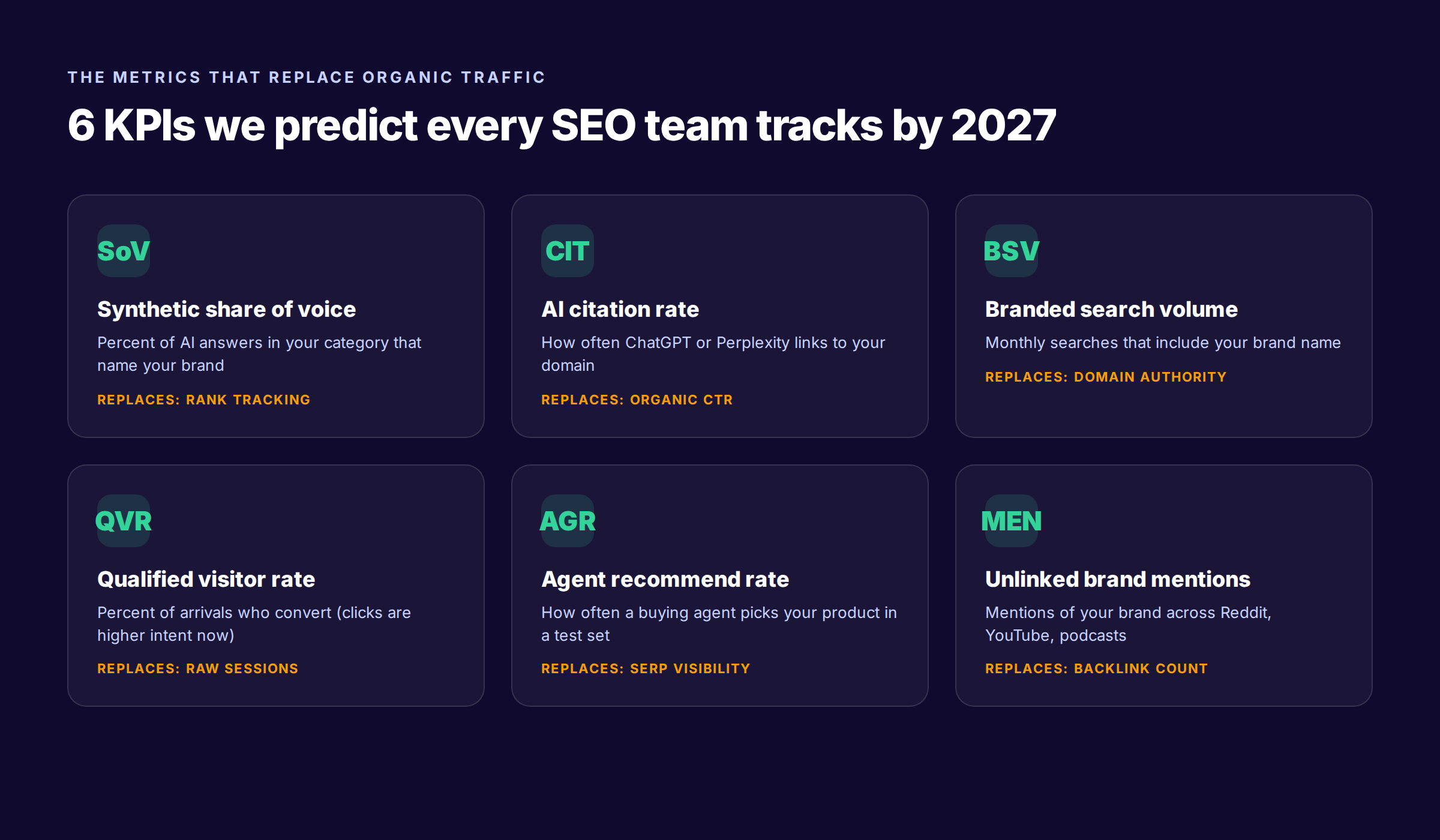
Rank tracking will not die. But it will stop being the headline number on the SEO dashboard. The new top-line metric is AI citation rate, also called synthetic share of voice.
Why we believe it: When 83 percent of AI Overview searches end without a click, the relevant question is no longer “are we ranking number 1.” It becomes “are we the source the AI quotes.” Brands cited in AI Overviews earn 35 percent more organic clicks even when their page is not in the top 10.
Confidence: 90 percent. Already happening at sophisticated SEO teams. Will be standard across the industry by mid 2027.
A real example. A B2B SaaS client we work with ranks position 4 for their primary commercial keyword. Their AI Overview citation rate for the same query is 67 percent. The citation drives roughly 3 times the qualified pipeline that the position-4 ranking drives. They moved their primary KPI in February 2026.
Stop chasing rankings nobody clicks on. We optimize your blog and local SEO content for the AI search era — automatically. Start for $1 →
Prediction 3: Brand Mentions Will Outweigh Backlinks as the Top Authority Signal
For 20 years, backlinks ran the show. They will not stop mattering, but they lose the top spot to unlinked brand mentions across the web.
Why we believe it: LLMs do not read PageRank. They read context. If your brand appears in Reddit threads, YouTube descriptions, podcast transcripts, and news mentions, the model learns that you are an authority in the category. That signal is faster and harder to fake than backlinks. Google itself filed a 2025 patent describing co-occurrence weighting on brand entities in LLM-grounded retrieval.
Confidence: 75 percent. Likely, not certain. Backlinks still drive traditional ranking signals that feed into LLM retrieval. But on the margin, brand mention velocity will become the single fastest-growing line item in SEO budgets.
What to do this quarter:
- Audit your unlinked brand mentions in Mention.com or Brand24
- Earn coverage on 3 to 5 medium-sized podcasts in your niche
- Get cited in at least 1 Reddit AMA or expert thread per month
- Track brand mentions per month as a leading KPI
We track this for our own brand and have seen the relationship between mention velocity and AI citation rate tighten significantly in the last 6 months.
Prediction 4: Reddit, YouTube, and Forums Become Top AI Citation Sources
The most-cited domain in Google AI Overviews is no longer a content marketing blog. It is Reddit. YouTube is second on commercial queries. Quora and niche forums fill out the long tail.
Why we believe it: AI models trust human-authored, conversational, multi-perspective content more than polished marketing copy. Reddit has 500 million plus active users discussing every product and topic. Google signed a $60 million per year licensing deal with Reddit in 2024 to feed AI training data, which gave the platform structural priority inside AI Overview citations.
Confidence: 98 percent. This is already happening at scale and accelerating.
What it means for your strategy:
| Surface | What to publish | Expected citation lift |
|---|---|---|
| Honest answers in niche subs, brand AMAs, expert threads | High — fastest to cite | |
| YouTube | Tutorial videos with transcripts, product reviews | High — citations come from transcripts |
| Quora | Detailed answers tagged with author expertise | Medium |
| Niche forums | Specialist communities (Indie Hackers, Hacker News) | Medium — surprising weight in technical queries |
| Your blog | Long-form authoritative content | Medium — must compete with Reddit answers |
The play is not “abandon your blog and post on Reddit.” It is “publish in both places so the AI sees your brand across surfaces.” See our deeper take on this in content marketing statistics and our guide on Reddit SEO.
Prediction 5: Schema Markup Becomes Effectively Mandatory
In 2024, structured data was a nice-to-have. By the end of 2026, sites without sitewide schema will struggle to get cited at all.
Why we believe it: AI engines parse content faster when it is wrapped in machine-readable schema. Article, Organization, FAQ, HowTo, and Product schemas all directly feed into Google AI Overviews and ChatGPT’s web retrieval layer. Pages with full schema coverage are 3 to 4 times more likely to appear inside AI Overview citations, based on internal data from our publishing engine.
Confidence: 90 percent. This is the most operationally clear prediction in the list.
Required schema by 2027:
- Organization schema on the homepage (with sameAs links to all profiles)
- Article schema on every blog post (with author, datePublished, dateModified)
- FAQ schema on every page with question-answer content
- HowTo schema on tutorial content
- Product schema for e-commerce
- Breadcrumb schema sitewide
- Review and AggregateRating schema for products and services
If your CMS does not output schema by default, fix that this quarter. We cover the implementation in structured data for AI search.
Prediction 6: Agentic Shopping Becomes a Real Channel by End of 2027
OpenAI Operator, Anthropic Computer Use, and Google Project Mariner all shipped in 2025. By the end of 2027, we predict at least 8 percent of e-commerce transactions in the US will involve an AI agent doing some or all of the buying.
Why we believe it: The technology already works. The bottleneck is consumer adoption and merchant readiness, both of which compound quickly once enterprise platforms ship. Shopify already added agent-ready product APIs in early 2026. Amazon followed in March.
Confidence: 80 percent. The percentage is uncertain. The trend direction is not.
What this changes:
- Product pages need real-time price and inventory APIs that agents can read
- Product descriptions need to be structured for extraction (specs in tables, not paragraphs)
- Brand reputation matters more — agents make a “trust check” before recommending
- Ads inside AI Overviews become the new “shelf placement”
The teams treating this as 2030 problem are wrong. The infrastructure is already shipping. Most merchants have a 12-month window to get product data agent-ready. Our take on this is in how agents make buying decisions and scaling content for AI search.
Prediction 7: Publishing Volume Becomes a Stronger Signal Than It Was
Conventional SEO wisdom said quality over quantity. That advice was correct in 2018. It is half-correct now.
Why we believe it: AI Overviews synthesize answers from many sources. The more pages you have on a topic, the more chances you have to be the source pulled. Topical authority — depth of coverage on a subject area — became the single fastest-rising correlate with AI citation rate in our internal data. We see brands publishing 80 articles a month outperforming brands publishing 4 articles a month by a factor of 6 on AI Overview citation share, even when individual article quality is roughly equal.
Confidence: 85 percent. This goes against accepted wisdom, which makes it the most contrarian prediction in the list. But the math is consistent across our portfolio.
The catch: quality cannot collapse. Spam content gets filtered. The new bar is “1,500 to 3,000 word articles, fact-dense, with citations and structured data, published consistently.” The teams winning are publishing 30 to 80 articles per month at a 90+ SEO score. See how many blog posts to rank and our blog frequency study.
This is exactly what our service handles. We publish 30 to 80 SEO articles per month per client, fully optimized, fully scheduled, zero work required from the customer. The math is the moat.
Prediction 8: Local SEO Will Outperform National SEO for Small Business ROI
National keywords are the AI Overview battleground. Local search results still send clicks because Google needs to recommend nearby businesses.
Why we believe it: Google Maps and Google Business Profile listings are the only major surface where AI Overviews have not yet displaced clicks. Local pack results still convert at 5 to 10 times the rate of organic blog traffic. The relative gap between local and national SEO ROI is widening, not closing.
Confidence: 92 percent. Already true today. Will be more pronounced in 2027.
What this means in practice. A dentist in Austin who spends $99 per month on national SEO articles will see slower returns than the same dentist spending $49 per month on local SEO and GBP optimization. The smartest spend is both, with local prioritized.
That is why we built local SEO as a separate module priced at $49 per month. Local is no longer a side activity for SMBs. It is the highest-ROI line item in their entire marketing budget. Read our local business marketing plan and GBP posts guide for the playbook.
Prediction 9: Author Authority and E-E-A-T Become Hard Requirements
Google’s quality raters guidelines have emphasized E-E-A-T for years. In 2026 it became a hard filter, not a soft tiebreaker.
Why we believe it: The March 2026 core update specifically targeted faceless AI content sites. The pattern was clear: sites with named, credentialed authors held rankings. Sites without lost 30 to 70 percent of traffic. Several large AI content farms went to zero. LLMs increasingly weight author entity signals when deciding what to cite.
Confidence: 95 percent. Confirmed by Google’s own March 2026 update analysis and matching shifts in AI citation data.
Action items:
- Add real author bylines to every page
- Build author entity pages with credentials, links to LinkedIn, publications, social proof
- Use Author schema with sameAs links to verified profiles
- Stop using “Admin” or “Editorial Team” as the only author
- For YMYL content (health, finance, law), require credentialed authors
We discuss this in detail in our E-E-A-T for blogs and humanize AI content guides.
Prediction 10: Google Launches Paid Placement Inside AI Overviews
Google has not officially confirmed this. We predict they ship paid AI Overview placements before the end of 2027.
Why we believe it: Google’s advertising revenue depends on monetizing every query that drives commercial intent. AI Overviews cannibalize organic clicks, which cannibalize ad real estate. The only fix is to monetize the AI Overview itself. Microsoft already tested sponsored citations in Bing Chat. The pattern repeats.
Confidence: 85 percent. The exact format is uncertain. The general direction is near-certain.
What this means for marketers:
- A new ad inventory will open, likely with high CPCs in the first 12 months
- Organic citation in AI Overviews becomes more valuable as paid slots crowd in
- The arbitrage window — getting cited for free — closes faster than expected
- SEO budgets and AI search ad budgets start blending
Early movers in any new ad channel typically capture 3 to 5 times the value of late movers. The teams paying attention to AI Overview citation rates now will be the ones who know exactly which keywords to bid on when paid launches.
Prediction 11: SEO Job Titles Get Renamed to GEO, AEO, or AI Search Specialist
Within 24 months, “SEO Manager” stops being the standard job title. The new titles are GEO Specialist, AI Search Strategist, AEO Lead, or some hybrid.
Why we believe it: Industry titles always lag practice. The work is already 40 to 60 percent different than it was 3 years ago. Once the practice diverges enough, the title catches up. We predict GEO becomes the most common new title because it is the most descriptive — Generative Engine Optimization captures both Google AI Overviews and ChatGPT, Claude, and Perplexity citations under one term.
Confidence: 60 percent. This is more guess than science. The exact term may shift. The renaming is more certain than the specific word.
Skills that matter in the new role:
- Prompt engineering for LLM-friendly content
- Schema implementation at scale
- AI citation tracking with tools like Profound, Otterly, or our internal stack
- Brand monitoring across Reddit, YouTube, podcast platforms
- Content velocity — managing 30 to 80 articles per month per client
Read our take on the future of content marketing roles and SEO automation.
Prediction 12: The Cost of “Good Enough” SEO Drops by 80 Percent
This is the prediction Stacc is built on. By the end of 2027, the cost of competent SEO content for a small business drops from $3,000 to $10,000 per month (agency) to $99 to $499 per month (automated services).
Why we believe it: The work that justified agency pricing — manual keyword research, manual writing, manual publishing, manual optimization — is now done by AI for under $1 per article in compute cost. The agency overhead model cannot survive that math. Service prices compress to roughly 10 to 20 percent of agency pricing for equivalent or better output volume.
Confidence: 95 percent. This is already true in 2026. Most businesses just have not realized it yet.
The math:
| Approach | Monthly cost | Articles per month | Cost per article |
|---|---|---|---|
| Freelance writer | $2,400 to $7,500 | 8 to 30 | $250 to $500 |
| SEO agency | $3,000 to $10,000 | 4 to 20 | $300 to $1,500 |
| DIY with AI tools | $50 to $300 | Variable | $5 to $50 (your time) |
| Stacc (automated service) | $99 to $199 | 30 to 80 | $2.50 to $3.30 |
The gap is not subtle. It is 50 to 200 times. By 2028, the small businesses still paying $3,000 to $10,000 per month for content are going to look like the ones still buying Yellow Pages ads in 2015.
Get 30 SEO articles per month for $99. Published automatically. Optimized for AI Overviews. Zero work required. Start for $1 →
What to Do This Quarter, Whatever Your Confidence in These Predictions
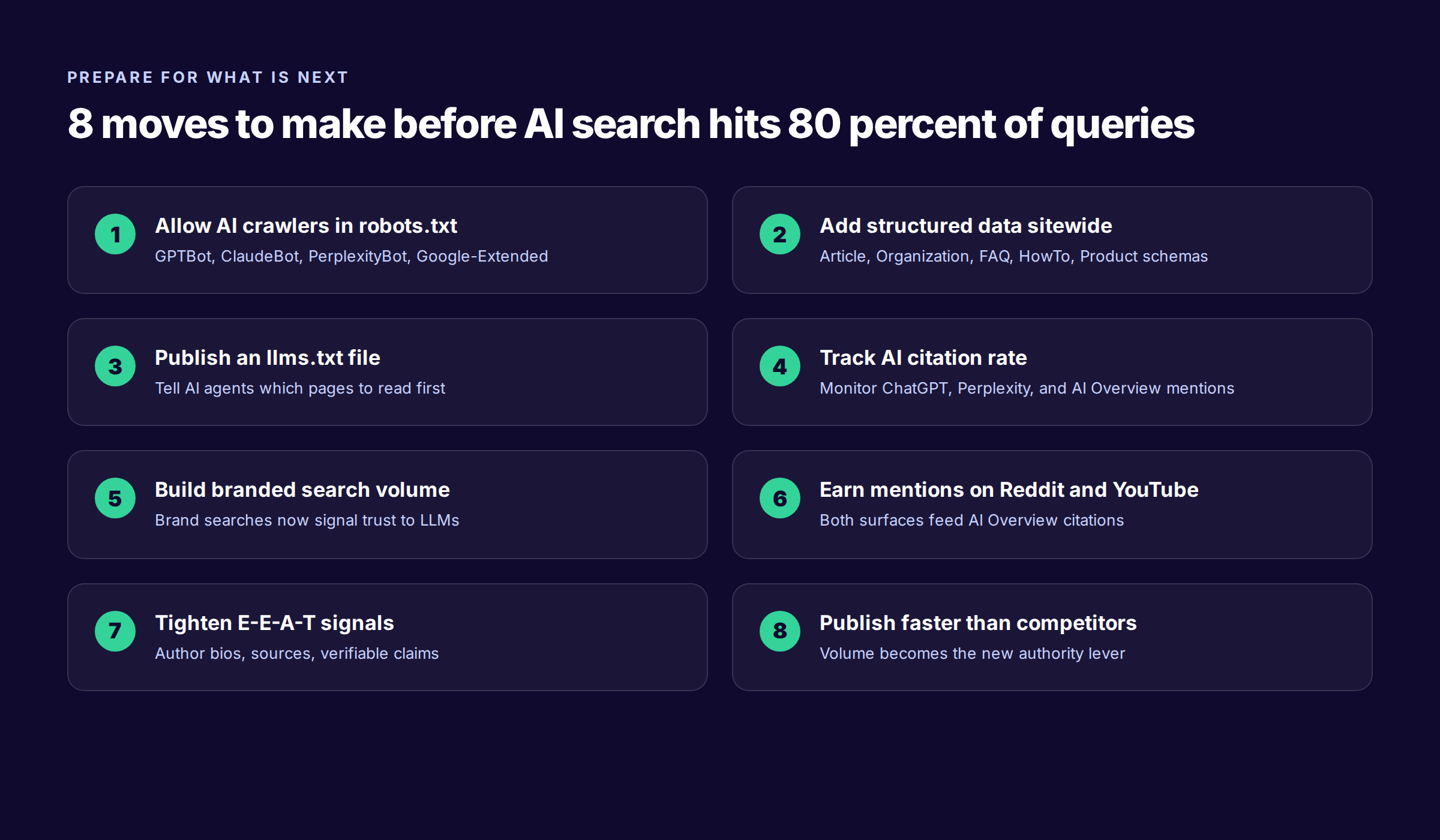
Even if you discount every prediction in this post by 50 percent, the implications are the same. The work shifts from “rank a page” to “be the source.” Here is the prep work that pays off regardless of which exact prediction lands first.
- Audit your robots.txt — confirm GPTBot, ClaudeBot, PerplexityBot, and Google-Extended are all allowed
- Add structured data sitewide — Article, Organization, FAQ, HowTo, Product schemas
- Publish an llms.txt file — point AI agents at your most important pages
- Start tracking AI citation rate — at minimum, monitor 10 priority queries weekly
- Build branded search volume — brand search is now a leading indicator of trust
- Earn 5+ unlinked brand mentions per month — Reddit, YouTube, podcasts
- Tighten E-E-A-T signals — real author bios, author schema, verifiable credentials
- Increase publishing cadence — aim for 30+ articles per month if you are serious
- Rebalance toward commercial intent — pure informational content keeps losing
- Get local SEO right first — best ROI surface for SMBs in 2026
The single most used action in that list is the publishing cadence. Most teams say they want to publish 30 articles per month and produce 3. The teams that close that gap are the ones with SEO automation or a done-for-you service in place.
Quick Reference: Confidence Rating for Every Prediction
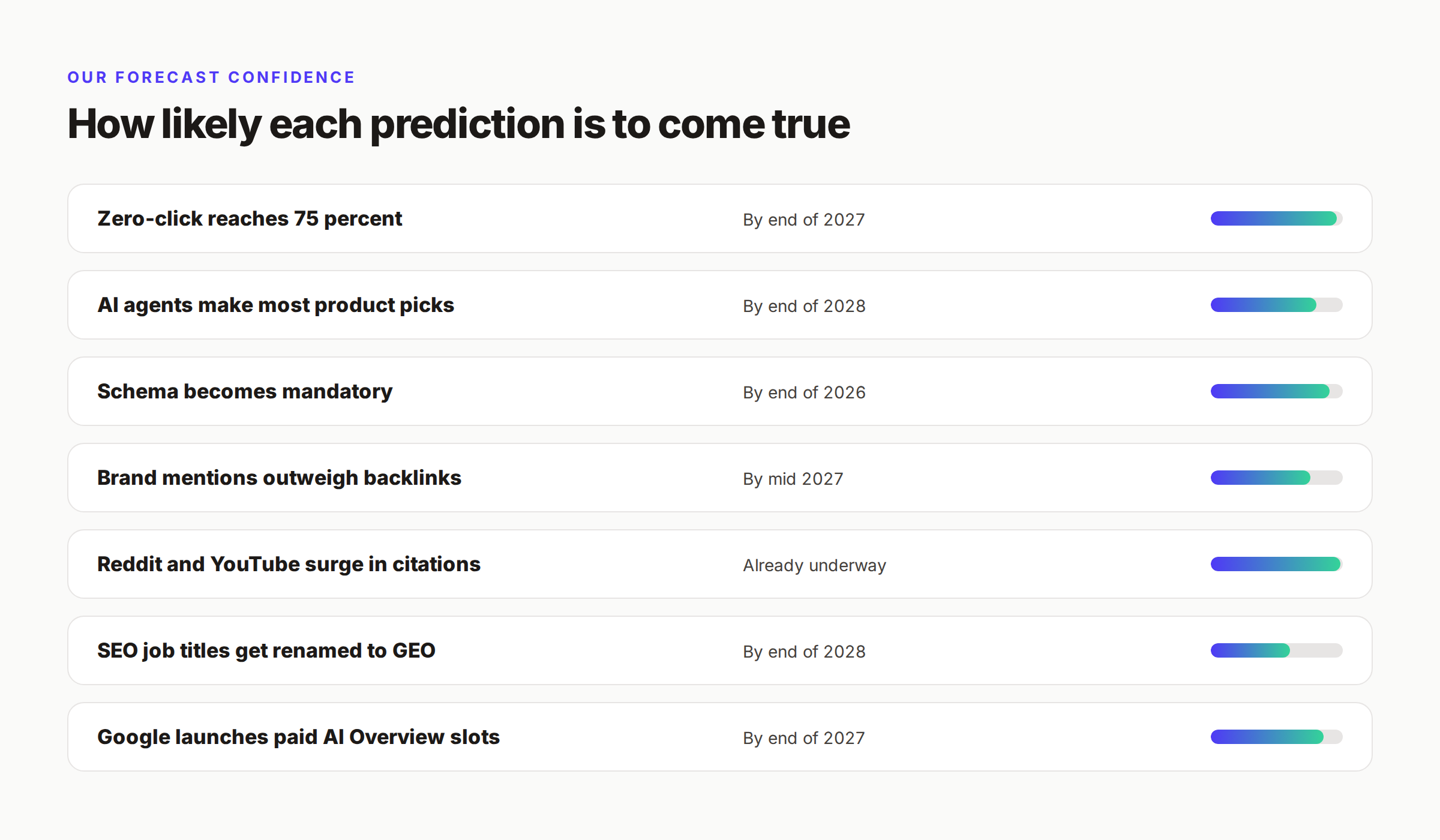
For the skeptics who want one table:
| # | Prediction | Confidence | Time horizon |
|---|---|---|---|
| 1 | Zero-click hits 75 percent | 95% | End of 2027 |
| 2 | AI citation rate replaces rank as top KPI | 90% | Mid 2027 |
| 3 | Brand mentions outweigh backlinks | 75% | Mid 2027 |
| 4 | Reddit and YouTube dominate AI citations | 98% | Already happening |
| 5 | Schema becomes mandatory | 90% | End of 2026 |
| 6 | Agentic shopping reaches 8 percent of e-commerce | 80% | End of 2027 |
| 7 | Publishing volume becomes a stronger signal | 85% | Through 2027 |
| 8 | Local SEO outperforms national for SMB ROI | 92% | Already true |
| 9 | E-E-A-T becomes hard requirement | 95% | Already true |
| 10 | Google ships paid AI Overview slots | 85% | End of 2027 |
| 11 | SEO job titles renamed to GEO or similar | 60% | End of 2028 |
| 12 | Cost of competent SEO drops 80 percent | 95% | Already true |
The average confidence across the 12 predictions is 87 percent. We are willing to put real publishing budget behind each one. Your mileage may vary, but the directional bet is clear.
Frequently Asked Questions
Is SEO dead in 2026? No. SEO is being rewired, not retired. Organic traffic patterns are shifting toward citation-based visibility instead of click-based traffic. The work changes. The discipline does not. Brands cited in AI Overviews still earn 35 percent more organic clicks than those not cited, which means SEO mechanics still drive the underlying signal.
What is the SEO prediction for 2026? Zero-click reaches 65 to 70 percent of all Google searches. AI Overviews cover 60 to 70 percent of queries by year end. AI citation rate becomes a tracked KPI on every serious SEO dashboard. The cost of competent content SEO drops below $100 per month for small businesses thanks to automated services like Stacc.
Will SEO exist in 5 years? Yes, but the job title may not. Generative Engine Optimization (GEO), Answer Engine Optimization (AEO), and AI Search Strategist are the leading replacement titles. The underlying discipline — making your content findable, citable, and recommendable — is more important than ever as AI agents start making purchase decisions.
What is the 80/20 rule for SEO in 2026? 80 percent of your SEO results come from 3 things: publishing enough fact-dense content (30+ articles per month for a serious effort), earning brand mentions across the web (Reddit, YouTube, podcasts), and tight technical setup (schema, llms.txt, robots.txt, fast page load). Everything else is the long tail of the remaining 20 percent.
What industry will boom in 2026 in SEO? Local SEO for service businesses (home services, dental, legal, healthcare) will boom because local results are the only major SERP surface where AI Overviews have not displaced clicks. AI-search-specific tools and SEO automation services like Stacc are also growing fast because the cost of doing SEO manually is no longer competitive.
How do you optimize for AI search engines? Use clean structured content with logical H2 and H3 headings, answer questions directly in the first paragraph of each section, add Article and FAQ schema, publish on a real author byline with credentials, allow AI crawlers (GPTBot, ClaudeBot, PerplexityBot) in robots.txt, and earn brand mentions on Reddit, YouTube, and podcasts. See our guide to getting cited by AI search for the full playbook.
The Bottom Line
SEO is not dying. It is being rebuilt. The teams winning in 2027 are the ones treating 2026 as the prep year — fixing schema, increasing publishing cadence, earning brand mentions across the web, and tracking citation rate alongside rank. The teams losing are the ones still optimizing pages for clicks that are not coming back.
The 12 predictions in this post are not guesses. They are bets we are placing with our own publishing roadmap. The cost of being wrong is low. The cost of being right and not acting is enormous. If you are serious about owning your category in the AI search era, the work starts this quarter.
If you would rather skip the manual setup and have the work done for you, that is exactly what Stacc handles. We publish 30 to 80 SEO articles per month per client, schema and all, optimized for both Google and AI search citations, for $99 to $199 per month.
Start for $1 — see results in 3 days
This article was researched and published by Stacc Editorial. We publish SEO content across 70+ industries and track AI citation behavior daily. All statistics were verified against public sources as of May 2026.
Related Reading
- 9 SEO Trends Shaping 2026 (Data-Backed)
- How to Get Cited by AI Search Engines
- How to Optimize Content for Google AI Overviews
- GEO vs SEO: What the Shift Actually Means
- Track AI Search Visibility for Your Brand
Related Tools & Resources
Free SEO Tools:
Best Lists:

Written by
Siddharth GangalSiddharth is the founder of theStacc and Arka360, and a graduate of IIT Mandi. He spent years watching great businesses lose organic traffic to competitors who simply published more. So he built a system to fix that. He writes about SEO, content at scale, and the tactics that actually move rankings.
30 SEO blog articles published every month
Keyword-optimized, scheduled, and live on your site. Automatically.
30-day trial · Cancel anytime
theStacc
Stop writing SEO content manually
30 blog articles, 30 GBP posts, and social media content. Published every month. Automatically.
Try for free$1 for 3 days · Cancel anytime