
UGC Ecommerce SEO Strategy: The Complete 2026 Guide
Master a UGC ecommerce SEO strategy in 2026. Use customer reviews, photos, and video to earn rich snippets, rank higher, and convert 5.4x better.
Most ecommerce stores leave free SEO content sitting in their inbox. Every customer who buys a product is willing to write copy, take photos, and answer questions Google is already trying to index. Yet 93% of shoppers read reviews before buying, and your product pages have three thin ones.
The cost of ignoring user-generated content is brutal. You lose rich snippet eligibility, surrender long-tail keyword surface area, and watch competitors with active review programs outrank you on commercial queries. Pages without UGC convert 5.4 times worse than pages that have it (Salsify).
This guide is the complete UGC ecommerce SEO strategy we use at Stacc. We publish 3,500+ blogs across 70+ industries, and the same compounding principle that works for editorial content works for customer-created content. The difference is your buyers do the writing.
Here is what you will learn:
- Why UGC is the single highest-ROI ranking lever for product pages
- The six UGC formats that move rankings and how each one ties to an SEO outcome
- How to collect reviews, photos, and video without bribing customers
- The exact schema markup and technical setup that earns review snippets
- How to mine UGC for blog content and PAA capture
- Moderation rules that keep Google penalties away
- How to measure UGC SEO impact across rankings, CTR, and revenue
- The mistakes that turn UGC into a ranking liability
Chapter 1: Why UGC Is the Highest-ROI Ecommerce SEO Lever
UGC stacks every ranking signal Google cares about in one place. Fresh content, long-tail keywords, dwell time, click-through rate, and trust all improve when customers post on your product pages. No other tactic affects this many factors at once.
The numbers settle the debate. Pages with verified reviews see a 35% click-through rate uplift in SERPs (Search Engine Land). Time-on-page rises by 40% when video reviews appear above the fold. Conversion rate goes up 5.4x when shoppers see UGC versus pages with only brand copy.
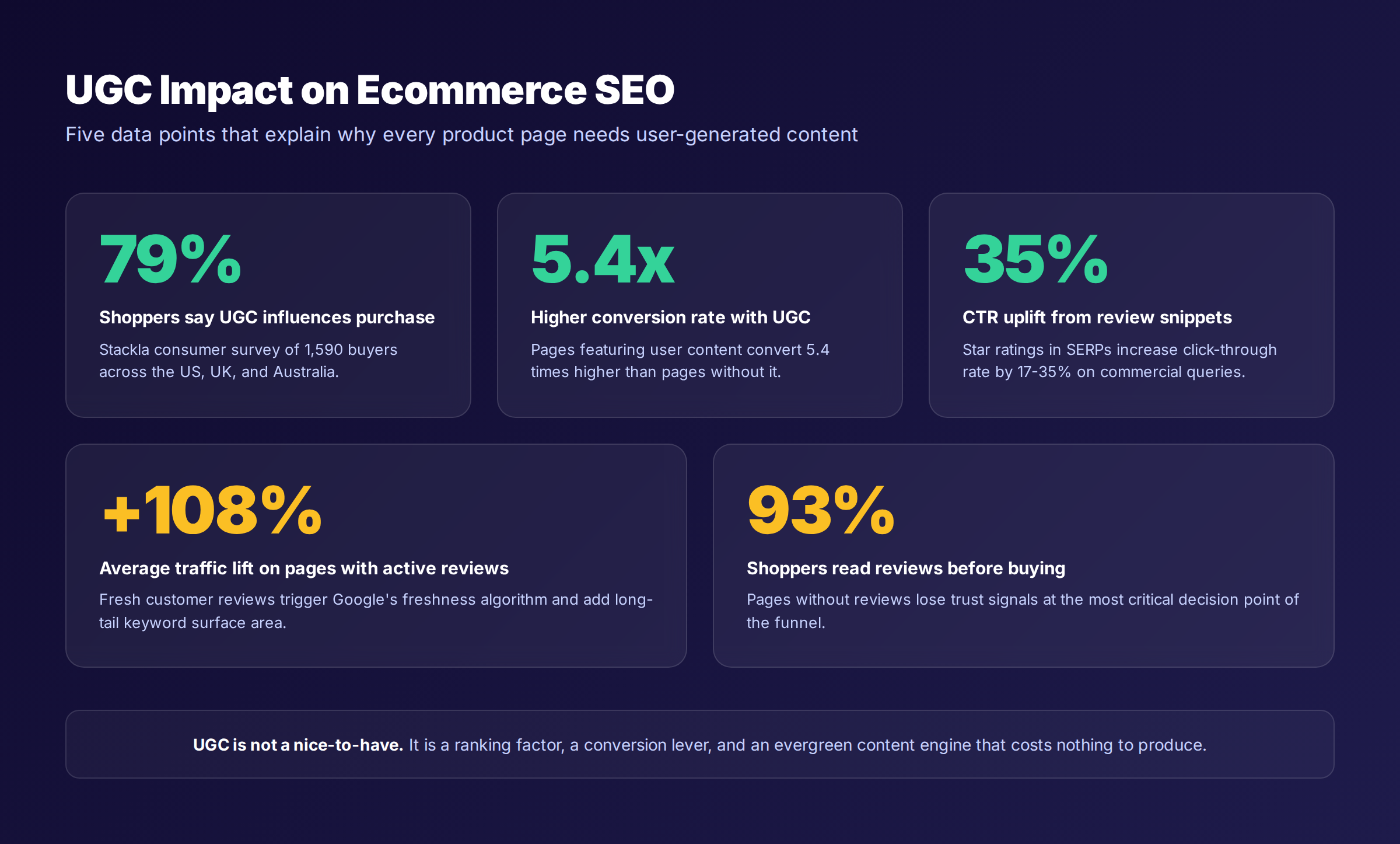
UGC Hits Five Ranking Signals at Once
Most SEO tactics improve one factor. UGC improves five.
| Ranking Signal | How UGC Affects It |
|---|---|
| Freshness | New reviews add dated content to product pages weekly |
| Long-tail keywords | Customer language captures queries your copy missed |
| Word count | A page with 50 reviews has 3,000+ additional words |
| Click-through rate | Star ratings in SERPs lift CTR by 17-35% |
| Trust signals | E-E-A-T improves through verified buyer experience |
The compounding effect matters most. A product page with 5 reviews today will have 50 in 12 months. Each review adds keywords. Each keyword expands the page’s ranking footprint. This is The Content Compound Effect applied to commerce. Read our ecommerce SEO guide for the broader playbook.
What Google Officially Says About UGC
Google has confirmed UGC is a positive signal multiple times. In the E-E-A-T guidelines, the “Experience” attribute was added specifically to elevate content from people who have firsthand product knowledge. Customer reviews are the purest form of experience signal.
The Helpful Content System further rewards pages that demonstrate real-world use. A product page with detailed buyer reviews demonstrates this. A page with three sentences of manufacturer copy does not.
But there is a tradeoff. Google’s user-generated content best practices require moderation. Unfiltered review systems open the door to spam, fake reviews, and ranking penalties. This guide covers how to collect UGC the right way.
The Three Failure Modes Most Stores Have
After auditing hundreds of ecommerce sites, the same three failures show up:
- Reviews render client-side. JavaScript-only review widgets do not get indexed. Googlebot sees zero UGC even if your page displays 100 reviews to humans.
- Schema is missing or broken. Without Product and Review schema, you forfeit star rating snippets in SERPs.
- Collection is passive. Stores wait for organic reviews. They get 5-10 per year per product. Active collection gets 10-30 per month.
Each failure is fixable in under a week. The compounding return starts the moment you fix them.
Chapter 2: The Six UGC Formats That Move Rankings
Not all UGC affects SEO equally. A 5-star rating without text helps less than a 200-word review with photos. Match each format to the SEO outcome you want.
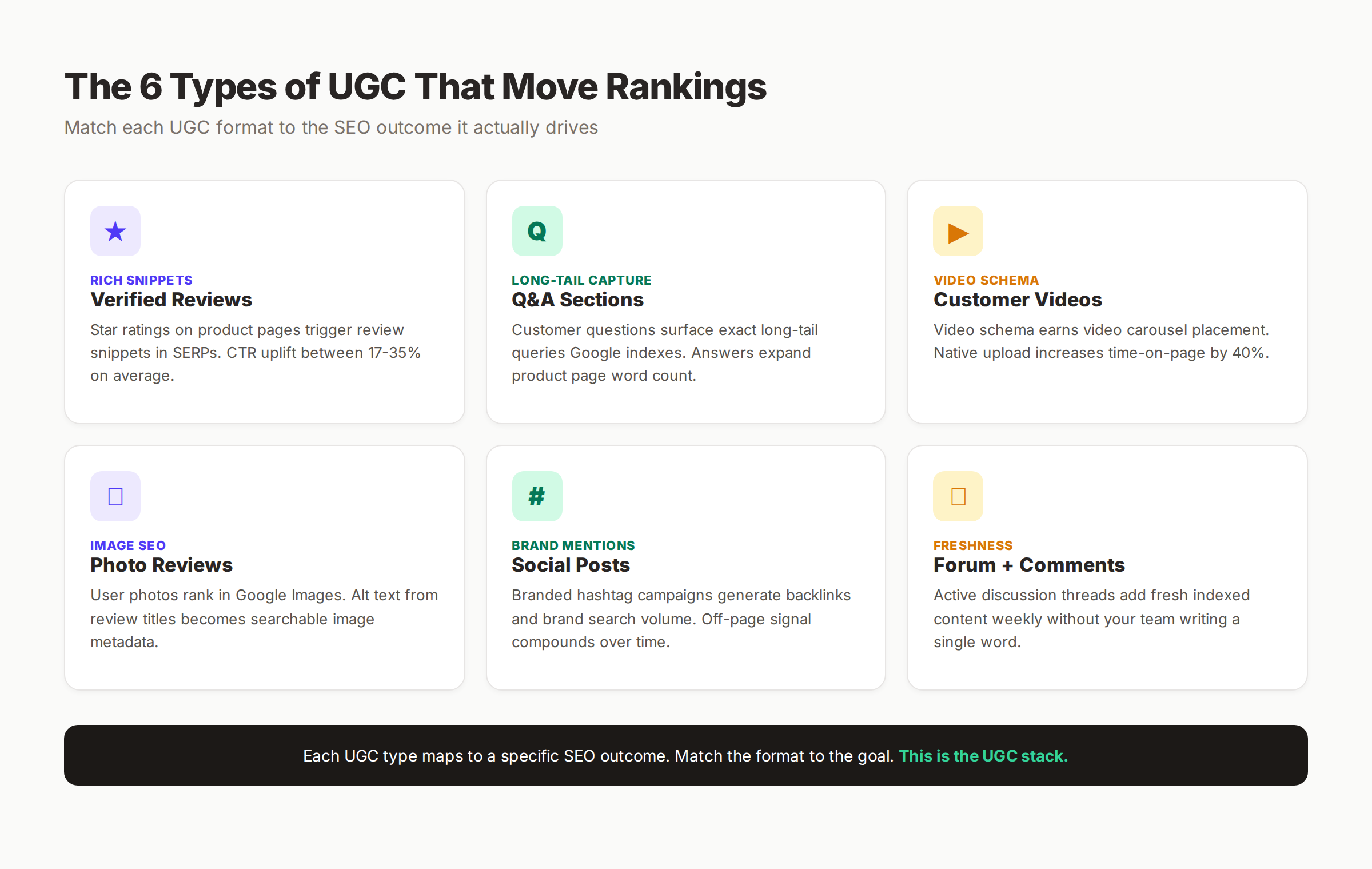
1. Verified Text Reviews
Verified reviews are the foundation. They feed the Review schema, drive star snippets, and add keyword-rich content to product pages.
Best practices:
- Require a minimum of 50 words to qualify for posting
- Add a verified buyer badge to filter incentivized spam
- Display the most recent reviews first to maintain freshness
- Include a “found this helpful” voting system to surface quality reviews
- Allow buyers to update reviews after 30 days of use
The verified label matters. Google’s structured data guidelines require honest, unincentivized reviews. Stores that publish fake reviews lose snippet eligibility and risk manual penalties.
2. Customer Photos
Photo reviews drive image search rankings and reduce return rates. They also expand your product page to include alt text and image-based metadata.
Implementation tips:
- Prompt for a photo in the review submission flow
- Use the review title as image alt text
- Compress images to under 200KB for page speed
- Lazy load below-the-fold review images
- Add the photos to your product image carousel
A clothing brand we audited had 800 customer photos sitting in a forgotten database. We pulled them into the product galleries with proper alt text. Image search traffic to those product pages rose 240% in 90 days.
3. Customer Videos
Video UGC is the highest-value format and the hardest to collect. One 30-second customer video can drive more conversions than 20 text reviews.
For SEO, video UGC unlocks:
- VideoObject schema for video-rich results
- Video carousel placement in SERPs
- Higher time-on-page (the average video review is watched for 22 seconds)
- YouTube embeds that link back to product pages
Host videos natively when possible. Embedding YouTube reviews helps social proof but hands engagement signals to Google’s YouTube property instead of your domain. Native hosting plus VideoObject schema keeps the SEO equity on your site.
4. Q&A Sections
Customer questions are a goldmine for long-tail SEO. Buyers ask in the exact language Google uses to match queries. “Will this fit a 6-inch wrist?” matches a search that no brand copywriter would think to target.
Set up a Q&A section on every product page:
- Allow any logged-in buyer to ask a question
- Notify previous buyers via email to crowd-source answers
- Display Q&A in the HTML source, not via API call
- Add FAQPage schema if the question matches a frequently asked question
- Pin verified expert answers from your support team
Q&A content captures People Also Ask placements. We have seen product Q&A blocks rank directly in PAA on commercial queries. Read our optimize for People Also Ask guide for tactical placement tips.
5. Social Posts and Hashtag Campaigns
Branded hashtag campaigns generate UGC at scale and drive backlinks back to product pages. Every Instagram or TikTok post that mentions your brand creates a brand search signal.
The mechanics:
- Create a branded hashtag (e.g., #YourBrandFit)
- Display a curated feed of hashtagged posts on the product page
- Embed the social posts in product galleries with proper attribution
- Pitch the best UGC to industry publications for backlinks
- Track branded keyword growth in Search Console
This is The Stacc Stack Method applied to social. One customer post becomes a product page asset, a social republish, and a backlink target. Our does social media help SEO guide breaks down the indirect ranking benefits.
6. Forum Posts and Comments
Brand-owned communities create the deepest UGC. Reddit-style discussion forums or comment threads on blog posts add fresh, indexable content to your domain every day.
Examples that work:
- A community Q&A section attached to your blog
- A product-specific discussion thread linked from each product page
- A “share your setup” section for product showcases
- Customer support transcripts converted to public Q&A pages
Forum-style UGC requires moderation discipline. Allow it to go unchecked and you invite spam, off-topic posts, and link manipulation. Use rel=“ugc” on user-submitted links to comply with Google’s link attribute guidelines.
UGC compounds when every customer becomes a content creator for your site. Stacc helps ecommerce brands build the publishing system around it. Start for $1 →
Chapter 3: How to Collect UGC at Scale
Passive collection delivers 5% review rates. Active collection delivers 20-30%. The difference is process, timing, and incentive design.
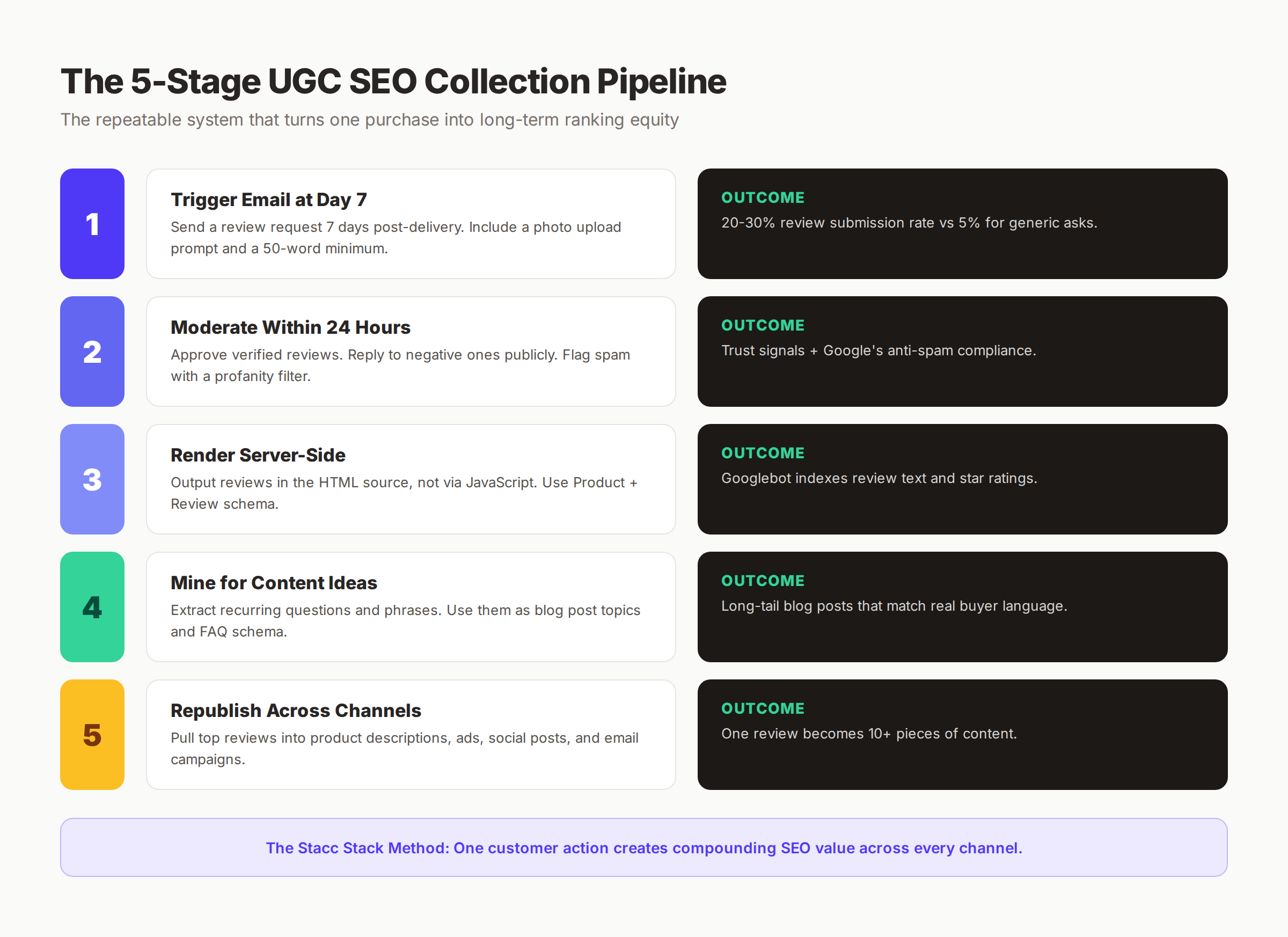
The 7-Day Review Trigger
Send the review request 7 days after delivery, not 7 days after purchase. The product has been used. The opinion is formed. The buyer remembers the experience clearly.
Email structure that works:
- Subject line that names the product: “How is your [Product Name] working out?”
- One specific question: “Did the sizing match?” instead of “Leave a review”
- A photo upload prompt with a 50-word minimum
- A clear incentive: 10% off the next order, free shipping, or loyalty points
- A one-click submit (no account required for verified buyers)
Stores using this structure see 22-28% submission rates. The generic “leave a review” email pulls 4-6%. The compounding gap is enormous over a year.
Incentive Rules That Stay Compliant
The FTC and Google both crack down on incentivized reviews when the incentive is tied to a positive rating. The compliant approach:
- Offer the incentive for any honest review, positive or negative
- Disclose the incentive in the review (e.g., “I received a discount for this review”)
- Never gate the incentive behind a star threshold
- Cap incentive value below the product’s purchase price
Google’s guidelines explicitly disqualify incentivized reviews that bias the outcome. Compliant disclosure protects both your snippet eligibility and your brand reputation.
Post-Purchase Touchpoints That Drive UGC
The thank-you email is too early. The shipping notification is too transactional. The review request at day 7 is the primary trigger. Add these supporting touchpoints:
| Touchpoint | Timing | Purpose |
|---|---|---|
| Order confirmation | Day 0 | Plant the seed: “We will ask for your feedback later” |
| Shipping notification | Day 2-3 | Include a “share on social” hashtag CTA |
| Delivery confirmation | Day 4-5 | Ask if delivery was smooth (NPS data, not a public review) |
| Review request | Day 7 | The primary collection trigger |
| Follow-up nudge | Day 14 | Send only to non-responders, with photo prompt |
| 30-day re-engagement | Day 30 | Ask buyers to update reviews after extended use |
Automate this with an email platform like Klaviyo, Drip, or ConvertKit. Use email tools to align this pipeline with your overall email newsletter strategy.
SMS, In-Pack, and QR Code Collection
Email opens average 22% for ecommerce. SMS opens hit 95%. Add SMS to your collection mix.
- SMS review request at day 7 with a one-tap upload link
- In-pack postcard with a QR code linking to the review page
- Packaging insert with a unique campaign code tied to the order
- WhatsApp message for international buyers where SMS is less common
The QR code in packaging is undervalued. Buyers scan it within minutes of unboxing. The review submission rate from in-pack QR codes is 18-25% in our internal benchmarks.
Loyalty Programs That Reward UGC
Tie review submission and photo uploads to your loyalty program. Award points for:
- Verified text review: 50 points
- Photo review: 100 points
- Video review: 200 points
- Answering a Q&A question: 25 points
This stays compliant because the points reward the act of submitting, not the rating. It also drives repeat purchase, since buyers redeem loyalty points on their next order. The flywheel is one customer creating content that drives more customers to buy and create more content.
Chapter 4: Technical SEO Setup for UGC
The technical foundation determines whether UGC affects rankings or sits invisible to Google. Most ecommerce stores fail this step by relying on third-party widgets that render reviews via JavaScript.
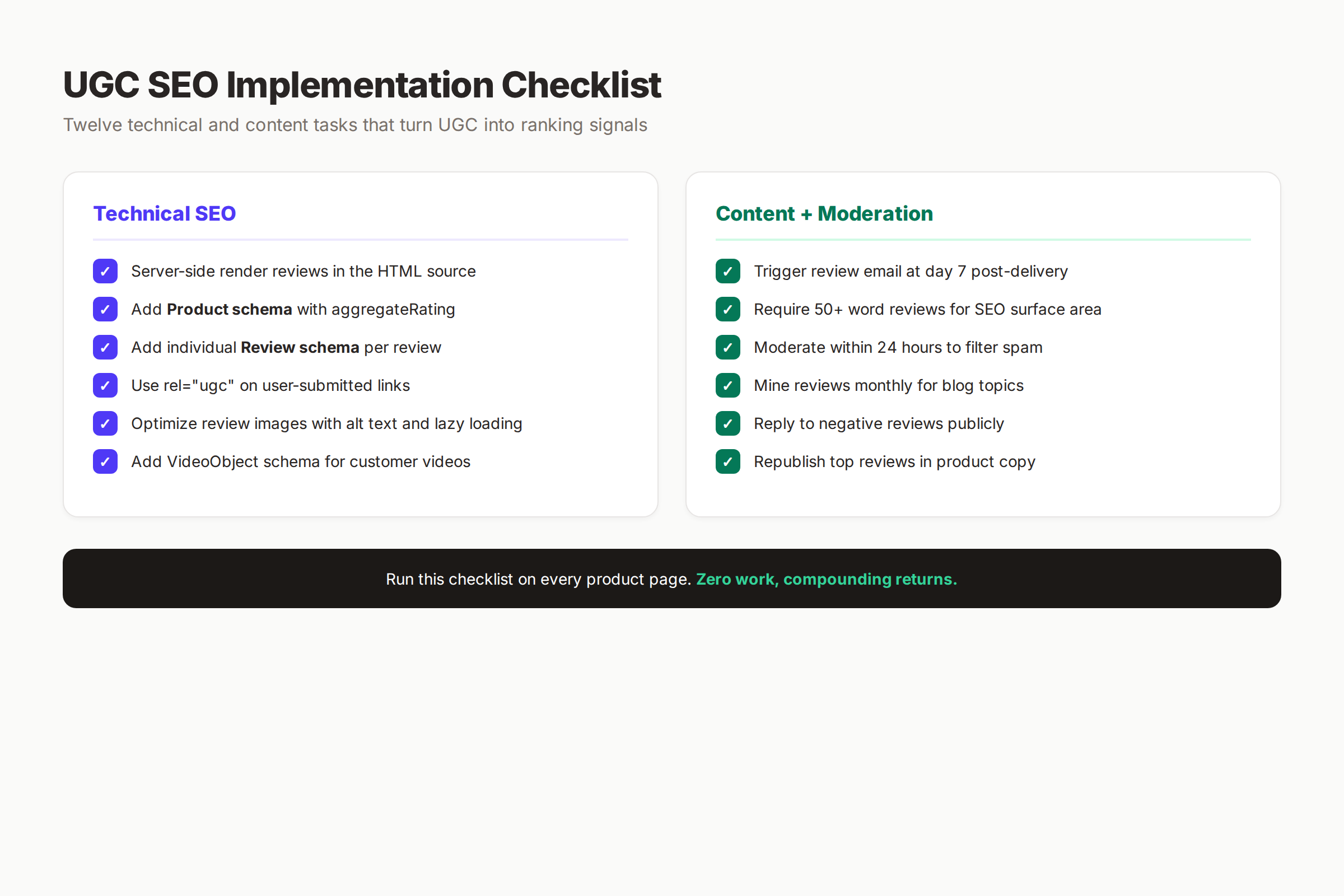
Server-Side Rendering Is Non-Negotiable
Google’s Web Rendering Service can execute JavaScript, but it does so on a delay and inconsistently. Reviews that render client-side may not appear in Google’s index for weeks or at all.
The fix is server-side rendering. Output review HTML directly in the page source. Tools that support SSR for reviews include Stamped, Yotpo (with the right plan), Okendo, and Reviews.io. Custom-built solutions on Shopify Hydrogen, Next.js, or Astro can render reviews at build time or via SSR.
Verify your setup:
- View the page source (right-click, View Page Source)
- Search for the review text
- If you see the text, it is server-rendered
- If you do not, switch providers or fix the rendering layer
A SaaS-style review widget that displays beautifully but renders client-side gives you zero SEO benefit. Read our JavaScript SEO guide for the full rendering breakdown.
Product Schema with AggregateRating
Add Product schema to every product page. Within the Product schema, nest the aggregateRating object. This unlocks star rating snippets in SERPs.
The minimum required fields:
{
  "@context": "https://schema.org",
  "@type": "Product",
  "name": "Product Name",
  "image": "https://example.com/product.jpg",
  "aggregateRating": {
    "@type": "AggregateRating",
    "ratingValue": "4.7",
    "reviewCount": "247"
  }
}
Use Google’s Rich Results Test to validate every product page. A schema error blocks snippet eligibility for the entire page.
Individual Review Schema
Beyond aggregateRating, add Review schema for individual reviews. This provides more context for AI search engines and improves the chance of being cited in AI Overviews.
The review schema should include:
- Author name (use first name and last initial for privacy)
- Date published
- Review body text
- Individual rating value
- Verified purchase flag
Cap the schema to your top 5-10 reviews per page to avoid bloated HTML. Rotate which reviews appear in schema based on helpfulness votes.
The rel=“ugc” Link Attribute
When users post links in reviews, comments, or Q&A, use rel=“ugc” on those links. This tells Google the link came from user-generated content rather than your editorial team.
The full attribute looks like this:
<a href="https://example.com" rel="ugc nofollow">Example Link</a>Combine rel=“ugc” with rel=“nofollow” if you want to be extra cautious. The “ugc” value alone signals user origin. The “nofollow” value declines to pass ranking equity. Read our anchor text optimization guide for the full attribute hierarchy.
Image Optimization for Customer Photos
User-uploaded images often arrive as 4MB phone photos. Compress them automatically on upload:
- Resize to a maximum of 1600px on the longest edge
- Compress to WebP or AVIF format
- Generate responsive srcsets for mobile and desktop
- Lazy load below-the-fold images
- Set alt text using the review title and the product name
- Add lazy=“loading” attribute and decoding=“async”
Cloudinary, ImageKit, and Shopify’s built-in image CDN all handle this automatically. Our page speed optimization guide covers the broader performance tradeoffs.
Pagination for High-Review Pages
A product with 5,000 reviews creates a rendering problem. Loading them all blows up page speed. The fix is paginated review pages with proper canonical and rel=“next” / rel=“prev” markup.
Best practices:
- Display 10-20 reviews on the main product page (the highest-helpfulness ones)
- Paginate the rest at /product/reviews?page=2
- Set canonical from paginated pages to the main product page
- Use rel=“next” and rel=“prev” for crawl signals
- Submit a separate XML sitemap for review pages
This keeps the main product page lean while letting Google crawl every review through pagination. Read our crawl budget optimization guide if your store has more than 10,000 products.
Technical UGC setup pays off for years. Stacc audits your schema and rendering as part of every ecommerce SEO engagement. Start for $1 →
Chapter 5: Mining UGC for Blog Content and PAA
Your reviews and Q&A are unfiltered keyword research. Customers write in the exact phrases other shoppers use. Mine this content to build blog posts that target real search demand.
Extract Recurring Questions
Run a monthly query on your Q&A and review data. Pull every question. Cluster them by topic.
The questions become:
- Blog post topics
- FAQ schema on category pages
- People Also Ask capture content
- Email FAQ for customer support deflection
A mattress store we worked with mined 400 customer questions. We turned them into 60 blog posts. The blogs captured 18,000 monthly organic visits within 9 months. Each post linked back to the relevant mattress product pages.
Identify Long-Tail Phrases You Did Not Target
Run a phrase analysis on your review corpus. Pull two-word and three-word phrases by frequency. Filter out generic terms (“great product,” “love it”). What remains is your long-tail keyword list.
Examples from a coffee equipment store:
- “fits under cabinets” (cabinet clearance content)
- “loud grinder” (noise comparison content)
- “easy to descale” (maintenance tutorial content)
- “long shot pull” (espresso technique content)
Each phrase becomes a blog post or a product page section. The phrases match exactly how shoppers search Google, since they came from shoppers themselves.
Build the FAQ Schema From Real Questions
Pull the top 5-8 questions per product category. Format them as FAQPage schema on the category page. This unlocks FAQ rich results in SERPs.
The schema structure:
{
  "@type": "FAQPage",
  "mainEntity": [{
    "@type": "Question",
    "name": "Will this espresso machine fit under my cabinets?",
    "acceptedAnswer": {
      "@type": "Answer",
      "text": "The machine measures 14 inches tall. Standard cabinet clearance is 18 inches, so it fits with room to spare."
    }
  }]
}
This works because the question is one a buyer would actually type. The answer pulls from real customer Q&A. The schema gives Google a structured way to surface it. For the full PAA strategy, read our People Also Ask optimization guide.
Repurpose UGC Across the Funnel
One review becomes 10+ pieces of content. The Stacc Stack Method in action:
- The review lives on the product page (SEO)
- A pull quote appears in the product description (CRO)
- A 60-second video gets cut for paid social ads (acquisition)
- The photo goes into an email campaign (retention)
- The customer’s story becomes a blog post (top-of-funnel SEO)
- The blog post links back to the product page (internal link equity)
- A screenshot becomes an Instagram carousel post (social proof)
- The full review goes into the next product launch press kit (PR)
This is content multiplication. Read our repurpose blog content for social media guide for the cross-channel mechanics.
Chapter 6: UGC Moderation and Google Compliance
Unmoderated UGC is a ranking liability. Spam, fake reviews, and off-topic content can trigger manual actions. Google has specific rules for how UGC must be handled.
Approve Within 24 Hours
Set up a moderation queue with three actions: approve, reject, escalate. Process every submission within 24 hours. Slow moderation kills the freshness signal and gives spam time to spread.
Auto-rules that work:
- Approve all verified buyer reviews with 50+ words and no profanity
- Hold reviews with external links for manual review
- Reject reviews with only emojis or single-word ratings
- Flag duplicate submissions from the same email or IP
- Escalate negative reviews with specific issues for customer support
Tools like Trustpilot, Yotpo, and Reviews.io include built-in moderation queues. Custom solutions can use OpenAI’s moderation endpoint to flag inappropriate content programmatically.
Reply to Negative Reviews Publicly
Negative reviews are not the enemy. Unanswered negative reviews are. A public, professional response signals that you stand behind your product.
The response template:
- Thank the buyer for the feedback
- Acknowledge the specific issue they raised
- Offer a concrete resolution (refund, replacement, support contact)
- Sign off with a real name, not “The Team”
This pattern earns trust from both the original reviewer and every future shopper who reads the response. Google’s E-E-A-T raters look at how brands handle negative feedback.
Detect and Remove Fake Reviews
Fake reviews destroy trust and violate Google’s policies. Detect them with:
- IP and device fingerprint matching across accounts
- Verified purchase requirements before review submission
- Time-on-page analysis (real reviewers spend 60+ seconds on the form)
- Pattern detection for review farms (similar phrasing, same submission times)
- Manual spot-checks on suspicious 5-star clusters
Trustpilot and similar third-party platforms have entire fraud teams. If you self-host reviews, dedicate engineering time to fraud detection or risk losing rich snippet eligibility.
Handle Negative SEO Attacks
Competitors occasionally launch negative review campaigns. Watch for:
- Sudden 1-star clusters from new accounts
- Reviews that mention competitor names or products
- Identical phrasing across multiple reviews
- Submissions from VPN IPs or known fraud regions
Report these to Trustpilot, Google Reviews, or your review platform’s fraud team. Document the patterns for legal action if the attack persists. Read our Google reviews glossary entry for the broader review management context.
Chapter 7: Measuring UGC SEO Impact
Without measurement, UGC becomes a feature instead of a strategy. Track these metrics monthly to prove ROI and identify what to scale.
The Five Metrics That Matter
| Metric | What It Tells You | Where to Track |
|---|---|---|
| Review submission rate | Effectiveness of your collection process | Email platform + review tool |
| Star snippet impressions | Schema implementation success | Google Search Console |
| Average position on commercial queries | UGC ranking impact | Search Console + Ahrefs |
| Conversion rate by UGC presence | Revenue contribution | A/B test in Google Optimize or Convert |
| New keywords ranked per quarter | Long-tail content gain | Ahrefs or Semrush rank tracker |
Set a baseline before you launch any UGC initiative. Compare quarterly. Most stores see meaningful movement within 90 days and substantial gains in 6 months.
Search Console Analysis
Filter Search Console by pages with high UGC volume. Compare them to pages with low UGC volume. The metrics to watch:
- Impressions (UGC pages should grow faster)
- Click-through rate (star snippets should lift CTR)
- Average position (long-tail captures should improve)
- New queries ranking (UGC keywords should appear)
Our Google Search Console guide walks through advanced filtering for content analysis.
A/B Testing UGC Display
Run controlled experiments to prove conversion impact:
- Test 1: Reviews above the fold vs below the fold
- Test 2: Photo reviews mixed in vs text-only
- Test 3: Video reviews on product page vs separate tab
- Test 4: Q&A section visible vs hidden behind a click
- Test 5: Review count displayed vs hidden
Most stores find that reviews above the fold lift conversion 10-20%. Photo reviews lift it another 5-15%. The exact numbers vary by category, but the directional finding is consistent.
Rich Snippet Performance
Track which product pages earn star snippets in SERPs. Use a SERP tracking tool like Ahrefs Rank Tracker or Semrush Position Tracking. Filter for “Reviews” SERP feature.
Pages without snippets are the priority list for the next sprint. Common causes:
- AggregateRating schema is missing or invalid
- Review count below Google’s threshold (typically 3+)
- Schema errors flagged in Search Console
- Recent algorithm update changed eligibility criteria
Run the Rich Results Test on every product page quarterly. Schema breaks silently when developers ship platform updates.
Chapter 8: UGC for AI Search and Zero-Click Ecommerce
AI Overviews now appear on 40%+ of commercial queries. The shopping experience is shifting from blue links to AI-generated answers. UGC is one of the strongest signals for AI citation.
How AI Search Engines Use UGC
ChatGPT, Perplexity, and Google AI Overviews all weigh user-generated content heavily when answering product questions. The reason is trust. AI models prefer to cite verified buyer experiences over brand copy.
When a buyer asks ChatGPT “what is the best espresso machine under $500?” the model pulls from:
- Product pages with detailed reviews
- Reddit threads with verified user experience
- Comparison blog posts that cite UGC
- Forum discussions on specialty sites
Your product pages with strong UGC become the cited source. Pages with thin brand copy get ignored. Read our get cited in AI search guide for the full citation playbook.
Structuring UGC for AI Citation
AI models parse structured data faster than unstructured prose. To get cited:
- Mark up reviews with Review schema
- Use FAQPage schema on Q&A sections
- Include verified buyer flags in the schema
- Add publication dates to every review
- Use clear question-and-answer format in product Q&A
The structured format gives AI models clean data to cite. Unstructured product pages force the model to guess at attribution, and your brand loses citation share to better-organized competitors.
Long-Tail UGC Capture
AI Overviews answer extremely specific queries. “Will this jacket keep me warm in 20-degree weather?” is the kind of question AI models love to answer. The answer comes from a customer review that says exactly that.
Encourage this depth in your collection prompts:
- Ask “Where did you wear this?” instead of “How do you like it?”
- Prompt “Compare this to other [products] you have owned”
- Request specifics: “How does the sizing run?”
- Ask “What conditions did you use it in?”
Detailed reviews capture long-tail queries you would never think to target. The customer captures them for you by describing their actual experience.
Brand Mention Tracking
AI search engines often mention brands without linking. Track these citations:
- Use a tool like Mention, Brand24, or BrandMentions for surface monitoring
- Manually query ChatGPT and Perplexity monthly with category-level questions
- Track which competitor brands appear alongside yours in AI answers
- Measure brand search volume in Search Console as a proxy
Brand visibility in AI Overviews drives downstream conversions even without clicks. Our track AI search visibility guide covers the measurement framework.
Chapter 9: Common UGC SEO Mistakes to Avoid
The same mistakes appear across hundreds of stores. Avoid these and you skip months of wasted effort.
Mistake 1: Hiding Reviews Behind a Tab
Reviews placed in a hidden tab still load in the HTML, but engagement drops to nothing. Google measures engagement signals through Chrome data and behavior patterns.
The fix: display reviews inline on the page, above the fold. Use a “show more” link to expand the full set rather than a tab pattern.
Mistake 2: Generic Review Prompts
“Leave a review” emails get 4-6% response rates. Specific prompts get 22-28%. The difference is asking a real question about the product instead of demanding a star rating.
The fix: write product-specific prompts. “How does the sizing run?” beats “Rate your purchase” by 5x.
Mistake 3: No Photo Uploads
Photo-less reviews still help SEO, but they leave conversion impact on the table. Photos lift conversion by 10-15% and add image search visibility.
The fix: make the photo upload field prominent. Offer a higher loyalty point value for photo reviews than text-only.
Mistake 4: Reviews Behind a Login Wall
Some stores require account creation before posting a review. This kills submission rate. Buyers already gave you their info during checkout. Reuse that data.
The fix: allow review submission via a magic link sent to the buyer’s email. No password required. No account needed.
Mistake 5: Deleting Negative Reviews
Deleting negative reviews destroys trust and violates Trustpilot, Google Reviews, and most platform policies. Buyers spot it instantly when a product has only 5-star reviews.
The fix: respond publicly. Resolve the issue privately. Let the original review stand. The mix of positive and constructive reviews signals authenticity.
Mistake 6: Ignoring Q&A Sections
Most stores enable Q&A and then abandon it. Questions go unanswered. The page looks dead.
The fix: assign Q&A response to customer support. Reply within 24 hours. Pin verified expert answers. Use the questions to inform new product development.
Mistake 7: Not Versioning Reviews After Product Updates
Products evolve. Sizing changes. Materials get reformulated. Old reviews referencing the previous version create confusion.
The fix: prompt buyers to update reviews after major product changes. Display the date prominently. Filter by “current version” reviews.
Avoiding these mistakes saves a year of wasted UGC effort. Stacc audits your UGC setup and ranks the highest-impact fixes. Start for $1 →
Chapter 10: UGC Programs for Small Ecommerce Brands
Most UGC advice is written for stores with millions in revenue. The reality is small brands can build effective UGC programs with $0 in additional tooling.
Start With Built-In Platform Reviews
Shopify, WooCommerce, and BigCommerce all include native review apps. Activate them first. They cost nothing and handle the basics:
- Email collection triggers
- Star rating display
- Basic Product schema (varies by app)
- Moderation queue
Shopify’s Product Reviews app and WooCommerce’s built-in reviews handle 80% of what most small stores need. Upgrade to a paid tool only when volume exceeds 100 reviews per month.
Use Free Schema Generators
If your platform does not output Review or AggregateRating schema, generate it manually:
- Schema.org’s official tool for hand-coded examples
- TechnicalSEO.com’s schema generator
- Google’s Data Highlighter for visual setup
Paste the generated schema into your theme’s product template. Validate with the Rich Results Test. This works on any platform with no developer help required for basic implementations.
Lean Into Customer Photos Even Without Tools
Email buyers a request for product photos. Manually post them to product pages. This takes 30 minutes per week and adds image SEO value immediately.
The minimum process:
- Create a #YourBrandHaul or similar branded hashtag
- Email buyers asking them to post photos with the hashtag
- DM creators for permission to use their photos on your site
- Upload approved photos to product pages with alt text
- Send a thank-you discount code to the contributor
Stores with 1,000 monthly orders can build a 200-photo library in 6 months this way. The compounding image SEO benefit is real.
Free Email Tools for Review Requests
Klaviyo, Drip, and ConvertKit all have free tiers under 500 contacts. Set up a single automated flow:
- Trigger: order fulfilled
- Wait: 7 days
- Send: review request email with product-specific subject line
- Wait: 7 days
- Send: follow-up to non-responders only
This is a 30-minute setup that runs forever. Read our free social media tools for local business guide for the broader free tool stack.
Measure With Google Search Console Only
You do not need Ahrefs or Semrush to measure UGC SEO impact at small scale. Search Console shows:
- Impressions per page (UGC pages should grow)
- Click-through rate (snippet pages should lift CTR)
- Average position (long-tail captures should improve)
- New queries ranking each month
Set up email alerts for ranking changes. Review weekly. Adjust your collection process based on what is working. For deeper measurement, our SEO reporting guide covers the full toolset.
Scale Content With AI
The most overlooked growth point for small brands is the blog content that surrounds your product pages. UGC mined from reviews can fuel dozens of blog posts. Most small brands lack the team to write them.
Stacc publishes 30 to 80 SEO-optimized posts per month starting at $99/month. The posts mine your existing UGC, target the long-tail keywords your customers are using, and link back to product pages. This is the Zero-Writer Method applied to ecommerce.
Frequently Asked Questions
Does user-generated content actually help SEO?
Yes. UGC affects five ranking signals simultaneously: freshness, long-tail keyword coverage, word count, click-through rate via star snippets, and E-E-A-T trust signals. Pages with active UGC convert 5.4x higher and earn rich snippets that lift CTR by 17-35%. Google’s official documentation lists customer reviews as a positive signal in both E-E-A-T and the Helpful Content System.
How many reviews do I need before star snippets appear in SERPs?
Google typically requires at least 3 verified reviews before showing aggregateRating in SERPs. The schema must be valid and the page must pass the Rich Results Test. Some product categories require more reviews to trigger snippets reliably. Aim for 10+ reviews per product page to maintain consistent snippet eligibility.
Can fake reviews get my site penalized?
Yes. Google has issued manual penalties to stores publishing incentivized reviews without disclosure, fake reviews, or reviews that violate the structured data guidelines. Penalties remove rich snippet eligibility and can demote the entire domain. Always require verified purchases and disclose incentives.
How long does it take for UGC to affect rankings?
Most stores see measurable ranking improvements within 90 days of launching a structured UGC program. Star snippets typically appear within 30-60 days after schema implementation. Long-tail keyword captures from review content can take 6-12 months to mature, but the compounding effect continues to grow as more reviews accumulate.
Should I use a third-party review platform or self-host?
Third-party platforms like Yotpo, Stamped, and Okendo handle moderation, schema, and email automation out of the box. Self-hosting gives full control over the data and avoids monthly fees but requires engineering investment. For most stores under $5M revenue, a third-party platform pays back faster than the development cost of building in-house.
What is the difference between UGC and influencer content?
UGC comes from real verified customers describing their own experience. Influencer content is paid promotional content from creators with audiences. Google treats them differently. UGC carries E-E-A-T weight through buyer experience. Influencer content does not unless properly disclosed and contextualized. UGC is the higher-trust signal for ecommerce SEO.
How do I handle UGC on category pages?
Category pages benefit from UGC differently than product pages. Display aggregate review counts on category pages (“3,247 reviews across 45 products”). Pull the best customer photos into a “shop the look” section. Use FAQPage schema to surface category-level questions. Read our ecommerce category page SEO guide for the full category playbook.
Can AI Overviews cite my customer reviews?
Yes. Google’s AI Overviews regularly pull from product reviews when answering shopping queries. The page must have valid Review or AggregateRating schema, server-side rendered review content, and clear verified buyer signals. Pages with strong UGC and proper structured data are the most likely to be cited.
The Compounding Math of UGC SEO
A product page with 5 reviews today will have 50 in 12 months if your collection process works. Each review adds 50-200 words. Each word feeds long-tail rankings. Each ranking feeds traffic. Each visitor feeds the next purchase. Each purchase feeds the next review.
This is the closest thing to a self-running content machine in ecommerce. The technical setup takes a week. The collection process takes 30 days to optimize. The ranking gains start within 90 days and never stop compounding.
Most stores wait too long to take UGC seriously. The window to outrank competitors closes quickly once they activate their own programs. Start the technical setup this week, the collection flow next week, and the moderation rhythm the week after. By month three, the freshness signal alone will move your product pages.
The brands that win in 2026 will be the ones whose customers became content creators. Your job is to give them the easiest possible path to do it.
Build the publishing engine around your UGC. Stacc handles the blog content that mines your reviews and links it all back to product pages. Start for $1 →
Related Tools & Resources
Free SEO Tools:
Best Lists:

Written by
Siddharth GangalSiddharth is the founder of theStacc and Arka360, and a graduate of IIT Mandi. He spent years watching great businesses lose organic traffic to competitors who simply published more. So he built a system to fix that. He writes about SEO, content at scale, and the tactics that actually move rankings.
30 SEO blog articles published every month
Keyword-optimized, scheduled, and live on your site. Automatically.
30-day trial · Cancel anytime
theStacc
Stop writing SEO content manually
30 blog articles, 30 GBP posts, and social media content. Published every month. Automatically.
Try for free$1 for 3 days · Cancel anytime