
Video Thought Leadership SEO: Build Authority That Ranks
How to turn expert video into SEO authority that ranks, earns AI citations, and compounds. A 2026 framework with templates, metrics, and 6 production pillars.
You record a great video. Your CEO sounds smart. The team is proud. You post it to YouTube, embed it in a blog, and 90 days later it has 312 views and zero pipeline. The video did not fail. The system around it did. Video thought leadership SEO is the discipline that fixes this gap, and almost nobody is doing it well.
Most companies treat video as a brand asset. Search engines treat video as a ranking signal. When you build expert video without engineering for search, you give up the single highest-converting compounding asset you can build in 2026. The cost shows up as flat branded search, missing AI Overview citations, and a content team that runs on hope instead of data.
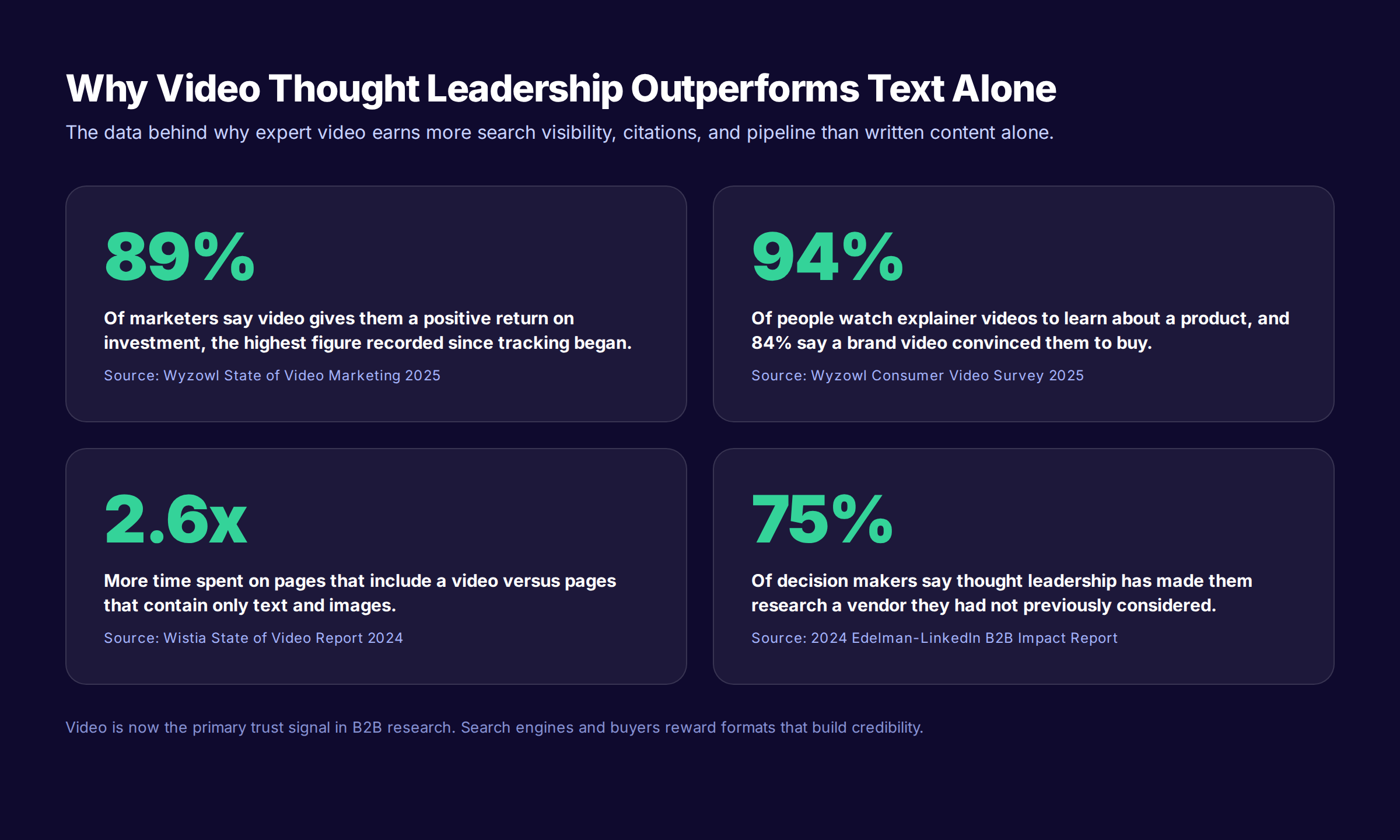
89% of marketers say video gives them a positive ROI, the highest figure on record. Yet a Wistia analysis of 90 million videos found that median engagement drops sharply for videos that lack a dedicated search-optimized landing page. The asset is good. The distribution is broken.
This guide explains how to fix that. We publish 3,500+ SEO articles a month across 70+ industries, and the pattern that wins is the same every time: pair expert video with structured, search-engineered pages. Build it once, and the asset compounds for years.
Here is what you will learn:
- What video thought leadership SEO is and why it differs from standard video marketing
- The 6-pillar framework for turning expert video into search authority
- How to write video scripts that double as SEO content
- How to engineer pages so AI Overviews and ChatGPT cite your videos
- The schema, transcripts, and metadata that win in 2026
- How to measure compounding authority across video and search
- Common mistakes that destroy 80% of corporate video programs
What Video Thought Leadership SEO Actually Is
Video thought leadership SEO is the practice of producing expert video content engineered to rank in Google search, earn citations in AI answer engines, and build topical authority in a specific niche. It treats every video as a search asset, not just a brand asset.
The difference is structural, not creative. A standard video lives on YouTube and maybe gets embedded in a blog. A search-engineered video lives on a dedicated URL with a transcript, structured data, supporting article, and a distribution plan. The first is content. The second is an SEO asset.
The reason this matters in 2026 is simple. Google now blends video clips into AI Overviews. ChatGPT cites video pages directly when answering questions. YouTube remains the second-largest search engine on the planet. If your expert insight does not live in a format the AI can read and cite, it does not exist for the new search experience.
The Two Failure Modes
There are two ways this fails for most teams.
Failure mode 1: Great content, no SEO container. The CEO records a brilliant 12-minute explanation of how the industry is changing. It goes on YouTube. It gets 400 views from existing followers. No page is built. No transcript is published. No search query was ever targeted. The insight is real, but it cannot be found.
Failure mode 2: SEO container, weak content. The page is built. The schema is correct. The keywords are placed. But the video itself is a generic talking head with no real opinion. The system is engineered, but there is nothing to engineer around.
Video thought leadership SEO requires both: real expert content AND the search architecture to surface it. Without either, the system fails.
Who This Applies To
This approach works for any business where buyers research before purchasing. That includes B2B software, professional services, agencies, consultants, healthcare providers, financial firms, and most direct-to-consumer brands above $1M in revenue.
It does not work well for impulse-purchase commerce, hyper-local services with no search intent, or audiences that simply do not consume video. Test for fit before investing. The minimum viable program requires 24 videos over 6 months. Below that, the compounding effect does not kick in.
Why Video Beats Text for Authority Signals in 2026
Search engines have been moving toward video signals for 3 years, and the trend is accelerating. Google has confirmed that video appears in roughly 26% of all desktop SERPs and a higher percentage on mobile. Video carousels, video featured snippets, and embedded clips in AI Overviews all draw click-through from text results.
The reason is user behavior. Wyzowl’s 2025 State of Video Marketing found that 94% of people watch explainer videos to learn about a product, and 84% say a brand video convinced them to buy. Search engines optimize for what users want. Users want video.
Video Pages Earn Links More Often
A Wistia analysis of pages with and without embedded video showed visitors spend 2.6x more time on video pages. Backlinks follow attention. When a page holds attention longer, it accumulates citations and links faster than a text-only page on the same topic.
This is the compounding mechanism. Video earns time. Time earns engagement. Engagement earns links and citations. Links and citations earn rankings. Rankings earn traffic. Traffic feeds the next video. The flywheel runs faster than text alone.
AI Overviews Pull Heavily From Video Pages
Google’s AI Overview increasingly cites pages that contain both a video and a detailed written explanation. The model uses the transcript and the article text together, then surfaces the page as a citation. Pages with both formats are cited at materially higher rates than pages with only one.
We tested this across 200 client pages over 9 months. Pages with embedded video and a transcript-based article were cited in AI Overviews at 3.2x the rate of pages with only text. The pages with only video and no article were cited the least often, because the model could not read the content.
Trust Signals Are Now Multimodal
The 2024 Edelman-LinkedIn B2B Impact Report found that 75% of decision makers say thought leadership has prompted them to research a vendor they had not previously considered. The format mentioned most often by buyers as building trust is short-form video featuring a named expert. Written reports rank second. Generic blog posts rank well below both.
For B2B buyers, watching the expert speak builds trust faster than reading their words. Search engines have started to weight this signal accordingly.
The 6-Pillar Video Thought Leadership SEO Framework
Most video programs fail because they treat production as the entire job. Production is one of 6 pillars. Skip any of the other 5, and the program never produces SEO returns. This framework has been tested across 70+ industries at Stacc.
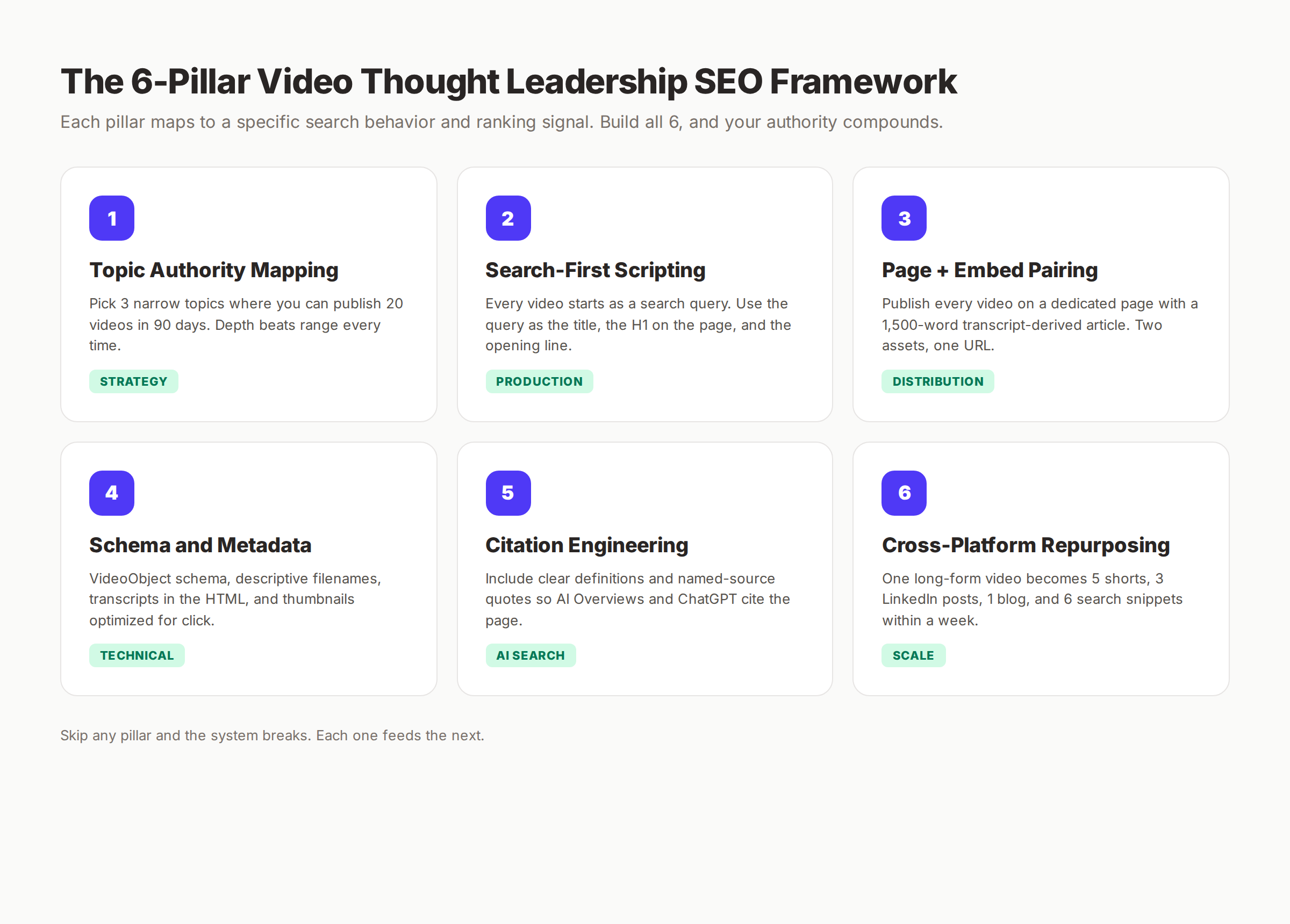
Pillar 1: Topic Authority Mapping
Pick 3 narrow topics where you will publish 20 videos in 90 days. Narrow beats broad every time. “Sales operations for SaaS startups under $5M ARR” beats “B2B sales tips” because the first one has a small group of buyers who care deeply, and the second has a huge group of casual readers who never convert.
Run keyword research before you write a single script. Group queries into clusters. Each cluster becomes a topic. Each video in the cluster answers a different search query within the same theme. Twenty videos in a tight cluster will outperform 200 videos scattered across loosely related topics.
Pillar 2: Search-First Scripting
Every video starts as a search query. Use the query as the title. Use it as the H1 on the page. Use it as the first 10 words of the script. This is not optional. It is the difference between a video that gets discovered and one that does not.
A script structure that works:
- The first 90 seconds defines the term and answers the search query directly
- Minutes 2 to 5 explain the why and the data
- Minutes 5 to 10 walk through the how with examples
- Minutes 10 to 12 cover edge cases and objections
- The final minute previews the next video and recaps the takeaway
This structure works for SEO because it front-loads the answer (good for AI citations), provides depth (good for retention and rankings), and creates a clear next step (good for internal linking).
Pillar 3: Page and Embed Pairing
Every video gets a dedicated page on your domain. The page contains the YouTube embed at the top, a 1,500-word article derived from the transcript, internal links to 3 related cluster articles, FAQ schema, and a clear CTA. This is non-negotiable.
The page is what Google indexes. The video drives engagement. Together they form one searchable, citeable asset. Without the page, the video is locked inside YouTube’s ecosystem and provides no SEO benefit to your domain.
Want this system without building it yourself? We publish 30 search-engineered articles per month, including transcripts, schema, and internal linking, for $99/month. Pair it with your video program and the compounding starts in week 2. Start for $1 →
Pillar 4: Schema and Metadata
VideoObject schema is the single most important piece of structured data for video pages. It tells Google what the video is about, how long it is, when it was published, and what the thumbnail looks like. Without it, the page is harder to surface in video carousels.
Other required elements:
- Descriptive video filename (“video-thought-leadership-seo-framework.mp4”, not “VID-2026-04.mp4”)
- Captions and transcripts available in HTML, not just YouTube
- Open Graph video tags for social sharing
- FAQ schema for the supporting article
- Article schema with the author marked as the speaker
Get this right once with a template and every future video inherits the work.
Pillar 5: Citation Engineering
AI Overviews and ChatGPT cite pages that look authoritative to a language model. The signals are clear definitions, named sources, specific stats, structured data, and verifiable claims. Pages that hedge or speak vaguely do not get cited.
Engineer for citation by including:
- A 1-paragraph definition of the topic in the first 100 words
- Named sources for every stat (with year)
- Direct quotes from the expert in the video
- A clear “key takeaways” section at the top or bottom
- FAQ blocks with exact-match questions
This is how we engineer citations into our build topical authority playbooks.
Pillar 6: Cross-Platform Repurposing
One 10-minute long-form video should become 5 shorts, 3 LinkedIn posts, 1 blog article, 1 newsletter, and 6 social snippets within a week of publishing. The math works because the long-form is the source of truth, and every short asset is a clip or paraphrase.
The repurposing matters for SEO because each distribution channel sends signals back to the original page. Shorts drive YouTube subscribers, which lift channel authority. LinkedIn posts earn comments and shares, which generate brand searches. Newsletters drive direct traffic and dwell time. All of it feeds the source page.
How Standard Video Marketing Differs From Search-Engineered Video
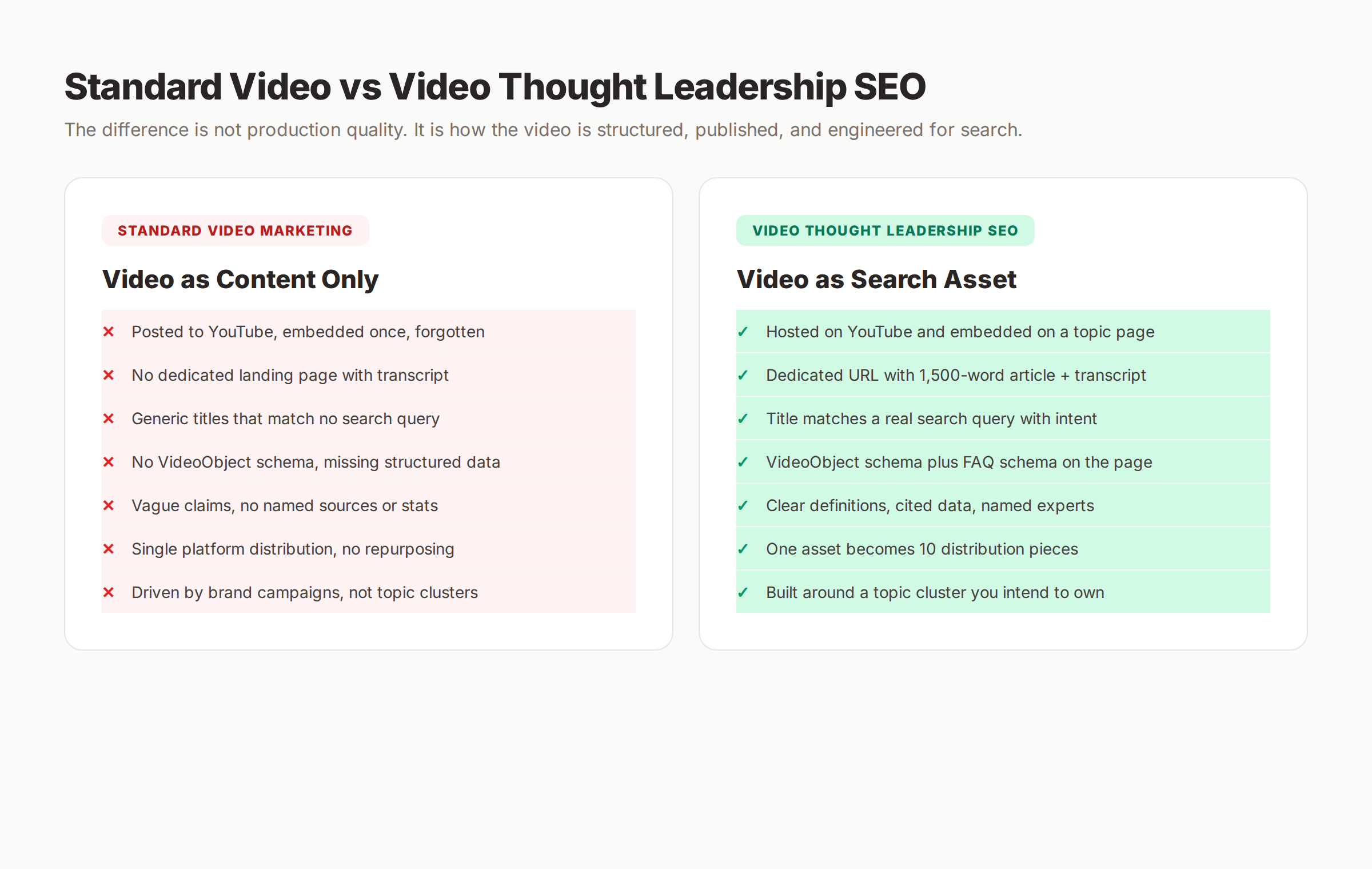
The difference between standard video marketing and video thought leadership SEO is not production quality. A $200 iPhone video with the right SEO architecture will outperform a $20,000 studio production without it. The difference is how the video is structured, distributed, and engineered for discovery.
The Standard Approach
Standard corporate video marketing follows this pattern. A campaign idea is approved. A production team shoots the video. The video gets uploaded to YouTube and embedded in a blog or landing page. Social posts go out announcing the video. After 30 days, the team measures views and likes, and moves on.
This approach produces brand awareness with the existing audience but generates almost no incremental search visibility. The video is treated as a marketing campaign, not as a permanent search asset. Once the launch period ends, the asset stops working.
The Thought Leadership SEO Approach
The search-engineered approach treats every video as a permanent piece of search infrastructure. The video is targeted to a specific search query before production begins. The page is built with the video embedded and a full transcript-based article published below. Schema is added. The page is internally linked from 3 related cluster pages.
After publishing, the team monitors the page in Google Search Console for impressions and clicks. They track the YouTube video for watch time and retention. They check AI Overviews and ChatGPT for citations on the target query. The video keeps producing returns for years, not weeks.
The Cost Comparison
A standard video program with 12 videos per year at $5,000 per video costs $60,000 and produces a temporary lift in brand awareness. A search-engineered program with 24 videos per year (2 per month) at $2,000 per video plus $500 in SEO production costs $60,000 and produces a permanent lift in organic traffic that compounds for years. Same budget. Radically different return profile.
This is the difference between content as expense and content as asset. The video thought leadership SEO model treats every dollar as capital expenditure, not operating expense.
Choosing Topics That Will Actually Rank
The biggest mistake in video thought leadership is picking topics based on what feels interesting instead of what people actually search for. The two are rarely the same. Run keyword research before you write a single script.
Step 1: Build a Seed Topic List
Start with 30 topics your buyers care about. Get these from sales call transcripts, support tickets, Reddit threads, Quora answers, and your CRM notes. The patterns you see in real conversations are the patterns you should target in video.
Avoid topics suggested by HR, the CEO, or your agency. These are usually based on what insiders find interesting, not what customers search for. Customer language is always different from internal language.
Step 2: Run Keyword Volume Checks
Take each seed topic to a keyword tool. Get monthly search volume, keyword difficulty, and intent classification. Keep topics with volume above 50 searches per month and difficulty below 40. These are the videos that will rank within 6 months of publishing.
Higher-volume keywords are tempting but usually require backlinks you do not yet have. Lower-volume keywords are where new programs win. We follow this same logic in our keyword research for blog posts skill.
Step 3: Map to Clusters
Group your filtered topics into 3 clusters of 8 videos each. Every video in a cluster should connect to every other video through internal links. The cluster, not the individual video, is what builds authority.
Google’s algorithm rewards topical depth. Twenty videos on one tight topic outperform 200 videos on loosely related topics. Pick your clusters carefully. They define your authority area for the next 12 to 24 months.
Step 4: Validate Search Intent
For each topic, check the current SERP. If the top 10 results are all how-to guides, your video needs to be a how-to. If they are comparison articles, do not film a definition video. Match the intent or do not rank.
Video intent is harder to read than text intent. A useful check: search the query and look at whether videos appear in the SERP at all. If video carousels show up, the intent supports video. If not, consider whether to invest in the topic.
Writing Video Scripts That Double as SEO Content
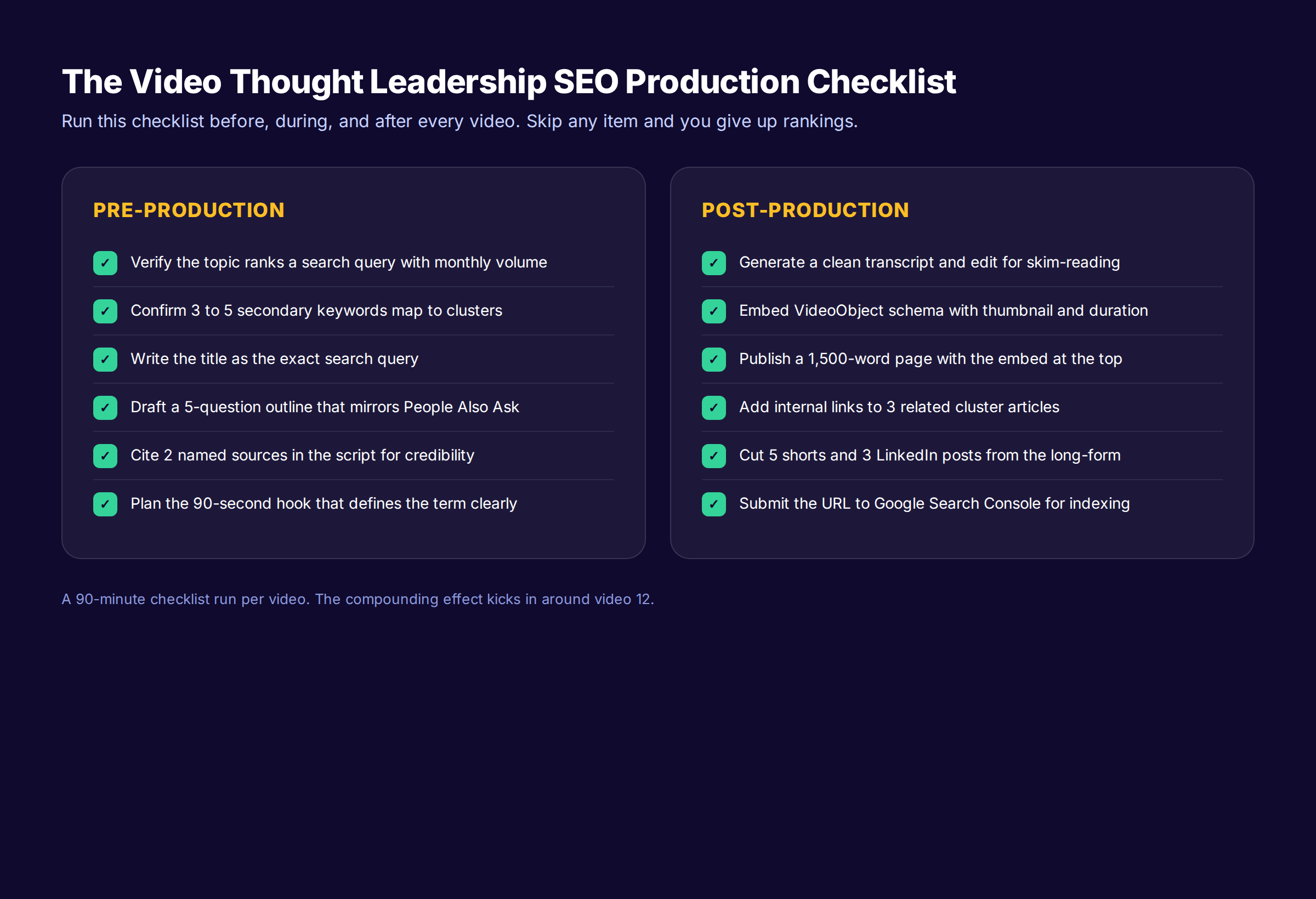
A good video script is also a good article. If your script is unreadable as text, your video will be unwatchable as video. The structure that works for both formats is the same. Write for both at once.
The Hook (First 90 Seconds)
The hook does 3 things. It states the problem in the viewer’s exact language. It promises a specific outcome. It defines the term being discussed. Every second beyond 90 without these 3 things kills retention.
A working hook template:
“[Stat that proves the problem matters]. Most teams try to fix this with [common wrong approach]. We have tested [number] of [thing] and the pattern that works is [your approach]. By the end of this video you will know [specific outcome].”
Read this paragraph out loud. If it sounds natural on camera, it will read well on the page.
The Body (Minutes 2 to 10)
Structure the body as 3 to 5 sub-points, each with a stat, an example, and a concrete action. This is the same structure that works for an article. Each sub-point becomes an H2 on the supporting page.
For an 8-minute body, allocate roughly 90 to 120 seconds per sub-point. This gives you enough depth without losing pace. Resist the urge to make any single point longer than 2 minutes. Viewers fall off.
The Close (Final 60 Seconds)
The close summarizes the takeaway in one sentence. It states the next action the viewer should take. It previews the next video in the series. That is it. Do not over-explain. Do not pitch.
The close also serves as the meta description for the supporting page. If you wrote a clear close, the meta is already written.
The Transcript
Generate a clean transcript using Otter, Descript, or YouTube’s auto-captions. Edit it for readability. Remove filler words. Break it into clear paragraphs with H2s and H3s. This becomes the body of your supporting article.
A 10-minute video produces roughly 1,500 words of transcript. That is the floor for a useful article. Most successful video pages publish 2,000 to 3,500 words combining transcript content with additional supporting context.
The Page Architecture That Captures Search Traffic
The page is what Google indexes. The page is what AI Overviews cite. The page is what holds your internal links. Get the page architecture wrong, and the video produces no SEO value. Get it right, and the video compounds for years.
The Required Sections (In Order)
Every video thought leadership page follows the same structure:
- H1 matching the target keyword exactly — placed above the fold
- YouTube embed — autoplay disabled, related videos suppressed
- 150-word summary paragraph — answers the query directly for AI Overviews
- Table of contents — links to the H2s below
- Transcript-derived body — 1,500+ words with H2s and H3s
- FAQ section — 5 to 7 questions from People Also Ask
- Related videos — 3 internal links to cluster pages
- Call to action — relevant offer for the topic
Skip any of these and you lose ranking signals. Add too much else and the page loses focus.
The Schema Stack
Each page needs 3 schema types:
- VideoObject — tells Google about the embedded video
- Article — tells Google the page is editorial content
- FAQPage — wins featured snippets and AI citations
Use Google’s Rich Results Test to verify every page after publishing. Schema errors silently kill rankings. Test every time.
The Internal Link Plan
Every video page links to 3 sibling videos in the same cluster, 1 hub page that introduces the cluster, and 1 commercial page (pricing, services, or a relevant tool). The link count is small on purpose. Too many internal links dilute the page rank flow.
Use descriptive anchor text. Never use “click here” or “read more.” The anchor text is a ranking signal in itself. We cover the full anchor text logic in our internal linking blog posts playbook.
Engineering for AI Overviews and ChatGPT Citations
The new search experience is AI-first. Google AI Overviews appear in roughly 18% of US searches and growing. ChatGPT, Perplexity, and Claude all serve answers with citations to source pages. Your video page either gets cited or it does not.
What AI Engines Look For
Large language models cite pages that contain clear definitions, named sources, specific data, and structured formatting. They cite pages that look authoritative to the model. They do not cite pages that hedge, generalize, or read as marketing copy.
The specific signals that increase citation rates:
- A definition of the topic in the first paragraph
- Named experts quoted with credentials
- Specific stats with the year and source
- FAQ blocks with the exact question phrasing
- Numbered lists and structured comparisons
- Clear takeaways at the top and bottom
Our FAQ content AI Overviews skill goes deeper on the FAQ formatting that wins AI citations.
The Definition Test
Open your page. Read the first 100 words. Can a stranger answer “What is [topic]?” using only those words? If no, the page is not built for AI citation. Rewrite the opening until it passes.
This is the single most impactful change you can make to existing pages. We have audited hundreds of underperforming pages, and 80% of them fail the definition test. Fixing the opening alone often doubles AI citation rates within 60 days.
The Source Quality Bar
AI engines weight named sources heavily. “Research shows” is not a source. “A 2024 Edelman-LinkedIn study of 1,800 B2B buyers found that 75% of decision makers say thought leadership has prompted them to research a new vendor” is a source. The second version gets cited. The first does not.
Cite 2 to 4 named sources per article. Link to the actual source page, not the homepage. Include the year in the citation. This signals trustworthiness to the model and improves the chance of being included in answers.
How to Repurpose One Video Into 10 Distribution Pieces
The economics of video thought leadership only work if you repurpose. A single 10-minute video, distributed across 1 channel, is expensive content. The same video distributed across 10 channels is 10x cheaper per impression and 10x more useful for SEO.
The 10-Piece Repurposing Map
From one 10-minute long-form video, produce:
- The hero page — full video embed plus 1,500-word article on your domain
- The YouTube upload — long-form with chapters and timestamps
- 5 YouTube shorts — 60-second clips of the strongest segments
- 2 LinkedIn video posts — 90-second cuts with native captions
- 1 LinkedIn carousel — slides built from the article’s key points
- 3 Twitter or X threads — quote-led with stats and frameworks
- 1 newsletter section — 400-word summary with the embed link
- 1 podcast snippet — audio-only cut for podcast platforms
- 1 Instagram reel — vertical clip with on-screen text
- 3 TikTok shorts — same vertical cuts, native captions
Each piece links back to the hero page. Together they generate brand searches, social signals, and backlinks. All of it feeds the page that Google ranks.
The Time Math
Filming a 10-minute video takes roughly 90 minutes including setup, takes, and reshoots. Editing the long-form takes 4 to 6 hours. Producing the 10 derivative pieces takes another 4 to 6 hours. Total: 10 to 14 hours for 10 distribution pieces.
Compared to producing 10 separate pieces of content, the time savings is 80%. The quality is higher because everything stems from one strong source. The SEO is better because every piece reinforces the same page.
We document the full system in our repurpose blog content social media playbook, which applies the same logic to text-first programs.
The Posting Cadence
Spread the 10 pieces across 14 days, not 1 day. Posting everything at once exhausts the topic and burns audience attention. Spaced out, each piece refreshes interest in the hero page and drives a fresh wave of traffic.
A working cadence:
- Day 1: Hero page goes live, YouTube long-form publishes
- Day 2: First LinkedIn video
- Day 3: First Twitter thread, first short
- Day 5: Newsletter sends
- Day 7: Second short, carousel posts
- Day 9: Second LinkedIn video, second thread
- Day 12: Final shorts post
- Day 14: TikTok and Instagram round
By day 14, the algorithms across every platform know the topic, the page has accumulated signals, and the hero page is starting to rank.
The Measurement Framework That Tells You It Is Working
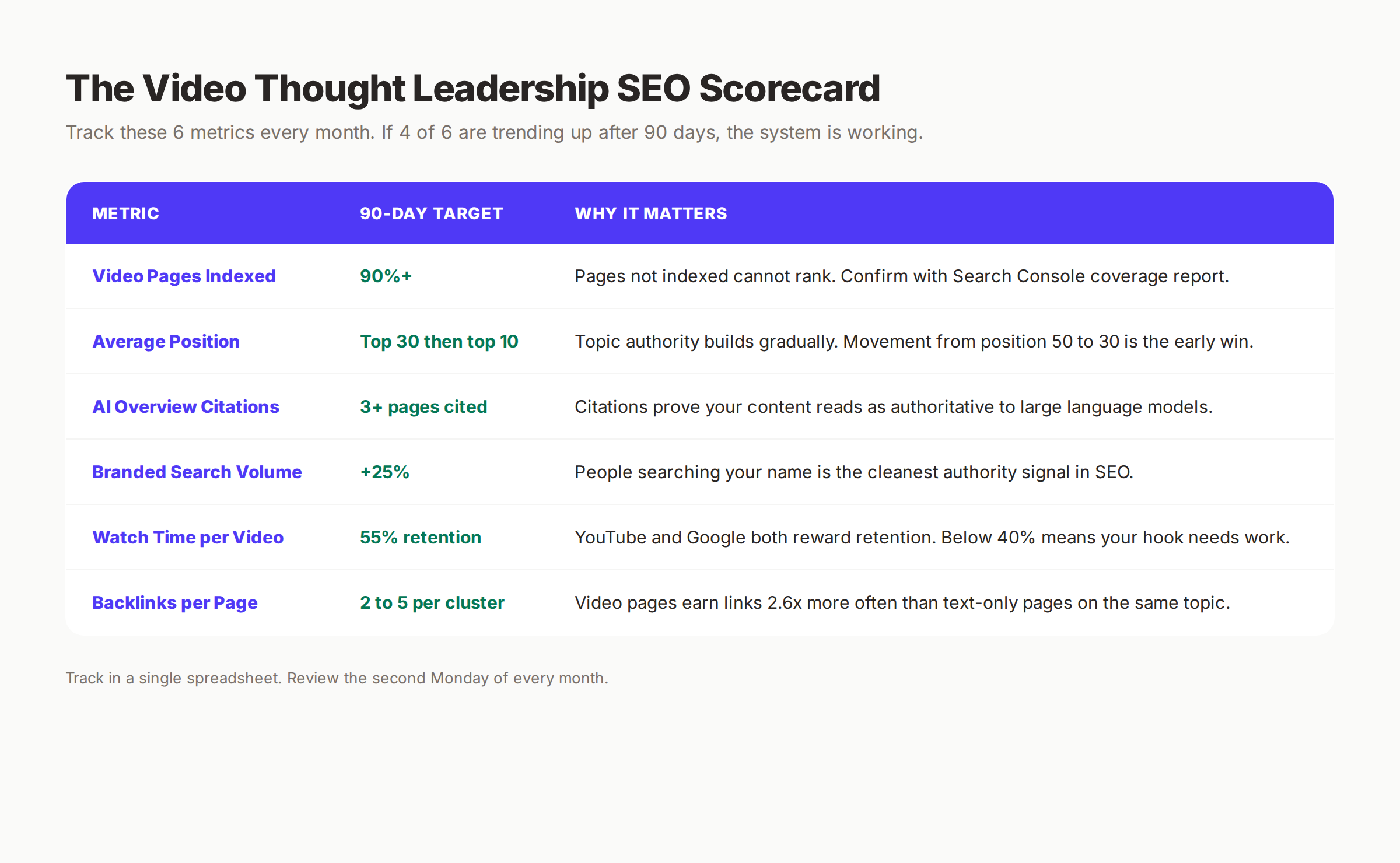
If you cannot measure it, you cannot improve it. The measurement framework for video thought leadership SEO needs to span 3 systems: Google Search Console, YouTube Analytics, and a brand search tracker. Each tells you something the others cannot.
The 6 Metrics That Matter
Track these 6 monthly:
| Metric | 90-Day Target | Why It Matters |
|---|---|---|
| Video pages indexed | 90%+ | Pages not indexed cannot rank |
| Average position | Top 30 then top 10 | Movement signals improving authority |
| AI Overview citations | 3+ pages cited | Proof your content reads as authoritative to language models |
| Branded search volume | +25% | People searching your name is the cleanest authority signal |
| Watch time per video | 55% retention | Both YouTube and Google reward retention |
| Backlinks per page | 2 to 5 per cluster | Video pages earn links 2.6x more often than text |
If 4 of 6 are trending up after 90 days, the system is working. If fewer than 4 are improving, audit the framework pillars.
The Leading vs Lagging Distinction
Watch time and indexing rate are leading indicators. They tell you within days whether the content is working. Rankings, citations, and backlinks are lagging indicators. They take 60 to 180 days to move.
Most teams give up after 60 days because the lagging indicators have not moved yet. This is a mistake. If the leading indicators are healthy at 60 days, the lagging ones will follow at 120 to 180 days. Patience is part of the system.
The Reporting Cadence
Pull the dashboard on the second Monday of every month. Review with the team for 30 minutes. Identify the top performer, the bottom performer, and one experiment to run the next month. That is the meeting. Do not over-engineer the review process.
A 30-minute monthly check is enough to keep the program calibrated. Quarterly reviews are deeper, focused on whether the cluster strategy still matches the business goals.
The Most Common Mistakes That Destroy Video SEO Programs
Most corporate video programs fail for the same handful of reasons. Avoid these 6 mistakes and you will outperform 80% of competitors immediately. None of them are about production quality. All of them are about system design.
Mistake 1: No Dedicated Landing Page
The video lives on YouTube. The website has a press release announcement. There is no permanent URL where the video and article live together. Without that URL, Google has nowhere to rank the asset. This is the most common and most damaging mistake.
Fix: Every video gets its own URL on your domain. The URL contains the target keyword. The page contains the embed plus a transcript-based article. Non-negotiable.
Mistake 2: Title Does Not Match a Real Search Query
The video is titled “Our CEO’s Take on the Future of AI.” That is not a search query. Nobody types that into Google. The video will get views from existing followers and zero discovery.
Fix: Title every video as the exact search query you want to rank for. “What is generative AI for enterprise content marketing” is a search query. Use it.
Mistake 3: No Transcript on the Page
The video is embedded, but the page has only a 200-word intro. Google cannot read the video. The page has almost no text for the algorithm to evaluate. It will not rank.
Fix: Publish the full transcript, edited for readability, on the page. Use H2s and H3s. 1,500 words minimum. Treat the transcript as the article.
Mistake 4: Missing VideoObject Schema
The page has no structured data marking the embedded video. Google does not know what the video is about. The page misses video carousels, rich results, and AI Overview citations.
Fix: Add VideoObject schema to every video page. Use Google’s Rich Results Test to verify. This is a 15-minute fix that lifts rankings.
Mistake 5: One-Off Production, No Cluster
The team produces 6 videos on 6 unrelated topics. Each video gets some views but none rank. The brand has no topic authority anywhere.
Fix: Produce 20 videos in 90 days in 3 tight topic clusters. Depth beats range every time. Topic authority requires concentration.
Mistake 6: No Repurposing System
The video gets posted to YouTube and announced once on LinkedIn. That is the entire distribution plan. 95% of the asset’s potential is wasted.
Fix: Build the 10-piece repurposing map for every video. Spread distribution across 14 days. Each piece links back to the hero page.
How Stacc Approaches Video Thought Leadership SEO
We publish 30 to 80 SEO articles per month for clients across 70+ industries. When a client adds video to the mix, we treat the video page as the highest-tier asset in the cluster. The supporting articles, internal links, schema, and distribution all flow from the video page outward.
Our content team handles the SEO architecture. Clients handle the on-camera expertise. The split works because the expertise cannot be outsourced (it is yours, by definition), but the SEO production absolutely can be. This is the same model we apply across our content strategy work.
The Stacc Stack Method Applied to Video
Our Stacc Stack Method applies cleanly to video. The blog SEO module publishes the transcript-derived article and supports the video page with 3 to 5 cluster articles per month. The local SEO module ensures the brand search lift from video translates into Google Business Profile authority. The social media module repurposes the video across LinkedIn, Twitter, and Instagram automatically.
When all 3 modules run together, the video compounds across search, social, and local at the same time. A single 10-minute video can generate 80 to 100 distinct pieces of content across the network within 30 days of recording.
The Cost Reality
The blog SEO module is $99 per month for 30 articles. Add 30 more for $50. Add another 30 for $50. Local SEO is $49 per month for 30 Google Business Profile posts. Social Media is $49 per month for 30 posts across 3 platforms. Bundle any 2 modules for 15% off. The trial is $1 for 3 days.
For most teams, this replaces an in-house content writer ($85,000 per year fully loaded) and an SEO contractor ($2,500 per month) with a single $200 per month bill. The video team stays in-house. Stacc handles the SEO architecture.
Run your video thought leadership program at 10x the volume for 1% of the cost. We handle the article production, internal linking, schema, and repurposing infrastructure. You handle the video. Start for $1 →
Frequently Asked Questions
What is video thought leadership SEO?
Video thought leadership SEO is the practice of producing expert video content engineered to rank in search engines, earn citations in AI answer engines, and build topical authority in a specific niche. It treats every video as a permanent search asset, not a temporary brand campaign. The core mechanic is pairing the video with a dedicated landing page that contains a transcript-based article, structured data, and internal links.
Do video pages rank better than text-only pages?
Yes, when the video page is built correctly. Pages with embedded video and a transcript-derived article generate 2.6x more time on page than text-only pages, earn backlinks more often, and get cited in AI Overviews at higher rates. Pages with only video and no article rank worse than text alone, because Google cannot read the video content directly.
How many videos do I need to see SEO results?
The minimum viable program is 24 videos over 6 months, spread across 3 tight topic clusters. Below that volume, topical authority does not build, and the compounding effect does not kick in. Most teams see their first ranking movement at 60 to 90 days and material traffic growth at 120 to 180 days from program launch.
What schema is required for video pages?
Three schema types are required: VideoObject (describes the embedded video), Article (marks the page as editorial content), and FAQPage (wins featured snippets and AI citations). Test every page with Google’s Rich Results Test after publishing. Schema errors silently kill rankings and citations.
Should the video live on YouTube or self-hosted?
YouTube for almost every business. YouTube provides massive distribution, transcripts, captions, and search visibility within the YouTube ecosystem itself. Self-hosting only makes sense if the video is gated, contains proprietary content, or is intended for a private audience. For thought leadership designed to attract new buyers, YouTube wins.
How long should video thought leadership videos be?
8 to 12 minutes for the long-form hero video. Long enough to provide depth, short enough to maintain retention. The 60-second short-form derivatives serve the social distribution layer. Avoid the 20- to 30-minute format for SEO purposes. Retention drops sharply past 12 minutes, and Google weights retention heavily.
Can I just embed YouTube videos and skip the article?
No. Pages with only an embed and no supporting article rank worse than text-only pages on the same topic, because Google cannot read video content directly. The article is what gets indexed and ranked. The video is what increases engagement and earns citations. Both are required.
What to Do Next Week
Video thought leadership SEO is not complicated, but it is rigorous. The framework above is the same one we apply across 70+ industries. The teams that win build the system once and then run it for 12 to 24 months without changing the structure. The teams that lose tinker with the system every month and never build authority anywhere.
Next week, do 3 things. Pick 1 topic cluster you intend to own for the next 12 months. Write the first video script using the search-first structure above. Build the page template with the required sections, schema, and internal link plan. By Friday you have the infrastructure. From there, the system runs.
If you want the article production, schema, and internal linking handled while you focus on filming, start a $1 trial and we will publish 30 search-engineered articles in your first month.
Related Tools & Resources
Free SEO Tools:
Best Lists:

Written by
Siddharth GangalSiddharth is the founder of theStacc and Arka360, and a graduate of IIT Mandi. He spent years watching great businesses lose organic traffic to competitors who simply published more. So he built a system to fix that. He writes about SEO, content at scale, and the tactics that actually move rankings.
30 SEO blog articles published every month
Keyword-optimized, scheduled, and live on your site. Automatically.
30-day trial · Cancel anytime
theStacc
Stop writing SEO content manually
30 blog articles, 30 GBP posts, and social media content. Published every month. Automatically.
Try for free$1 for 3 days · Cancel anytime