
Video Content Marketing: The 2026 Strategy Playbook
Master video content marketing in 2026. Formats, platforms, production, ROI, and the system 91% of marketers use to drive 82% positive returns.
Most brands waste their video content marketing budget by treating every channel the same way. A 9-minute YouTube tutorial gets cross-posted to TikTok as a vertical clip. The CTA dies. The hook lands flat. Watch time collapses inside the first 3 seconds.
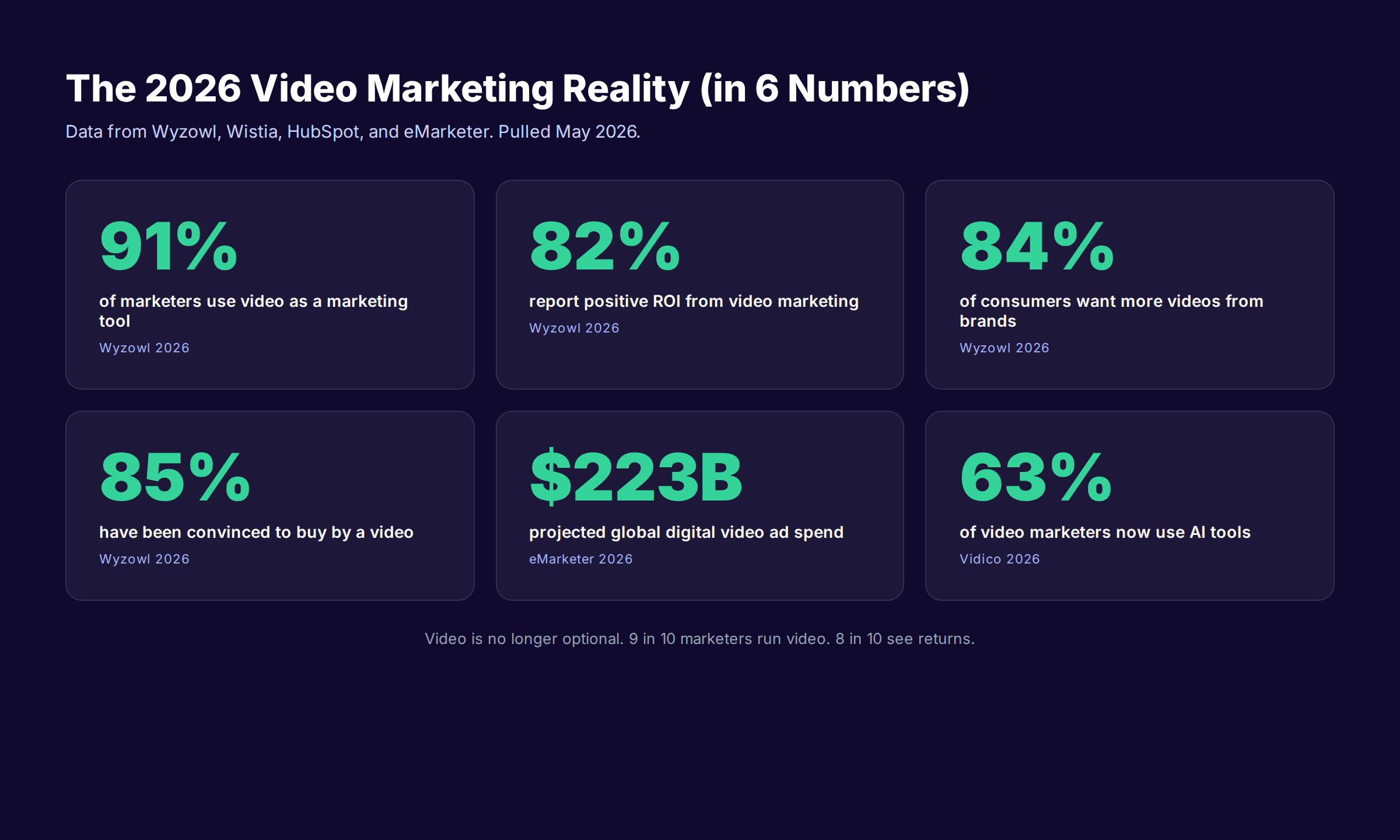
The cost is brutal. Wyzowl reports that 91% of marketers now run video, and 82% see positive ROI. The bottom 20% burn $5,000 to $20,000 per quarter on production that nobody finishes watching. The gap is not budget. The gap is system.
This guide gives you that system. We publish 30+ articles per month across 70+ industries and run the same video content marketing playbook we recommend to our clients. Here is what you will learn:
- The 6 video formats that actually move pipeline, ranked by reported marketer ROI
- Which platforms suit which audiences (with 2026 user-base data)
- The 5-step production pipeline that ships a finished video in under 4 hours
- Real budget tiers for solo, small team, and agency setups
- The 8 metrics worth tracking, and the vanity ones to ignore
- A 14-item launch checklist you can copy today
By the end, you will know exactly what to record, where to post it, and how to measure whether it worked.
What Is Video Content Marketing?
Video content marketing is the practice of producing and distributing video assets that attract, engage, and convert a specific audience.
It differs from video advertising in one important way. Ads rent attention. Content earns it.
The output ranges from 30-second TikToks to 45-minute webinars. The goal stays the same. Build trust, drive action, and create durable demand for your product. A 60-second product demo on your landing page is content. A boosted version on Meta Ads is advertising. Most brands run both. The content layer is the one that compounds.
Wyzowl’s 12-year video marketing report shows the trend line clearly. In 2014, 62% of marketers used video. In 2026, that figure sits at 91%. The 9% who do not use video are mostly local services brands without an online presence, and even that segment is shifting fast. Our video SEO guide for the AI era covers what changed once Google started surfacing video in AI Overviews.
Why Video Beats Static Content for Engagement
Three factors stack the deck:
- Algorithm priority. Every major platform, including LinkedIn and Google, now weights video higher than static posts. Reels get 22% more reach than carousel posts on Instagram according to Sprout Social.
- Conversion lift. Wyzowl found 85% of consumers have been convinced to buy something after watching a brand video. That number has held within 4 points since 2018.
- Information density. A 60-second video can convey what a 1,500-word article does, faster, and with emotional weight that static copy struggles to match.
The catch is production cost. A blog post takes 4 hours. A 60-second video, done right, takes the same 4 hours but requires a different set of skills. Most marketers underestimate this and ship low-quality work for the first 6 months before the system clicks.
How Video Fits Into a Wider Content Strategy
Video should never sit on its own. It feeds, and is fed by, the rest of your content engine. Our content marketing strategy guide lays out the full multi-format approach, but here is the short version:
- A long-form YouTube video becomes the source asset
- 5 to 8 short clips get cut from it for Reels, Shorts, and TikTok
- The transcript becomes a blog post, with the video embedded
- Key quotes become LinkedIn carousels and X threads
- Audio gets stripped into a podcast episode
This 1-to-many model is the most efficient way to ship video at scale. Wistia’s State of Video 2026 reports brands using a hub-and-spoke model produce 4.7x more content than single-format teams, with only 1.8x more budget.
The 6 Video Content Marketing Formats That Drive ROI
Not every video format is built for the same outcome. Top-of-funnel reach demands a 9-second TikTok hook. A bottom-of-funnel conversion demands a 90-second product demo with a clear CTA. Pick the wrong format for the goal and you will spend a quarter producing content that never moves a metric.
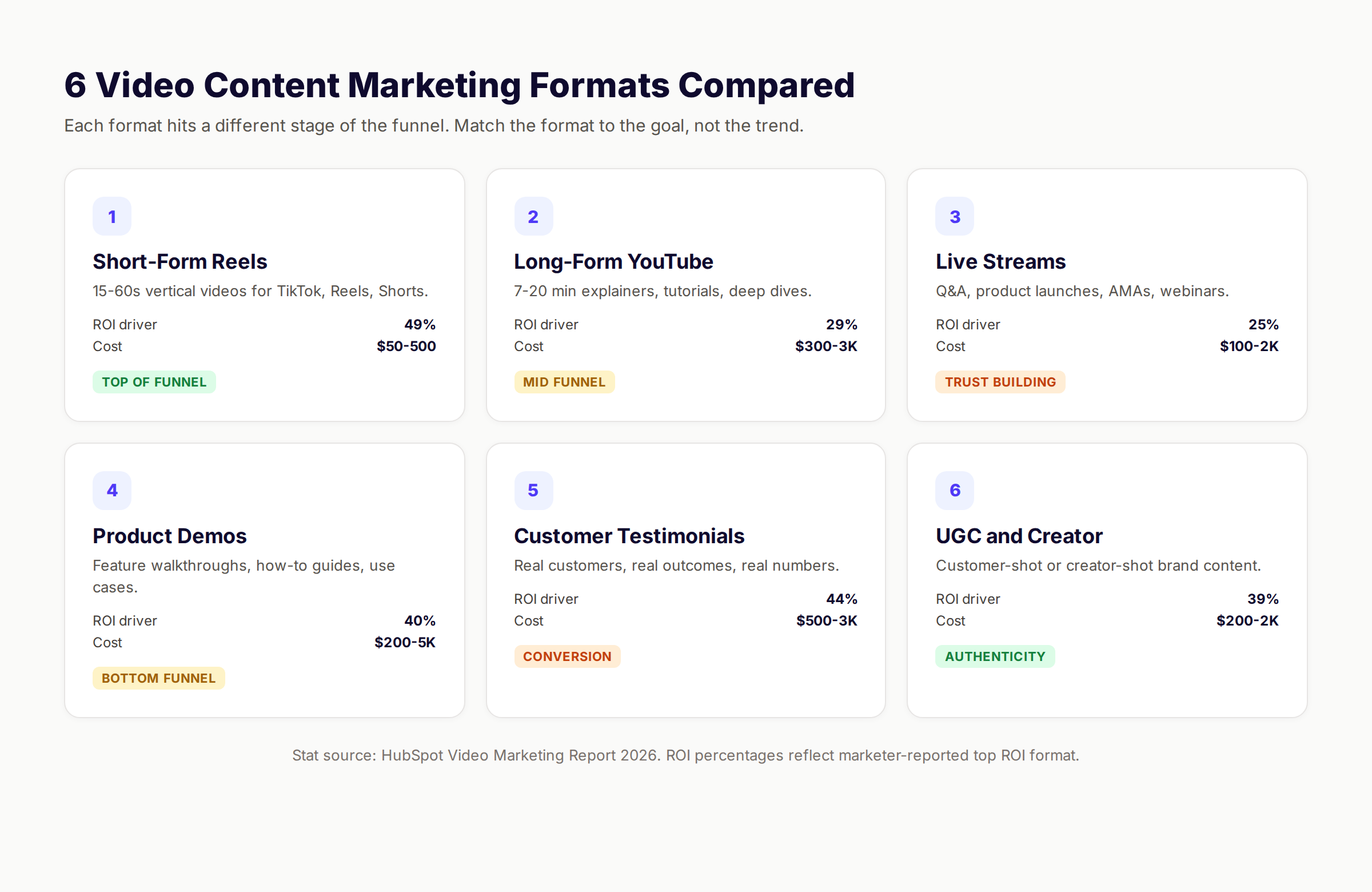
HubSpot’s 2026 Video Marketing Report ranked the formats marketers report as highest ROI. The top 3 are short-form video (49%), long-form video (29%), and live streaming (25%). The table below adds detail on what each format costs and where it fits in the buyer journey.
Format 1: Short-Form Vertical Video
This is the format every brand defaults to in 2026, and the data supports the choice. Short-form video is the #1 ROI driver across B2B and B2C, hitting 49% in HubSpot’s survey. The format works because the platforms (TikTok, Reels, Shorts) have algorithms tuned for discovery, not for follower count.
The format rewards three things:
- A hook in the first 3 seconds that promises a payoff
- Captions on every frame, since 85% of mobile video is watched on mute
- A single point per video, not a list of 5
For a deeper breakdown of what 2026 viewing behavior actually looks like, see our short-form video statistics roundup.
Best for: Top-of-funnel awareness, brand personality, hiring, trend participation Worst for: Complex product education, B2B enterprise sales motions Cost: $50 to $500 per video
Format 2: Long-Form YouTube Video
YouTube is the only short-form-adjacent platform where SEO compounds. A short on TikTok dies in 48 hours. A 9-minute tutorial on YouTube can drive traffic for 4 years. That gap is why YouTube remains the strongest platform for B2B content.
The format rewards:
- An over-the-fold hook in the first 30 seconds
- Chapter markers that let viewers jump to value
- High retention curves through the 50% watch-time mark
- A descriptive title that matches a real search query
Our YouTube content strategy guide covers cadence, pillars, and the SEO setup in detail. For the SEO-specific tactics, the YouTube SEO guide walks through tag strategy and thumbnail optimization.
Best for: Mid-funnel education, evergreen traffic, thought leadership Worst for: Trend-jacking, real-time culture moments Cost: $300 to $3,000 per video
Format 3: Live Streaming and Webinars
Live streaming pulls 25% of marketers as a top ROI format. The number sounds low until you note the conversion rates. A live product launch with 200 viewers can outperform a 50,000-view ad campaign for actual revenue. The audience self-selected to show up at a specific time.
The format rewards:
- A scheduled, promoted time slot (with email and ad amplification)
- Q&A built into the runtime, not tacked onto the end
- A replay published within 24 hours, sliced for social
Wistia found webinars convert 8 to 12% of registered attendees into pipeline, the highest of any video format.
Best for: Product launches, sales enablement, community building Worst for: Cold audience awareness, low-intent traffic Cost: $100 to $2,000 per session
Format 4: Product Demos and Tutorials
A 90-second product demo is the single highest-converting asset on most B2B landing pages. Wistia data shows demos lift trial signup by 28% on average when placed above the fold.
The format rewards:
- A real screen recording, not an animation
- A persona-specific opening (“If you run a 5-person agency…”)
- Three concrete outcomes shown in under 90 seconds
For SaaS and service businesses, the demo is the most underrated video asset. Most teams treat it as a “marketing video” instead of a sales tool. The two are not the same. A sales demo runs 12 minutes. A marketing demo runs 90 seconds and points to a CTA.
Best for: Bottom-of-funnel conversion, sales enablement Worst for: Brand storytelling, top-of-funnel reach Cost: $200 to $5,000 per asset
Format 5: Customer Testimonials and Case Studies
Testimonial video pulls 44% as a top ROI format, second only to short-form. The reason is trust. Buyers in 2026 distrust scripted ads, but a real customer telling a real outcome lands harder than any other format.
The format rewards:
- A real customer, not a paid actor
- A specific number (“We went from 50 to 280 demo calls per month”)
- A 60-second cut for social plus a 5-minute case study for the website
Our content marketing examples post breaks down how brands like HubSpot and Shopify structure their testimonial libraries.
Best for: Sales pages, late-stage nurture, trust building Worst for: Cold reach, top-of-funnel awareness Cost: $500 to $3,000 per video
Format 6: User-Generated and Creator Content
UGC and creator-produced video pulls 39% as a top ROI format. The economics are unique. A brand pays a creator $200 to $2,000 to produce a video. The brand then licenses that video for paid ads, organic posting, and email. One asset, four distribution channels.
The format rewards:
- A clear brief, not a creative free-for-all
- Usage rights baked into the contract
- A creator whose existing audience matches yours
For local businesses, our AI UGC content for local business guide walks through how to source and produce UGC without an agency.
Best for: Authenticity-led campaigns, paid social creative, e-commerce Worst for: Highly technical B2B, regulated industries Cost: $200 to $2,000 per video
Which Platforms to Post On (And Which to Skip)
The mistake most teams make is treating every platform like a billboard. Post the same vertical to TikTok, Reels, Shorts, and LinkedIn. Watch engagement crater on at least 2 of the 4. Each platform has a distinct algorithm, audience age, and content expectation.
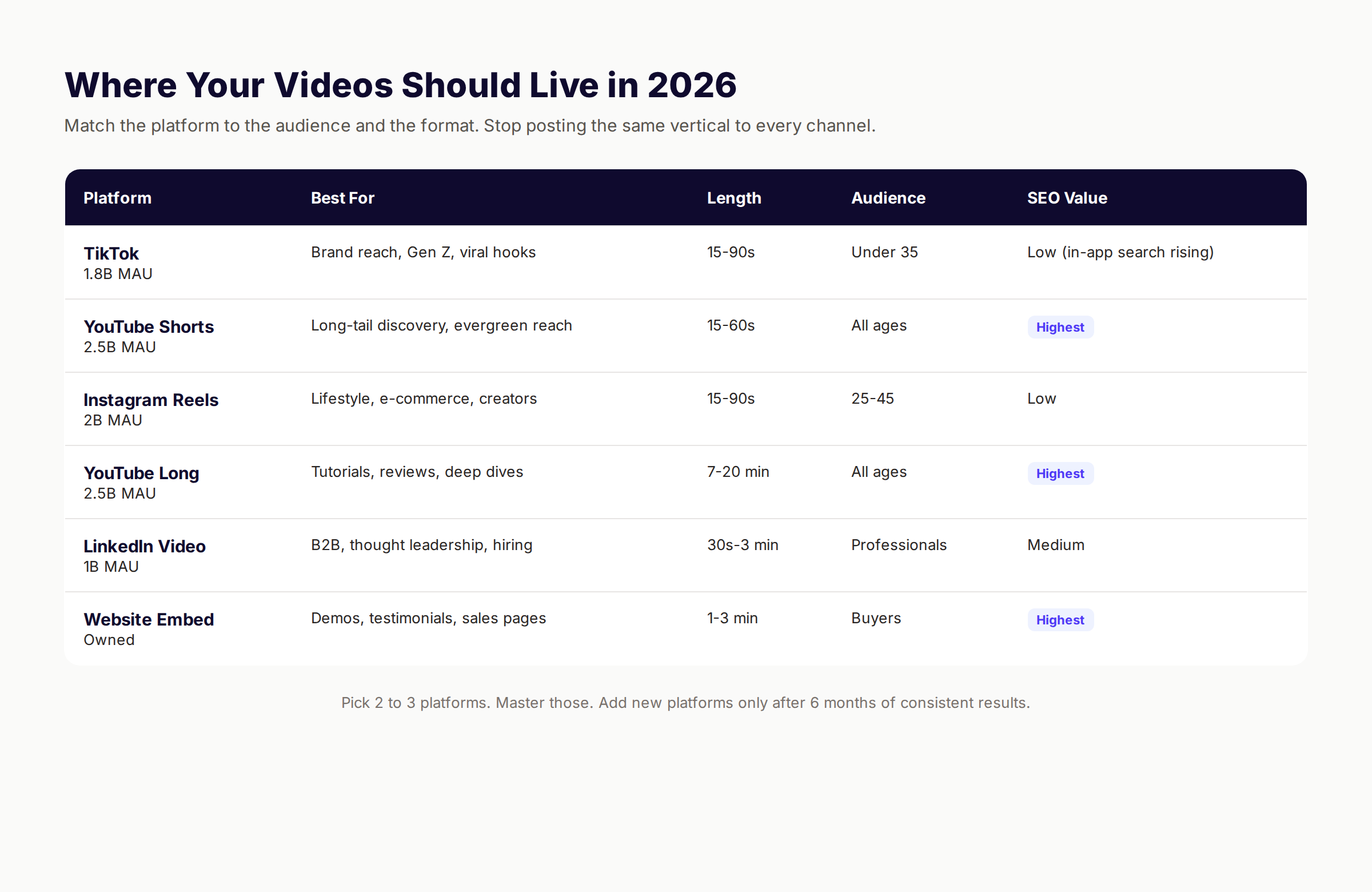
The grid below lays out where each format thrives. The honest answer is that no brand needs more than 3 platforms in year one. Sprout Social data shows brands posting to 4+ platforms produce 38% less engagement per asset than those posting to 2 to 3.
TikTok
TikTok hits 1.8 billion monthly active users with an average session time of 95 minutes. The platform defined the short-form category and still leads on cultural relevance for audiences under 35.
What works on TikTok:
- Hooks under 3 seconds, no logo intros
- Trends and sounds, used selectively
- Conversational direct-to-camera over polished production
What does not work:
- B2B enterprise content
- Long-form education
- Highly produced ads that “feel” like ads
For local businesses, the platform is rising fast. Our TikTok for local business guide covers the specific tactics that work for restaurants, salons, and service providers.
YouTube Shorts and Long-Form
YouTube is the only platform where every format earns SEO value. Shorts now sit at 2.5 billion monthly active users, surpassing TikTok on global reach. The platform also has the deepest discoverability for evergreen content.
Use YouTube for:
- Long-form education (7 to 20 minutes)
- Shorts as a discovery layer feeding long-form
- Tutorials, reviews, and listicles that match search intent
The YouTube Shorts SEO guide covers how to title and tag Shorts so they cross-pollinate with long-form view counts.
Instagram Reels
Reels reaches 2 billion monthly active users with strong purchasing intent. Meta’s algorithm now prioritizes Reels above static posts and Stories, so even brands posting carousels are forced into the format.
Use Reels for:
- Lifestyle, fashion, beauty, food
- E-commerce product showcases
- Behind-the-scenes content for service businesses
The platform works less well for B2B than TikTok does, despite Meta’s push. LinkedIn beats Reels for B2B every time.
LinkedIn Video
LinkedIn has 1 billion members and reports 5x higher video engagement than text posts. The platform suits B2B, hiring, and personal brand content. Video on LinkedIn is undervalued by most teams because production quality matters less than the actual idea.
Use LinkedIn for:
- Founder thought leadership
- Hiring and culture content
- B2B product education (1 to 3 minute format)
Need a steady drumbeat of content without a video team? We run blog SEO, GBP posts, and social media as a service. 92% average SEO score across 70+ industries. Start for $1 →
Owned: Website Embeds and Email
The most overlooked “platform” is your own website. A 90-second product demo above the fold on your pricing page can lift trial conversion by 20 to 35%. Wistia’s data is consistent on this. The video gets watched by a high-intent audience, and the conversion math is direct.
Use website video for:
- Hero section of landing pages
- Product demos on feature pages
- Testimonials on pricing pages
- Welcome videos in email nurture
Owned video has the highest SEO value of any format when combined with a transcript and structured data. Our video thought leadership SEO guide covers the schema setup.
Building Your Video Content Marketing Strategy
Strategy is what separates the brands that compound from the brands that burn out at month 4. A real strategy answers 5 questions:
- Who is the audience, in 1 sentence?
- What 3 content pillars do you own?
- What 2 to 3 platforms get your focus?
- What is the posting cadence?
- What is the primary metric?
Skip any one of these and your video output drifts within 90 days. We see this pattern in every audit we run.
Step 1: Define a Single Audience
The fastest way to kill video performance is to “talk to everyone”. Algorithms cannot recommend content to “everyone”, because there is no signal. Pick a single audience and write to them.
Use this 1-sentence format:
We make video for [specific role] at [specific company stage] who are trying to [specific outcome].
Example: “We make video for content marketers at 10 to 100-person SaaS companies. They want to ship a video strategy without hiring a producer.”
If you cannot fit your audience in one sentence, your audience is too broad. Narrow it.
Step 2: Pick 3 Content Pillars
Pillars are repeatable topic categories. They give the algorithm and the viewer predictability. Most successful video brands run 3 pillars in a roughly 3:1:1 ratio:
- Pillar 1 (50% of content): Education that solves a real problem
- Pillar 2 (30% of content): Opinion and commentary on industry shifts
- Pillar 3 (20% of content): Behind-the-scenes, hiring, culture
The numbers will vary by industry, but the structure should not. A SaaS company might run 50% product education, 30% founder opinion, 20% customer stories. A local restaurant might run 50% food prep, 30% menu drops, 20% staff features.
Step 3: Choose 2 to 3 Platforms
Resist the urge to “be everywhere”. Pick 2 to 3 platforms based on where your audience already spends time, and what production capacity you have. A solo founder probably picks Shorts + LinkedIn. A small team picks Shorts + Reels + LinkedIn. An agency picks all 5 plus owned.
Hold the line on this for at least 90 days. Algorithms reward consistency, not range.
Step 4: Lock In a Cadence
Cadence beats volume. Posting 3 times a week for 12 weeks beats posting 5 times a day for 2 weeks then ghosting. Pick a cadence you can hold during your worst week, not your best.
Realistic 2026 cadences:
- Solo founder: 2 to 3 short-form per week, 1 long-form per month
- Small team (2 to 5 people): 5 short-form + 1 long-form per week
- Agency or in-house team (6+): Daily short-form, 2 long-form per week
Step 5: Pick One Primary Metric
The temptation is to optimize for “engagement”. This is a trap. Pick one metric tied to your business outcome:
- B2B SaaS: Pipeline influenced (CRM-attributed)
- E-commerce: Click-through rate to product pages
- Local service: Direct messages or form submissions
- Creator brand: Watch time and follower growth
Track that metric weekly. Ignore the rest. We expand on the full attribution setup in our content marketing metrics guide.
The 5-Step Video Production Pipeline
The biggest blocker to consistent video output is production friction. Most teams treat each video as a one-off creative project. The fix is to industrialize the process. Same pipeline, every video, every week.
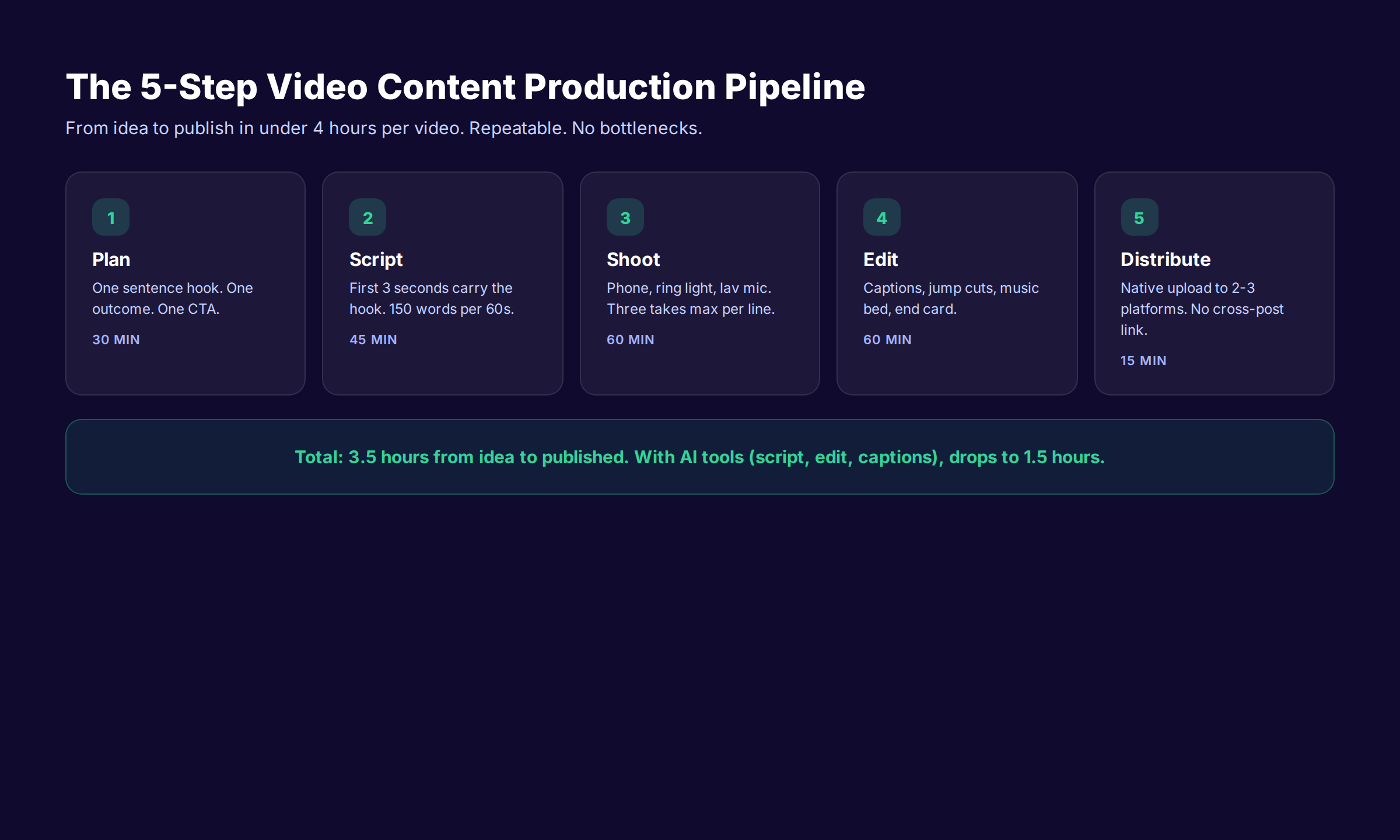
A repeatable pipeline gets a finished, captioned, branded short from idea to publish in under 4 hours. With AI tools, that drops to 90 minutes.
Step 1: Plan (30 Minutes)
Open a doc. Answer 3 questions:
- What is the single hook? (One sentence)
- What is the single outcome? (One sentence)
- What is the single CTA? (One sentence)
If you cannot answer in 3 minutes, the idea is not ready. Park it and pick the next one. Do not move to script until these 3 are locked.
Step 2: Script (45 Minutes)
A 60-second video uses about 150 words of script. The first 3 seconds carry the hook. The next 5 to 8 seconds set up the problem. The middle 30 to 40 seconds delivers the payoff. The last 5 seconds delivers the CTA.
Use this template:
[0-3s]  Hook (a number, a contrarian take, a question)
[3-10s] Problem setup (name the pain)
[10-50s] Payoff (the actual content)
[50-60s] CTA (what to do next)
AI tools accelerate this step. Our AI content strategy guide walks through the prompt structures that actually produce usable video scripts.
Step 3: Shoot (60 Minutes)
For 80% of teams, a phone is enough. Add three things:
- A ring light or natural window light
- A lavalier or shotgun microphone (audio matters more than video)
- A tripod or phone mount
Shoot 3 takes per line, maximum. More takes do not produce better video. They produce decision fatigue in the edit.
Step 4: Edit (60 Minutes)
The edit handles 4 jobs:
- Cut filler words (Descript automates this in one click)
- Add captions (Submagic or Captions.ai)
- Add a music bed (Epidemic Sound, Artlist)
- Add an end card with the CTA
Resist the urge to over-edit. Heavy jump cuts and zoom-ins feel dated. Native, conversational pacing performs better in 2026 than the 2021 “MrBeast style”.
Step 5: Distribute (15 Minutes)
Upload natively to each platform. Do not cross-post a TikTok URL to Reels. Algorithms throttle external links, and the cropping ratios differ.
For each upload:
- Native vertical aspect ratio (9:16)
- Platform-specific caption length (TikTok: short, LinkedIn: longer)
- Trending sounds where appropriate (TikTok and Reels)
- Custom thumbnail (YouTube and Shorts)
A finished video published to 3 platforms takes about 15 minutes if you have the assets pre-cut. The full pipeline runs 3.5 hours per video, or 1.5 hours with AI assistance.
Budget and Resourcing for Video Content Marketing
Budget anxiety stops more video programs than any other factor. The reality is that every tier from $300 to $25,000 per month can hit positive ROI. The constraint is consistency, not budget size.
Wistia’s 2026 State of Video reports brands at every spend level seeing returns. The difference is not who spends more. The difference is who ships more.
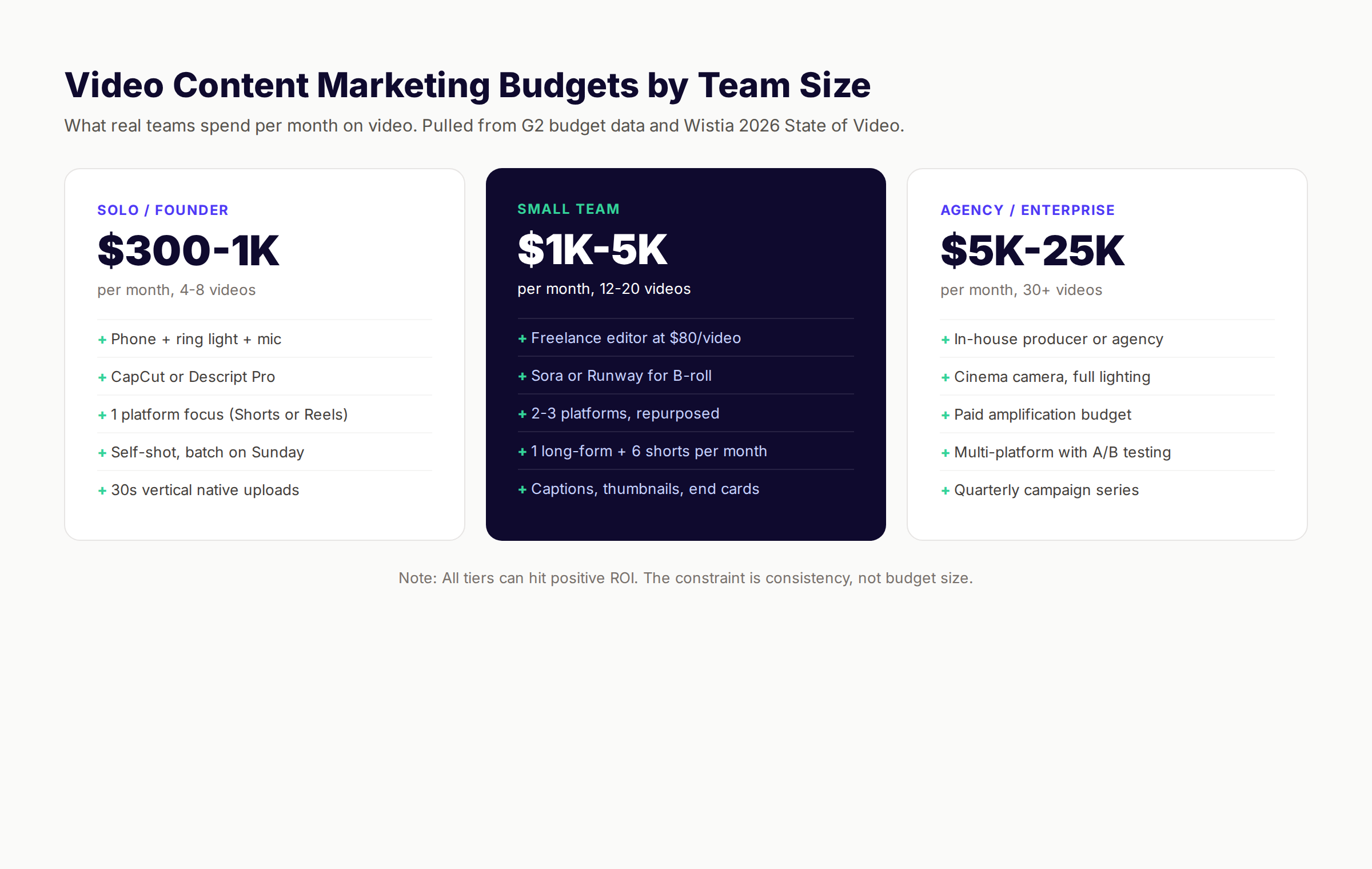
Tier 1: Solo Founder ($300 to $1,000 per Month)
You shoot, you edit, you post. Tools and gear are the only spend.
| Item | Cost | Frequency |
|---|---|---|
| Phone (iPhone 13 or newer) | Sunk cost | One-time |
| Ring light or softbox | $50-150 | One-time |
| Lavalier microphone (Rode or DJI) | $80-200 | One-time |
| Descript Pro subscription | $30/mo | Recurring |
| CapCut Pro or Submagic | $20/mo | Recurring |
| Music subscription (Epidemic Sound) | $15/mo | Recurring |
| Stock B-roll (Storyblocks, optional) | $25/mo | Recurring |
Output: 4 to 8 videos per month, 1 platform focus.
This tier is where the content marketing for small business playbook intersects with video. The constraint is your time, not budget.
Tier 2: Small Team ($1,000 to $5,000 per Month)
You bring in a freelance editor and possibly a part-time strategist. Production stays in-house.
| Item | Cost | Frequency |
|---|---|---|
| Freelance editor at $80 per video | $640-1,600/mo | Per video |
| Sora or Runway (B-roll generation) | $30-95/mo | Recurring |
| Submagic + Descript Pro | $50/mo | Recurring |
| Music subscription | $25/mo | Recurring |
| Stock footage and graphics | $50-100/mo | Recurring |
| Thumbnail design (Fiverr or in-house) | $200-400/mo | Per asset |
Output: 12 to 20 videos per month, 2 to 3 platforms.
Tier 3: Agency or Enterprise ($5,000 to $25,000+ per Month)
You bring in a producer, possibly a videographer, and you run paid amplification on top of organic. Production quality steps up.
| Item | Cost | Frequency |
|---|---|---|
| In-house producer or agency retainer | $4,000-12,000/mo | Recurring |
| Cinema camera and lens kit | $3,000-15,000 | One-time |
| Lighting and audio kit | $1,500-5,000 | One-time |
| Paid amplification budget | $2,000-10,000/mo | Recurring |
| Multi-platform scheduling tool | $99-299/mo | Recurring |
Output: 30+ videos per month, full multi-platform with A/B testing.
The Hybrid Option: Done-for-You Content
For brands that want video output without building a team, the done-for-you path runs around $500 to $3,000 per month. We cover this approach in our done-for-you SEO services guide, and it pairs naturally with video production retainers.
Stacc does not produce video content directly. We run blog SEO, GBP posts, and social media at $99/month per module. The content we publish frequently gets repurposed into video by client teams.
How to Measure Video Content Marketing ROI
The single biggest lie in video marketing is “views”. A 100,000-view TikTok with 0 clicks and 0 attributed pipeline is not a success. Measurement separates the brands that scale from the brands that quit.
Track 8 metrics, split across awareness and conversion. Skip the rest. Our content marketing ROI guide covers the full attribution model, but the video-specific metrics live below.
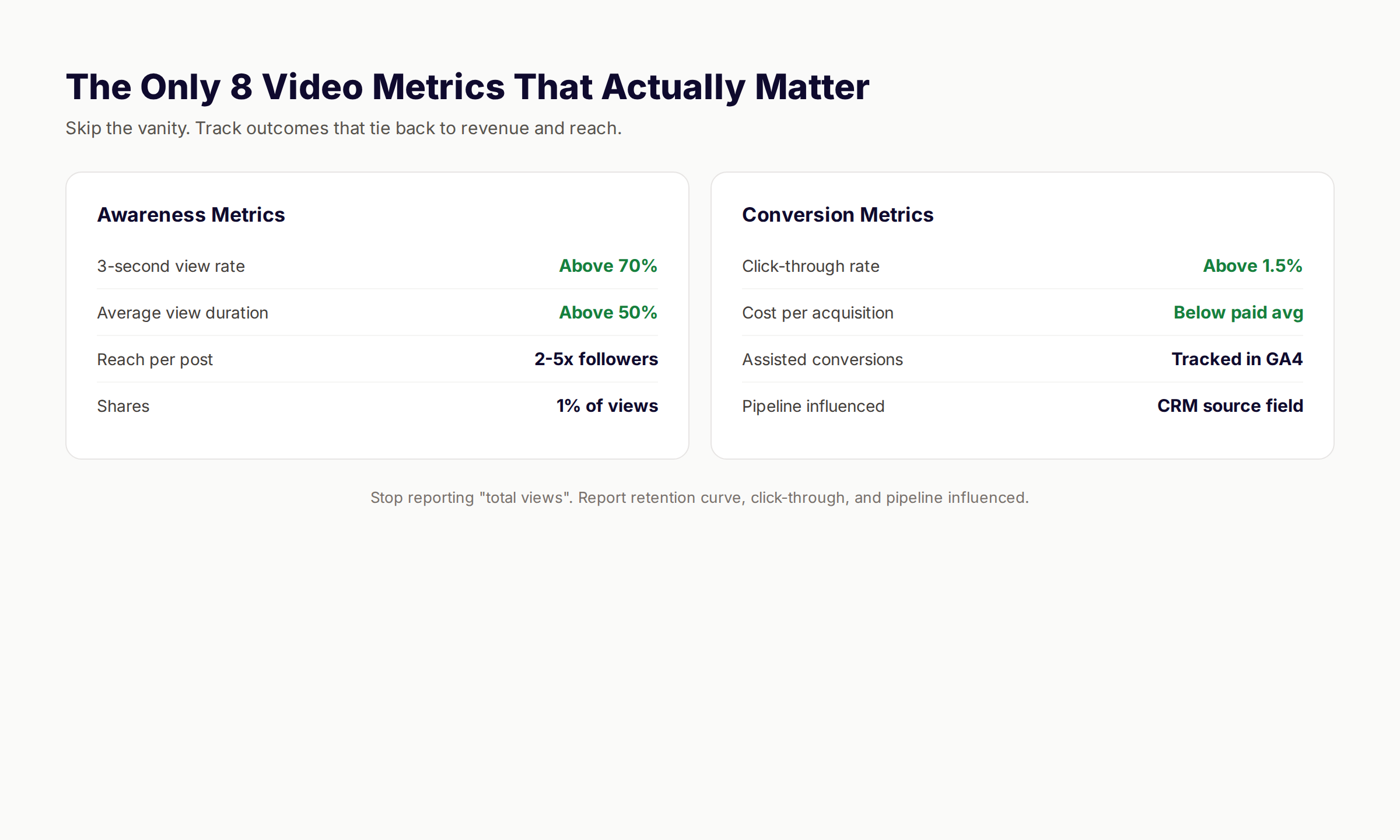
Awareness Metrics
These tell you whether the video is reaching the right audience and holding attention.
3-second view rate. The percentage of viewers who pass the 3-second mark. Healthy benchmark: above 70% on TikTok and Reels, above 50% on LinkedIn. Below 50% means the hook is broken.
Average view duration. What percentage of the total video gets watched. Healthy benchmark: above 50% retention. A 60-second video should average 30+ seconds watched.
Reach per post. How many unique accounts saw the post. Healthy benchmark: 2 to 5x your follower count. If reach is sub-1x, the algorithm is not serving the video, often a hook or pacing problem.
Shares. A share is the strongest engagement signal. Healthy benchmark: 1% of views. A 10,000-view video should produce around 100 shares to be considered viral within your category.
Conversion Metrics
These tell you whether the video drives revenue.
Click-through rate (CTR). Clicks to your CTA destination, divided by views. Healthy benchmark: above 1.5% for cold audiences, above 4% for warm audiences. Track via UTMs.
Cost per acquisition (CPA). For paid amplification, the cost to acquire a customer. Healthy benchmark: below your paid social average across other formats.
Assisted conversions. Set up GA4 to attribute video views as assists in the conversion path. Most videos do not last-click convert. They influence.
Pipeline influenced. For B2B, a CRM field that tags every closed-won deal with which video assets the buyer consumed. This is the gold-standard metric.
For local businesses, the metrics shift toward direct messages, form submissions, and GBP profile views. Our local SEO ROI statistics post covers the full local attribution stack.
Repurposing One Video Into 8 Pieces of Content
The fastest way to scale a video content marketing program is to stop thinking of each video as a one-off. Start thinking of each long-form video as the source asset for 8 to 12 derivative posts.
Here is the 1-to-many model in practice. Start with a 9-minute YouTube tutorial. From that single asset, you produce:
- The original long-form YouTube upload
- A 60-second Short or Reel of the strongest hook
- A 30-second TikTok with a different opening
- A 90-second LinkedIn native video
- A 2,000-word blog post built from the transcript
- 3 to 5 X or Threads posts with key quotes
- A LinkedIn carousel summarizing the main points
- A podcast episode with the stripped audio
This is the same approach we cover in our repurposing blog content for social media guide and our blog-to-social-videos AI workflow. The math is straightforward. One 4-hour production session produces 8 to 12 assets. The same time invested in 8 separate posts produces 1 to 2 polished assets.
Wistia found teams using this model produced 4.7x more content output with 1.8x the budget compared to single-asset teams. The compounding sits in the system, not the spend.
The Video Repurposing Workflow
Run this every time you produce a long-form video:
- Identify the 3 strongest moments (hook, payoff, summary)
- Cut each into a 30 to 60-second short
- Caption each short for the target platform
- Transcribe the full video with Descript or AssemblyAI
- Edit the transcript into a blog post (1,500 to 2,500 words)
- Pull 3 to 5 quotable lines for X and Threads
- Build a 6 to 10-slide carousel from the key points
- Strip the audio for a podcast feed
- Schedule across platforms with native uploads
- Track each derivative back to the source video in your CRM
Common Video Content Marketing Mistakes
After auditing hundreds of brand video programs, the same 10 mistakes show up. Each one is fixable in a single sprint. The brands that compound are the ones that fix all 10.
Mistake 1: Cross-Posting the Same Vertical Everywhere
Every platform has different ratios, caption norms, and audience expectations. A TikTok with a TikTok-style hook will underperform on LinkedIn even if the content is excellent. Cut platform-specific versions.
Mistake 2: Logo-First Intros
Any intro that starts with a logo, animation, or “Hey everyone, welcome back to…” is a 3-second view killer. The hook starts at second zero. Burn the logo into the corner if you need brand recognition, but never as an intro.
Mistake 3: No Captions
85% of mobile video is watched on mute. A video without burned-in captions excludes that audience entirely. This is a 30-second fix with Submagic or CapCut and probably the single highest-ROI change you can make.
Mistake 4: Talking to “Everyone”
If the script could apply to any role at any company, the algorithm cannot find the right audience. Get specific. “If you run a 5-person agency…” beats “If you run a business…” every time.
Mistake 5: No Repeatable Hooks
Top creators use 3 to 5 hook formats and rotate. Most brands write a new hook from scratch every time, which produces inconsistency. Build a hook library and reuse it.
Mistake 6: Reporting Vanity Metrics
A weekly report that leads with “total views” buries the actual question. Report 3-second retention, click-through, and pipeline. Cut the rest.
Mistake 7: Inconsistent Cadence
Posting daily for 2 weeks then ghosting for a month kills algorithmic momentum. Pick a cadence you can hold for 90 days, even at your worst.
Mistake 8: Over-Producing
A $5,000 produced video that lands flat is worse than a $50 phone video that hits. Production quality has diminishing returns past a certain point. Invest in audio, lighting, and editing. Skip the cinema camera until you have proven the format works.
Mistake 9: Skipping the CTA
A video without a CTA is a missed conversion. Even a brand awareness video should end with “Comment X to get the link” or “Save this for later”. The platforms reward saves and comments.
Mistake 10: Not Tracking Attribution
If you cannot prove which videos drove pipeline, you cannot defend the budget. Set up UTM tracking, CRM source fields, and GA4 conversions before you publish video 1. Trying to retrofit attribution 6 months in is painful.
Want to stop guessing whether content is working? We publish 30 articles per month with an average SEO score of 92. Bundle blog + local + social for 15% off. Try Stacc for $1 →
Your Video Content Marketing Launch Checklist
Print this. Tape it to the wall. Do not publish a single video until every box is checked. The checklist takes about 90 minutes to complete and saves about 90 days of trial and error.
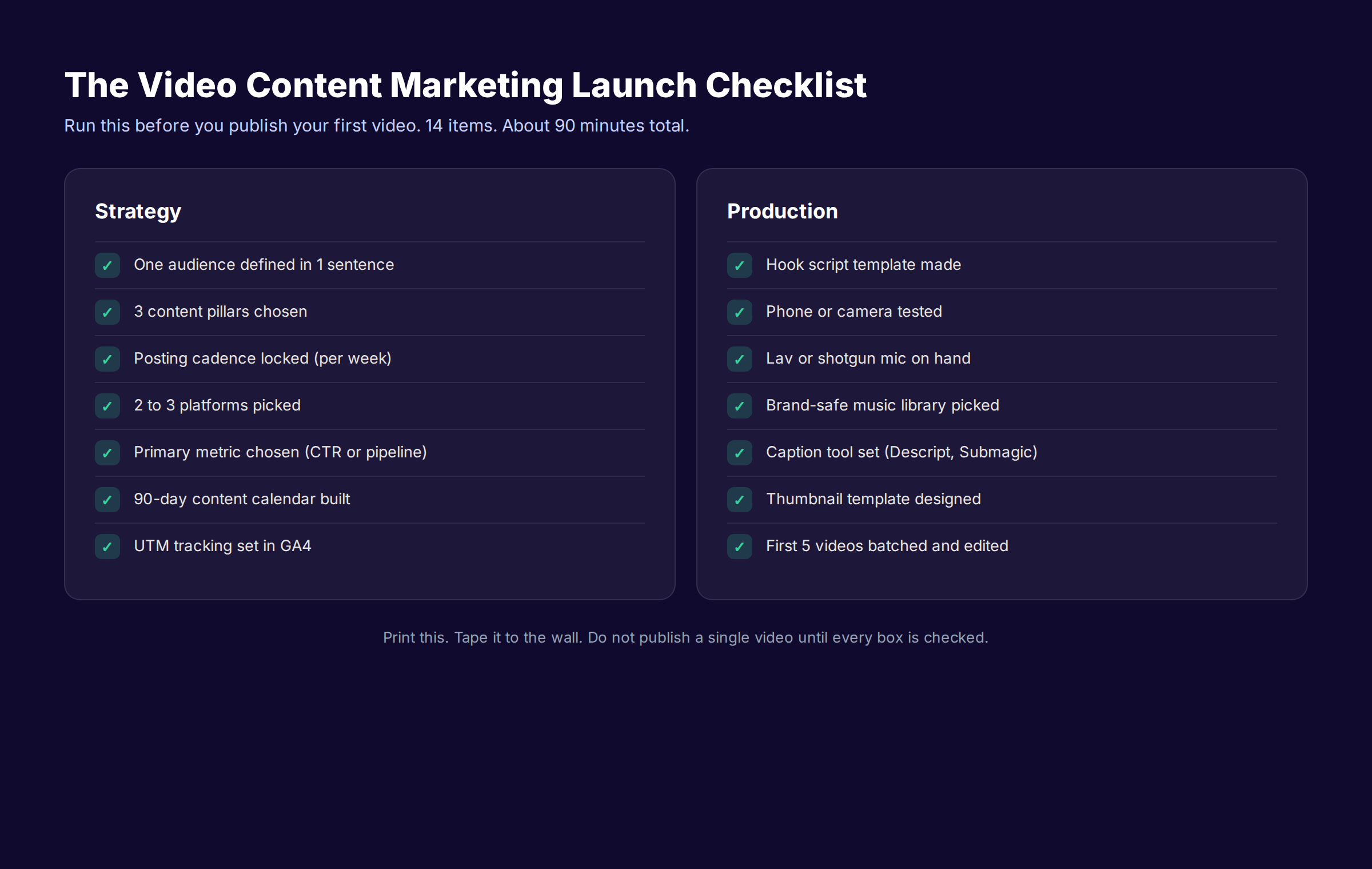
Strategy Setup
- One target audience defined in 1 sentence
- 3 content pillars chosen and locked
- Posting cadence committed (per week, per platform)
- 2 to 3 platforms picked (no more)
- Primary success metric chosen
- 90-day content calendar populated
- UTM tracking parameters set up in GA4
- CRM source field added for pipeline attribution
Production Setup
- Hook script template built and saved
- Phone or camera tested for both vertical and horizontal
- Lavalier or shotgun microphone purchased
- Music subscription active (Epidemic Sound or Artlist)
- Caption tool subscribed (Descript, Submagic, or CapCut)
- Thumbnail template designed in Canva or Figma
- First 5 videos batched, edited, and queued
- Cross-platform scheduler set up (Buffer, Later, or native)
Launch Week
- Video 1 published natively on each platform
- Metrics dashboard refreshed at 24, 48, and 72 hours
- Engagement triaged (every comment replied to)
- Top-performing format noted for replication
- Underperforming hook variant flagged for revision
Run this checklist once per month for the first 6 months. After that, the system runs on autopilot.
Frequently Asked Questions
What is video content marketing?
Video content marketing is the practice of producing and distributing video assets to attract, engage, and convert a specific audience. It includes short-form social video (TikTok, Reels, Shorts), long-form YouTube content, live streams, product demos, customer testimonials, and creator-led UGC. The goal is to build trust and demand at a lower cost-per-engagement than paid advertising. In 2026, 91% of marketers run video as part of their content strategy and 82% report positive ROI according to Wyzowl.
What is the 3 3 3 rule in marketing?
The 3 3 3 rule says viewers decide whether to keep watching in 3 seconds. They decide whether to engage in 3 minutes. They decide whether to take action in 3 days. For video content marketing, the implication is clear. The first 3 seconds carry the hook. The middle carries the value. The post-view follow-up (email, retargeting, DM) carries the conversion. Most brands obsess over the second 3-minute window. They ignore the first 3 seconds. That is why their videos die in the feed.
What is the 5 5 5 rule for social media?
The 5 5 5 rule is a posting and engagement framework. Spend 5 minutes commenting on 5 other accounts, then post 5 pieces of content per week. The rule keeps small teams accountable to both inbound creation and outbound engagement. Algorithms reward accounts that engage rather than just broadcast. For video specifically, the framework translates to 5 short-form posts plus active replies on every comment within 24 hours.
What are the 5 C’s of content marketing?
The 5 C’s of content marketing are Clarity, Consistency, Conversation, Credibility, and Conversion. Clarity means one message per asset. Consistency means a fixed cadence. Conversation means real engagement, not broadcast. Credibility means real data, real customers, real numbers. Conversion means every asset has a next step. For video, the 5 C’s translate to a single hook per video and a fixed weekly posting schedule. Add replies to every comment, named sources for every claim, and a clear CTA in every end card.
How much does video content marketing cost?
Costs range from $300 per month for a solo founder to $25,000+ per month for an agency or enterprise team. The mid-tier sweet spot is $1,000 to $5,000 per month. This buys 12 to 20 videos per month with a freelance editor and AI tools. The main variable is not equipment cost but production time. AI tools (Descript, Submagic, Runway) reduce the per-video time from 4 hours to 90 minutes, which directly impacts cost per asset.
Which video format has the highest ROI in 2026?
Short-form vertical video has the highest reported ROI at 49%. Long-form YouTube follows at 29%, and live streaming at 25% per HubSpot’s 2026 Video Marketing Report. The reason short-form leads is reach. TikTok, Reels, and Shorts have algorithms tuned for discovery, so a single video can reach 10 to 50x the creator’s follower count. The trade-off is that short-form has lower conversion intent per view, so brands need volume to convert.
Do AI-generated videos work for content marketing?
AI-generated videos work well for B-roll, animations, and explainers, but underperform for direct-to-camera and testimonial content. 63% of video marketers used AI tools in 2026 per Vidico, mostly for script generation, captions, and B-roll. Pure AI-generated talking-head video still triggers the “uncanny valley” effect for most audiences. The hybrid model (real human on camera + AI editing and B-roll) is the dominant 2026 workflow.
The Compound Effect of Video Content Marketing
Video content marketing is the highest-return content format in 2026, but only for the brands willing to build a system. Teams that ship 4 videos per week for 12 months beat teams that ship 40 videos in a 6-week sprint then quit. Cadence beats volume. Specificity beats reach. Attribution beats engagement.
Pick 2 platforms. Pick 3 pillars. Run the 5-step pipeline. Measure 8 metrics. Repurpose every long-form into 8 derivative assets. The system compounds because algorithms reward consistency and audiences reward specificity.
We publish 3,500+ blogs across 70+ industries and watch this exact pattern play out every quarter. The brands that win are the ones who build the system before they build the brand.
Related Tools & Resources
Free SEO Tools:
Best Lists:

Written by
Siddharth GangalSiddharth is the founder of theStacc and Arka360, and a graduate of IIT Mandi. He spent years watching great businesses lose organic traffic to competitors who simply published more. So he built a system to fix that. He writes about SEO, content at scale, and the tactics that actually move rankings.
30 SEO blog articles published every month
Keyword-optimized, scheduled, and live on your site. Automatically.
30-day trial · Cancel anytime
theStacc
Stop writing SEO content manually
30 blog articles, 30 GBP posts, and social media content. Published every month. Automatically.
Try for free$1 for 3 days · Cancel anytime